 Skip to main content


On October 30, 2026, the Bihar Education Department issued fresh directions for the state’s Saraswati Vidya Niketan model schools, and the headline item leaves little room for doubt: student attendance will be watched far more closely from now on. Schools must strictly enforce the 75% attendance requirement and monitor attendance regularly, putting the everyday habit of showing up at the centre of how model schools are run.
The directive is not a single-rule circular. Its six guidelines touch almost every part of a school day, from morning assembly to school-office staffing, from support for struggling Class 9 students to how buildings are used during examination season. Read together, they describe a department that wants its model schools to function as teaching institutions first, with fewer distractions pulling staff, students and buildings from classroom work.
For students and parents, the practical question is straightforward: what actually changes on Monday morning? A student comfortably above the attendance line will notice little beyond a more regular assembly and a school building used less often for outside work. A student hovering near the 75% mark, or a Class 9 student who did not pass, will feel the directive much more directly. This article works through all six guidelines, explains who feels each change first, and separates what the directive changes from what it leaves alone.
The six guidelines at a glance
| Guideline | What the department has directed |
|---|---|
| 1. Attendance | Strictly enforce the 75% attendance requirement and monitor attendance regularly |
| 2. Morning assembly | Conduct the Chetna Satra properly, with appropriate musical instruments and district-level monitoring |
| 3. Academic support | Arrange special classes for students who did not pass Class 9 |
| 4. Examination centres | Avoid using model school premises as examination centres so teaching continues uninterrupted |
| 5. Staff gaps | Fill clerk and attendant vacancies by deputing staff from nearby schools |
| 6. Premises use | Avoid accommodating police personnel on school premises wherever possible |
The table gives the shape of the directive; the sections below explain each item.
1. The 75% attendance rule, enforced more strictly
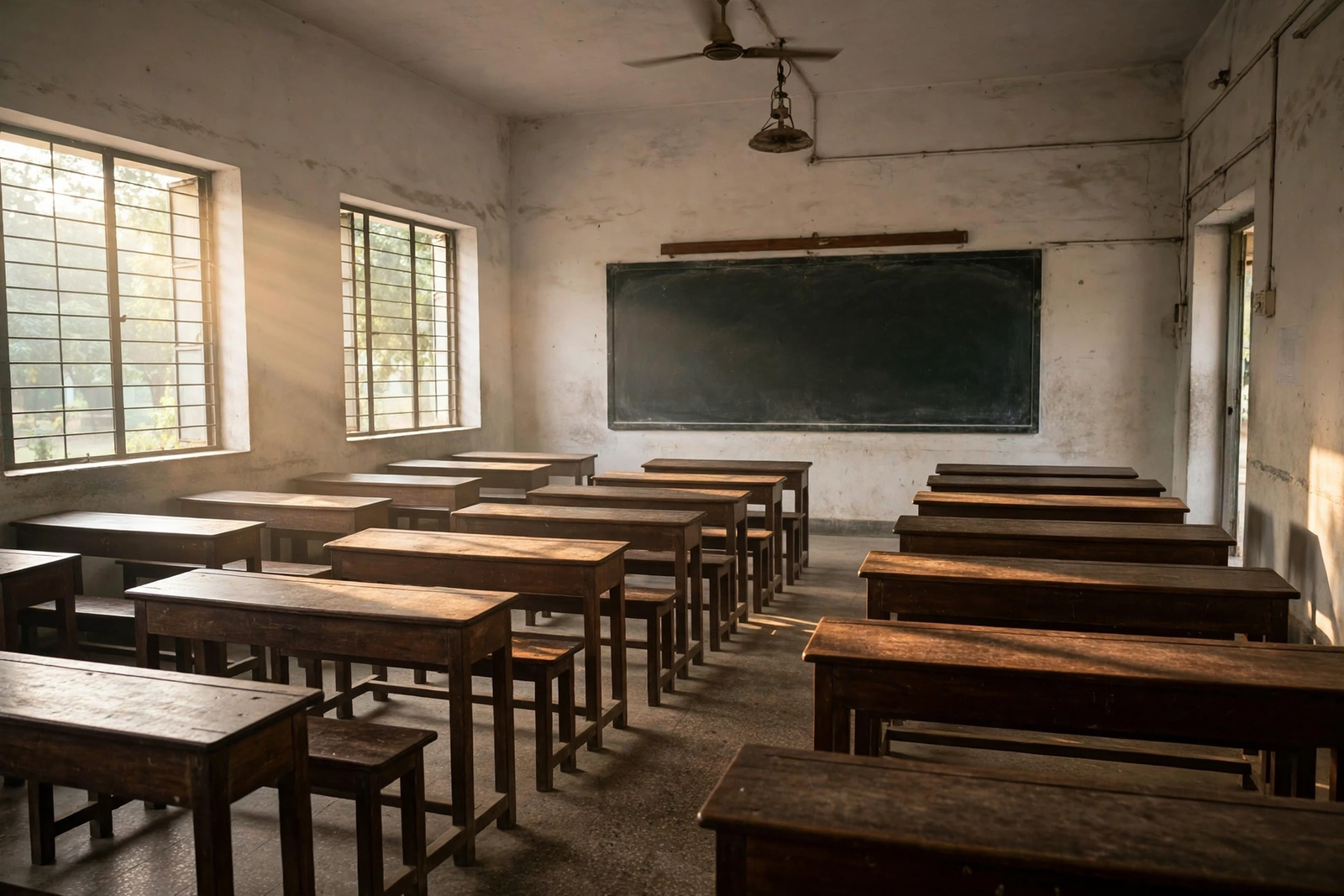
The first guideline is the one every model school student should understand clearly: schools must strictly enforce the 75% attendance requirement and keep a regular watch on attendance figures. In plain terms, a student is expected to be present for at least three out of every four school days, and schools must now track that figure closely, not discover a shortfall at the end of a term.
What stricter enforcement means in practice
Regular monitoring changes the rhythm of attendance management. When attendance is checked often, a dip is spotted while there is still time to recover it, and a student who misses a run of days can be spoken to early. Attendance stops being a number added up only when an examination form or promotion decision comes around. For families, the sensible response is equally regular: watch attendance through the term, not only at report-card time.
The 75% figure itself is not new to Indian school education. Boards and universities across the country have long used similar attendance thresholds, and readers who want the wider context can see how the rule has been applied elsewhere in the discussion of the CBSE Class 12 attendance requirement. What is new here is the emphasis: model schools must now treat the requirement as a live, monitored standard rather than a background rule. Enforcement drives elsewhere have taken the same direction, including surprise inspections of schools over dummy admissions.
Why the 75% line matters so much
Attendance thresholds exist because classroom learning is cumulative. A student who misses a quarter of lessons does not simply miss a quarter of the syllabus in neat slices; missed concepts compound, because later topics build on earlier ones. That is especially true in Classes 9 and 10, where board examination foundations are laid. Regular presence also keeps a student inside the school’s support systems: teachers notice strugglers, classmates share notes, and doubts get cleared the same day.
There is a second reason for the monitoring push. Model schools are meant to set an example, and a carefully tracked figure is one the school can act on: it shows which classes are slipping, whether absences cluster on particular days, and whether a student’s absence is a one-off or a pattern needing a conversation with the family.
2. Morning assembly done properly: the Chetna Satra
The second guideline turns to the start of the school day: schools must conduct the Chetna Satra, the morning assembly session, properly, including appropriate use of musical instruments, monitored by a district-nominated official.
Morning assembly is often treated as a formality, but in the department’s framing it is part of daily discipline. A properly conducted assembly sets the tone: students gather on time, the school community starts together, and announcements reach everyone at once. The mention of musical instruments points to the same idea: the assembly should run as a real session, not rushed through or skipped.
District-level monitoring adds accountability: when a district-nominated official watches assemblies, school heads have a clear reason to run the session every day and run it well. For students, the visible change is likely small but real: assemblies that start on time, run in full, and feel like a proper part of the school day.
3. Special classes for Class 9 students who did not pass
The third guideline is the most directly supportive: schools must arrange special classes for students who failed Class 9, giving them structured help rather than leaving them to repeat the year without additional support.
This matters because Class 9 is a hinge year. Students who move into Class 10 without closing their gaps carry them into board examination preparation, where pressure is higher and repair time shorter. Special classes give them a second route through missed material, with teaching pitched at the points where they stumbled.
The report of the directive, as published by Jagran Josh, gives no schedule, duration or start date for these classes, so families should look to their own school for the timetable. A parent of an affected student should ask when the classes begin, which subjects they cover, and how attendance at them will be tracked. What the directive establishes is the principle: a failed year should trigger teaching support, not just repetition.
4. School premises stay for teaching, not examination centres

The fourth guideline protects teaching time: model school premises should not be used as examination centres, so regular teaching is not interrupted. Where avoiding this is impossible, schools are to seek District Education Officer recommendations for alternative venues.
Anyone who has studied in a school that doubles as an examination centre knows why. Examination days bring outside candidates, changed seating and closed classrooms, and days when regular classes do not happen. A few such days may seem minor, but across a session they add up to lost teaching time, often exactly when revision or new topics are due. Keeping model school buildings for their own students guards the teaching calendar.
The exception clause is worth noting: the directive imposes no absolute ban, asking schools to find alternatives through the District Education Officer when use of the premises cannot be avoided. The preference is clear, but the system retains a route for genuine cases of need.
5. Filling clerk and attendant gaps from nearby schools
The fifth guideline addresses school-office staffing: where clerk and attendant posts are vacant, schools are to fill the gaps by deputing staff from nearby schools as required.
School offices run on a small number of people doing a large amount of unglamorous work: records, correspondence, supplies and building upkeep. When those posts sit vacant, the work falls on teachers and the school head, pulling them from academic work. Deputing staff from nearby schools is a stopgap with a clear purpose: keep administration functioning while permanent arrangements are made, so teaching staff stay focused on teaching.
For students, this guideline is mostly invisible, and that is the point: a smoothly run office means records in order, notices on time, and teachers spending working hours in classrooms rather than on paperwork.
6. Police accommodation on school premises discouraged
The sixth guideline asks schools to avoid accommodating police personnel on their premises wherever possible. Like the examination-centre guideline, it is about keeping school buildings for school purposes: a campus housing outside personnel, even temporarily, loses parts of the building, restricts movement, and feels less devoted to students.
The wording is deliberately qualified: “wherever possible” leaves room for genuine emergencies. The direction of travel, however, is clear: school premises should belong to the school community during the session, and outside uses should be the exception, not routine.
Who feels the change first
Not every guideline lands on everyone equally, so it is worth mapping the effects plainly.
Students near the 75% line feel the first guideline first. For them, the change is not abstract: every missed day counts against a figure the school now watches regularly, and recovery time for a dip is shorter than it used to feel. The advice is simple: attend consistently, and when an absence is unavoidable, return promptly and catch up on missed work rather than letting a gap widen.
Class 9 students who did not pass feel the third guideline first. Special classes are an opportunity, but only if students attend and use them. Families should treat the special-class timetable as seriously as the regular one and ask early about subjects and timings.
School heads and teachers feel the remaining guidelines most directly. Heads must organise assemblies that stand up to district monitoring, arrange special classes, protect the teaching calendar from outside uses of the building, and manage staffing gaps with deputations. Teachers benefit where the guidelines work: fewer distractions and fewer lost teaching days.
Parents feel the directive through information. Regular monitoring only helps if the family hears about a problem early, so checking in with the school through the term, not waiting for a term-end summary, gets the most from the new emphasis.
What the directive does not change
It is equally important to be clear about what this directive does not do.
First, the directive describes no new exemptions from the attendance requirement. The report mentions no fresh categories of exemption and no change to how existing rules treat genuine, documented absences. Parents should not assume stricter monitoring comes with a softer rule; the rule is the same, and the monitoring is what has tightened.
Second, the directive is not a change to examination policy for students. The examination item concerns the use of school buildings as centres, not the conduct of board or school examinations, and nothing in it alters how students are examined or promoted. The Class 9 special classes are remedial teaching support, not a change to promotion rules.
Third, the directive announces no new academic content, textbooks or syllabus. It is an administrative circular: it governs how schools run, not what they teach. Families looking for curriculum changes will not find them here.
That restraint is itself informative. The department has chosen to work on the conditions of learning — attendance, assembly, staffing, building use and remedial support — rather than rewriting academic rules. Get daily functioning right, and academic results have a firmer base to stand on.
How families can check where they stand
A directive about monitoring is only useful if families can monitor too. Attendance percentage is simple once two numbers are known: days attended, divided by total school days held, multiplied by 100. A student who has attended 90 of 120 days held sits at exactly 75%, which shows how thin the margin can become after a run of absences.
For a quick check without doing the arithmetic by hand, the free attendance percentage calculator on this site takes the same two numbers and returns the percentage immediately, making it easy to test how many more days a student can miss before slipping below the line. Readers who want to build the habit behind the number will find practical steps in the guide to improving attendance percentage, which covers routines that help students stay present consistently.
The habit matters more than any single calculation. Attendance recovered early is recovered cheaply: one or two days made up through consistent presence cost far less effort than a large deficit chased at term’s end. Families who mirror that monitoring habit at home will rarely be surprised by it.
Frequently asked questions
What are the six new guidelines for Bihar’s model schools?
The Bihar Education Department has directed Saraswati Vidya Niketan model schools to strictly enforce the 75% attendance rule with regular monitoring, conduct the Chetna Satra assembly properly under district monitoring, arrange special classes for Class 9 students who did not pass, avoid using model school premises as examination centres, fill clerk and attendant vacancies from nearby schools, and avoid accommodating police personnel on school premises wherever possible.
What is the 75% attendance rule for model school students?
The rule requires a student to be present for at least 75% of school days held — at least three out of every four days. The new directive does not change the percentage; it requires schools to enforce it strictly and monitor attendance regularly, so shortfalls are spotted during the term, not at its end.
Do the new guidelines change examination rules for students?
No. The examination item concerns the use of model school buildings as examination centres, not how students are examined or promoted. It asks schools to keep premises available for regular teaching and to seek District Education Officer recommendations for alternative venues where their use cannot be avoided.
What are the special classes for Class 9 students?
They are extra teaching sessions for students who did not pass Class 9, meant to close gaps in subjects they struggled with. No schedule or duration is specified in the report, so families should ask their school for the timetable and subjects covered.
How can a student check their attendance percentage?
Divide days attended by total school days held and multiply by 100: 90 out of 120 gives exactly 75%. The free attendance percentage calculator on this site performs the same calculation instantly and shows how further absences would affect it.
The Bihar directive is, at heart, a statement about what model schools are for: attendance first, assembly done properly, struggling students supported, buildings kept for teaching, offices staffed, campuses kept for the school community. None is dramatic alone, but together they describe a school day with fewer interruptions and clearer expectations. For students, the message is simple: be present, be on time, and use the support now on offer. Families can check any attendance figure at any time with the free attendance percentage calculator and see exactly where a student stands against the 75% line.


