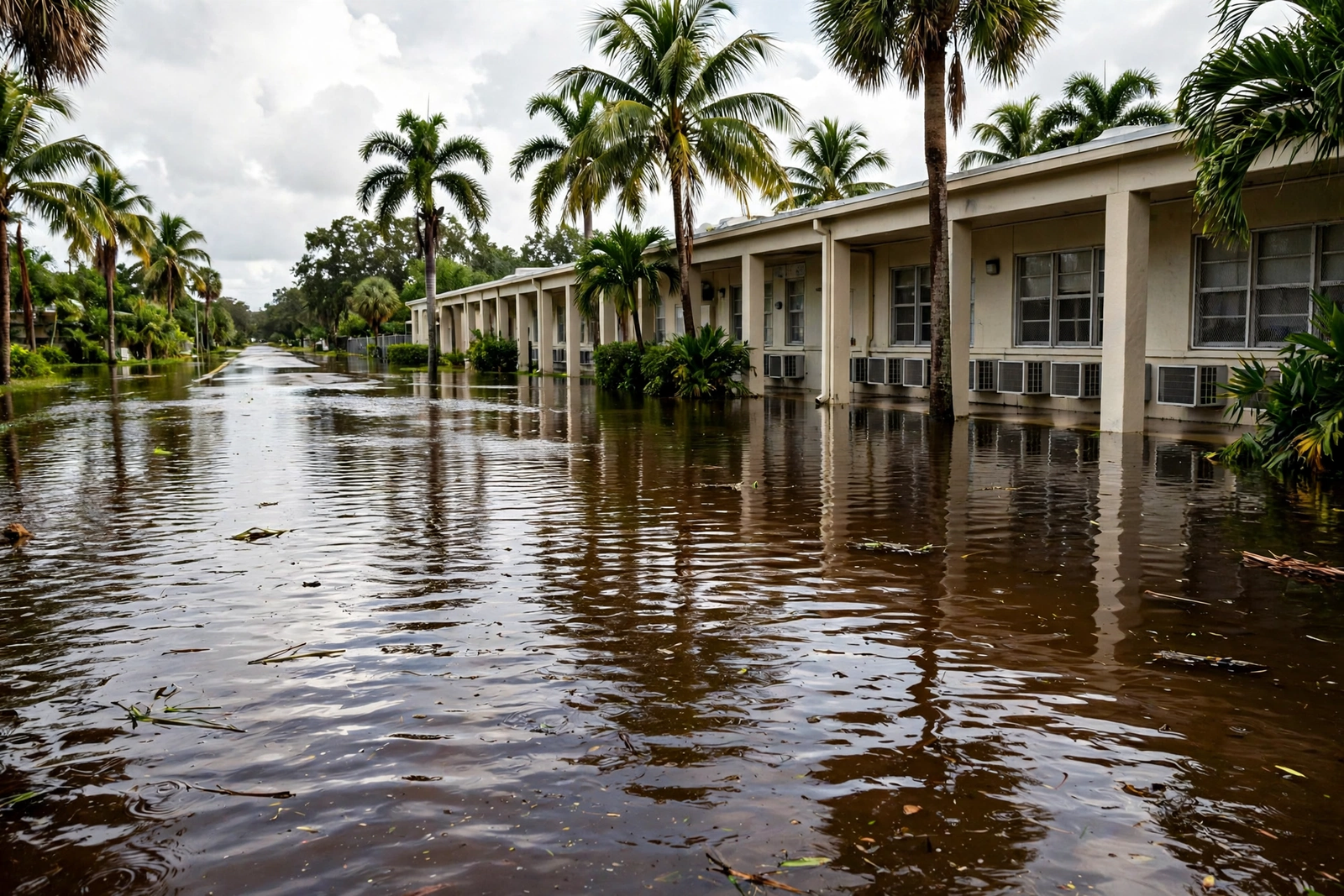
School closures used to arrive with a forecast. A hurricane warning, a named storm, a window for preparation. The flooding that closed schools across Florida this week arrived differently: a slower, wetter pattern, intense local downpours, saturated ground, and roads that became impassable in places that had not expected to be cut off. The result was a patchwork of closures that changed day by day, district by district, and sometimes school by school within the same county.
For thousands of Florida families, this school week has not followed the calendar. A deluge of rain early in the week flooded roads, damaged campuses, and left districts making day-by-day decisions about whether classes could safely open. Some counties closed for a single day, others stayed shut for most of the week, and at least one county reopened while still excusing weather-related absences, because safe travel was not possible for every family even after the doors reopened.
The story is a useful reminder of something attendance discussions often overlook. Attendance is usually treated as a matter of individual choice: a student goes, or does not go. But when roads are under water, buses cannot run, and staff cannot reach their schools, attendance becomes a question of infrastructure, and the district, not the family, decides whether attendance is even possible that day.
A four-day diary: from record rain to closed classrooms
The disruption began on Monday, November 2, with rainfall on a scale that forecasters described in terms usually reserved for events expected once in centuries. Robert Haley, a meteorologist with the National Weather Service in Melbourne, described November 2 as at least a 500-to-1,000-year rainfall event. St. Lucie County received varying amounts of rain that day, with the highest totals in the area of Interstate 95 into the Port St. Lucie area, at about 12 inches. The highest rainfall in Indian River County on November 2 fell in the area of Interstate 95, at about 13 inches. Elsewhere in the state, reports described almost two feet of rain in some areas, bringing what Florida Today called catastrophic flooding. Governor Ron DeSantis declared a state of emergency for seven counties.
Tuesday, November 3, was already a no-school day across much of Florida, as schools closed for Election Day. In Palm Beach County, all district schools were closed on Tuesday as voters went to the polls, as covered in an earlier article on this site about schools with no classes on Election Day. The election closure meant that the flooding disruption and a planned closure ran into each other, and for many families the week began with two consecutive days without classes before any flooding decision had been taken.
Wednesday, November 4, brought the first round of flooding closures. According to the Florida Department of Education, schools were closed on November 4 in three counties: Brevard, DeSoto, and Okeechobee. Brevard County’s closure was its third straight day without classes, after record rain flooded roads, homes, and campuses on the Space Coast. In Palm Beach County, ten schools were also closed on Wednesday because of localised flooding after recent heavy rains, spanning the county from Riviera Beach to western Boca Raton, including six West Palm Beach-area schools, with a combined enrolment of roughly 9,660 students.
Thursday, November 5, brought a split picture. Schools in Indian River and St. Lucie counties remained closed, while schools in Martin County were back in session, with weather-related absences excused. The National Weather Service in Melbourne forecast that rain chances would decrease on November 4, with most areas rain-free from Thursday through the weekend along the central east coast, which gave districts some hope that the worst of the disruption was passing. But for the counties still closed on Thursday, the problem was no longer falling rain. It was what the rain had left behind.
County by county: who closed, and when
Because closures are decided district by district, families in neighbouring counties faced different school weeks. The table below summarises the position reported for each county. Districts updated their positions as conditions changed, so this is a snapshot of the reporting, not a permanent record.
| County | School position reported |
|---|---|
| Brevard | Closed Wednesday, November 4, the third straight day of closure, after flooding affected water service, roads, buildings, and staffing. |
| DeSoto | Closed Wednesday, November 4, according to the Florida Department of Education. |
| Okeechobee | Closed Wednesday, November 4, according to the Florida Department of Education. |
| Indian River | Closed Thursday, November 5, with many major roads still closed and nearly 100 employees unable to report to work. |
| St. Lucie | Closed Thursday, November 5, according to a district spokesperson. |
| Martin | Back in session Wednesday, November 4, with weather-related absences and tardies excused on parent or guardian notification. |
| Palm Beach | All schools closed Tuesday, November 3, for Election Day; ten schools closed Wednesday, November 4, because of localised flooding. |
The pattern in this table tells its own story. The counties that closed earliest were those where the rain itself made campuses unusable or unreachable. The counties that stayed closed longest were those where the roads, rather than the rain, were the problem. And the county that reopened first did so with an explicit safety valve for families still affected, which is the part of this story most relevant to attendance records.

Why a dry building can still mean a closed school
The Indian River County case is the clearest illustration of why a school can be closed even when its buildings are in good shape. The district reported that its buildings were dry and secure, with power and air conditioning. By the usual measure of whether a school is ready to open, that sounds like a pass. Yet the district kept schools closed on November 5, and its explanation shows why the usual measure is incomplete.
Students need safe bus routes, roads, bridges, sidewalks, and pathways to reach school, the district stated. Many major roads remained closed across the county, including in South County and along the Oslo corridor. In parts of Highlands, roads remained unsafe and some homes were without power. Nearly 100 employees could not report to work because of conditions in their areas. Practice fields were closed, and extracurricular activities and practices were cancelled until further notice.
Each of those details is a separate reason a school cannot function, even with dry classrooms. Buses cannot run on closed roads. Students cannot walk safely on flooded sidewalks. A school that opens without enough staff cannot supervise its students properly. And a district that opens some schools while its employees cannot reach them risks creating a two-tier week, in which families with safe routes attend and families without them are marked absent through no fault of their own. The full reporting on the November 5 closures can be read in this TCPalm report.
Brevard County’s experience points the same way. The district named four problems that keep campuses shut: water service, roads, damaged buildings, and staffing. Only one is about the building itself; the others are about the systems around it. Attendance depends on all four, and the failure of any one can close a school just as surely as a flooded classroom.
This is worth stating plainly, because it affects how families should interpret closures. A closed school is not necessarily a flooded school. It may be a safe school that cannot be reached, a dry school that cannot be staffed, or a school that is being checked before it can be reopened. None of those reasons is a failure of planning; all of them are consequences of a system that depends on roads, power, water, and people, not just on buildings.
Excused absences: what the districts actually said
The most common question after a closure is whether the days count as absences. The short answer is: when a district closes a school, the day is not normally counted as a student absence, because the school was not in session for that student. The closure is a district decision, not a student absence, and attendance records should reflect that distinction.
The longer answer is more complicated. If a district reopens but a family cannot safely reach the school — because their road is flooded, because their home has been affected, or because they have been displaced — the absence may need to be excused on an individual basis. Most Florida districts have procedures for excused absences linked to weather, displacement, or family emergency, but they usually require a note, a form, or a contact with the school. The absence is not automatically excused simply because there was flooding in the county; it is excused because the family’s circumstances prevented attendance on a day when the school was open.
That distinction matters for students who are close to an attendance threshold. A district closure should not push a student over a threshold, because the day was not a school day for them. An individual absence on a day when the school was open, even if the reason was flooding, may need to be documented to ensure it is recorded as excused rather than unexcused. The difference between those two categories can affect truancy procedures, exam eligibility in some contexts, and, in Florida, the way chronic absenteeism is calculated.
For families, the practical step is simple: keep the district’s closure announcement, and, if the school was open but you could not attend, contact the school as soon as practicable and ask how the absence will be recorded. Do not assume that a general flooding situation will be inferred from the attendance record. A short note, an email, or a form submitted through the school’s usual channel creates a record that can be checked later, if the absence is ever queried.
The wider lesson is about how attendance is measured. Attendance percentages are often treated as a simple measure of a student’s commitment, but they are also a record of a system: whether the school was open, whether transport ran, whether the family could travel, and whether the absence was recorded correctly. Flooding exposes all of those dependencies at once. A complete overview of school attendance rules in the US explains how excused and unexcused absences are treated differently, and why the distinction matters more than the raw percentage.
What families should do on a closure morning: five steps
If your child’s school has been affected, five steps will cover most situations.
First, check the school-level announcement, not just the district headline. Districts often publish a list of individual schools that remain closed, and that list can change overnight. A school that was closed on Wednesday may reopen on Thursday, and a school that reopened may close again if conditions worsen. The school’s own website, the district’s social media, and any text or email alert system the district operates are the most reliable sources.
Second, do not attempt a flooded route. If a road is closed, if water covers the road markings, or if you are unsure about depth, do not drive through it. The risk is not only to your vehicle; it is to the rescue services that may need to respond, and to other road users. Districts close schools precisely to avoid putting families in that position, and a family’s decision to stay home on safety grounds is one that schools should understand, even if the school itself is open.
Third, keep a record. Save the district’s closure notice, take a photograph of a flooded access road if it is safe to do so, and keep any communication with the school. If an absence needs to be excused, that record will make the process straightforward. If a grade, an exam, or an attendance threshold is later affected, the record will show that the absence was linked to flooding, not to choice.
Fourth, ask about missed work, not just about attendance. A closure does not normally mean that learning stops, but it does mean that the timetable is disrupted. Ask the school whether work will be posted online, whether deadlines will be extended, and whether any assessments scheduled for the closure days will be rescheduled. For students in exam years, that question is at least as important as the attendance question.
Fifth, check on reopening conditions, not just reopening dates. A school may reopen on a given date, but with a changed bus route, a different entrance, or a reduced service in the cafeteria. Those details are often published in the reopening announcement, and they can affect how early a child needs to leave home, and whether they need a packed lunch or other preparation.

What reopening depends on
Reopening is not a single decision; it is a sequence. Roads must be passable, buildings must be checked, staff must be able to travel, and kitchens and other services must be ready. Each of those steps has its own timeline, and the slowest step determines when a school can reopen safely.
For districts that remain closed, the next update is likely to focus on specific schools rather than on the county as a whole. That is a sign of progress, not of confusion: it means that enough schools have been cleared to reopen, and that attention is now focused on the remaining cases. Families should expect school-by-school updates, and should check for their own school rather than assuming that a county reopening applies to every campus.
For districts that have already reopened, the risk is not over. Further rain, saturated ground, and high tides can cause renewed flooding, and a school that reopened on Thursday could close again on Friday. The pattern of this week — local, changing, and uneven — is likely to continue until the ground has dried and the drainage system has caught up. Parents should therefore keep checking announcements, even after a school has reopened.
Frequently asked questions
Are Florida schools closed because of flooding this week?
Yes, in several counties. Brevard, DeSoto, Okeechobee, Indian River, St. Lucie, Martin, and Palm Beach counties all reported closures, partial closures, or excused weather-related absences between November 2 and November 5, 2026, with the pattern varying by district and by individual school.
Does a district closure count as an absence?
No, not normally. When a district closes a school, the day is not a school day for that student, and it should not be recorded as a student absence. Individual absences on days when the school was open may need to be excused separately, with a note or contact to the school.
Why would a school stay closed if its building is dry?
Because reopening depends on more than the building. Bus routes, staff access, electrical and plumbing checks, kitchen operation, and the risk of conditions worsening during the day can all keep a dry building closed.
How can I check whether my child’s school is open?
Check the district’s school-by-school announcement, the school’s website, and any text or email alert system. Do not rely on a county headline alone, because individual schools within a county can have different statuses.
What should I do if we could not attend on a day the school was open?
Contact the school as soon as practicable, explain the flooding-related reason, and ask how the absence will be recorded. Keep the district’s closure notice and any other record that shows the flooding affected your route or home.
Florida’s flooding closures show, in a very practical way, why attendance is not just about showing up. It is about whether the system around a student — roads, buses, buildings, and staff — allows showing up to happen safely. When that system is disrupted, the right response is not to count the disruption against the student, but to record it accurately, communicate clearly, and reopen as soon as it is safe to do so. For families, the most useful habit this week is the simplest one: check the school, not just the county, and keep the record. A free attendance percentage calculator can help you see how a small number of excused or unexcused days affects a percentage, but it cannot replace the district’s own attendance record. That record, and the note that explains it, is what matters if the closure is ever queried.