 Skip to main content


Every semester ends the same way: result sheets arrive, and students reach for a calculator to turn a messy list of grades and credits into one clean number — the SGPA. An SGPA calculator does that arithmetic for you, but the students who get the most out of it are the ones who understand what goes in, what comes out, and where the traps are.
This guide covers everything about the generic SGPA calculator: what SGPA means, the formula every calculator uses, the two inputs that decide the result, the official 10-point grading scale, a step-by-step walkthrough of using the tool, a fully worked semester example, how failed subjects and backlogs are handled, and how to read the result like a placement officer would.
What an SGPA Calculator Does
An SGPA calculator is a tool — online, in an app, or in a spreadsheet — that computes your Semester Grade Point Average from your subject grades and their credit values. You enter each subject, its grade (or marks), and its credits; the calculator applies the weighted-average formula and returns your SGPA, usually alongside the total credits and sometimes an estimated percentage.
The value of the tool is not just speed. Manual SGPA math involves a dozen multiplications and a division, and a single slipped digit can move your result by several tenths — enough to matter for placement cutoffs. A calculator removes the arithmetic risk. But it cannot remove input risk: feed it the wrong grade scale or the wrong credits, and it will confidently return the wrong SGPA.
What SGPA Actually Means
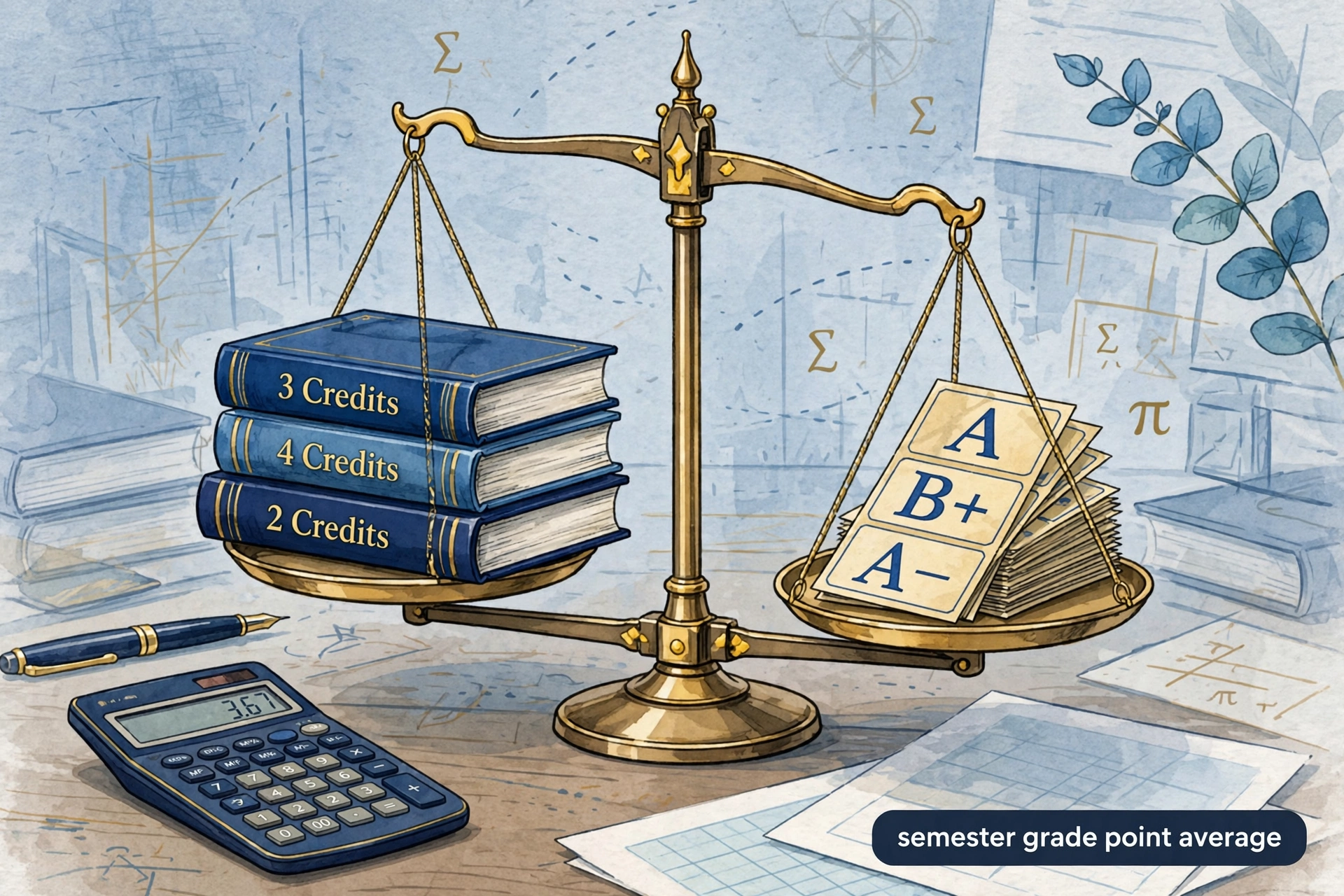
SGPA stands for Semester Grade Point Average. It is the weighted average of the grade points you earned across all subjects in a single semester, where each subject’s influence is proportional to its credit value. It is reported on a 10-point scale, from 0.00 to 10.00.
Think of it as your semester compressed into one number. Your marks say how you did subject by subject; your SGPA says how you did overall, giving heavier subjects their due weight. Recruiters use it for placement shortlists, universities use it for admissions, and you can use it to track whether you are improving from one semester to the next.
SGPA resets every semester — each term gets a fresh one. The running average across all your completed semesters is the CGPA (Cumulative Grade Point Average), which is what your final degree transcript emphasizes. If you work with the American-style 4.0 scale instead, the site’s GPA calculator covers that system.
The Formula Every SGPA Calculator Uses
Behind every SGPA calculator — no matter how fancy its interface — sits the same formula:
SGPA = Sum of (Grade Point × Credits) for every subject ÷ Total Credits of the semester
In plain words: convert each subject’s result into grade points, multiply by that subject’s credits to get “credit points,” add up all the credit points, add up all the credits, and divide the first total by the second.
The formula is a weighted average, which means a 4-credit core subject influences your SGPA twice as much as a 2-credit lab. That single fact should shape how you divide your study time: credits are a rough map of where your effort pays off most.
Grade Points and Credit Hours: The Two Inputs That Matter
Every SGPA calculation needs exactly two inputs per subject, and misunderstanding either one is the root of most wrong results.
Grade points are the 0–10 numbers your letter grades convert into. An O (Outstanding) is worth 10, an A+ is worth 9, and so on down to F (Fail) at 0. You never type raw marks into a proper SGPA calculator — you type the grade, and the grade points come from your university’s official scale. Using one university’s scale for another university’s grades is a classic error.
Credit hours (credits) measure a subject’s weight — roughly, how many hours of work it represents per week. Theory subjects often carry 3–4 credits, labs 1–2. Your syllabus or course handbook lists them; never guess.
The 10-Point Grading Scale
Most Indian universities follow the University Grants Commission’s recommended 10-point grading system under the Choice Based Credit System. The official letter grades and grade points are:
| Letter Grade | Grade Point | Meaning |
|---|---|---|
| O | 10 | Outstanding |
| A+ | 9 | Excellent |
| A | 8 | Very Good |
| B+ | 7 | Good |
| B | 6 | Above Average |
| C | 5 | Average |
| P | 4 | Pass |
| F | 0 | Fail |
| Ab | 0 | Absent |
These grades and the rules around them — including how failed subjects must be reappeared for and how non-credit courses are excluded from the computation — come straight from the UGC’s official framework. Students who want the authoritative source can consult the UGC guidelines on the Choice Based Credit System, which define the scale universities are expected to follow.
One caution: individual universities sometimes use different letter labels (S/A/B/C/D/E/F, for example) or different marks bands for each grade. The grade points on the 10-point scale stay comparable, but always confirm your own university’s grade table before calculating.
How to Use an SGPA Calculator: Step by Step
Here is the reliable process, whether the calculator is a website, an app, or your own spreadsheet:
Step 1: Collect your inputs. List every subject from the semester with its credits (from your syllabus) and your grade in each (from your result sheet). Include failed subjects — they count, as the next sections explain.
Step 2: Verify the grade scale. Check that the calculator uses your university’s 10-point scale and letter labels. If it lets you pick a university or scheme, pick yours.
Step 3: Enter subjects one by one. Type the subject name (for your own reference), select the grade, and enter the credits. Double-check each credits entry against your syllabus — this is where most errors creep in.
Step 4: Calculate and review. Hit calculate, then eyeball the result. Does the total credits figure match your syllabus total? Does the SGPA feel plausible given your grades? A quick sanity pass catches most input slips.
Step 5: Save or note the breakdown. Keep the per-subject credit points, not just the final number. That breakdown shows exactly which subjects dragged you down when you plan the next semester.
Worked Example: A Full Semester, Start to Finish
Priya’s semester has five subjects. Here is how her SGPA is computed, exactly as a calculator would do it:
| Subject | Grade | Grade Point | Credits | Credit Points |
|---|---|---|---|---|
| Engineering Mathematics | A+ | 9 | 4 | 36 |
| Data Structures | A | 8 | 4 | 32 |
| Digital Electronics | B+ | 7 | 3 | 21 |
| Communication Skills | O | 10 | 2 | 20 |
| Programming Lab | A | 8 | 2 | 16 |
| Total | 15 | 125 |
SGPA = 125 ÷ 15 = 8.33
Priya’s SGPA is 8.33. Notice how the two 4-credit subjects dominate: Mathematics and Data Structures together contribute 68 of the 125 credit points — more than half the total. That is the weighted average doing its job, and it is why credit-aware study planning beats equal-time-for-every-subject planning.
What to Do When a Subject Is Failed or Has a Backlog
Failed subjects are where SGPA calculations most often go wrong, so this deserves care.
A subject with an F grade contributes zero grade points but its credits still count in the denominator. That asymmetry is what makes a backlog so damaging. Consider a student with four subjects: three passed (credit points totaling 96 across 11 credits) and one failed 4-credit subject (0 points, 4 credits). The SGPA becomes 96 ÷ 15 = 6.40 instead of the 96 ÷ 11 = 8.73 it would have been without the failed subject. One backlog can cost nearly two and a half points.
An Absent (Ab) grade is treated the same way: zero points, credits counted. Subjects marked as withdrawn or incomplete are generally excluded from both the numerator and the denominator until they are completed — but rules vary, so confirm with your university’s regulations.
The strategic lesson is blunt: clearing backlogs quickly matters more for your SGPA than polishing an A into an O in a passed subject.
Reading Your Result: What Your SGPA Tells You
An SGPA is more than a trophy number — it is a diagnostic. Here is how to read it:
8.5 and above: Strong. You are comfortably above most placement and scholarship cutoffs, which commonly sit between 6.5 and 7.5.
7.0 to 8.5: Solid. Eligible for nearly all opportunities, with room to push higher by targeting high-credit subjects.
6.0 to 7.0: Acceptable but watchful. You clear many cutoffs but sit close to the edge; one bad semester could drop you below key thresholds.
Below 6.0: Needs attention. Identify whether the damage came from one failed subject or broad underperformance, and plan the next semester’s effort around credits.
Remember that recruiters often pair SGPA cutoffs with attendance requirements — many campuses expect the standard 75% attendance bar alongside academic eligibility. If you are unsure where you stand on that front, the 75% attendance criteria checker helps you verify it.
SGPA to Percentage: The Quick Conversion
Many application forms still ask for a percentage even when your transcript shows SGPA. The two most common conversion formulas in India are:
- Percentage = SGPA × 9.5 (the widely used CBSE-style multiplier; 8.33 SGPA becomes 79.14%)
- Percentage = (SGPA × 10) − 7.5 (used by several technical universities; 8.33 SGPA becomes 75.8%)
These give different answers, so always use the formula your university officially notifies. The rule of thumb: never invent a conversion, always check the official one.
From SGPA to CGPA: The Bigger Picture
Your CGPA is the cumulative version of the same idea: combine every semester’s SGPA, weighted by that semester’s credits. The simple version averages your SGPAs; the precise version weights each semester’s SGPA by its total credits before dividing by total credits across all semesters.
Each new semester’s SGPA nudges your CGPA toward itself — a strong semester pulls it up, a weak one drags it down, with the pull proportional to that semester’s credit load. A slow start is recoverable but takes sustained effort to reverse. The site’s CGPA calculator handles the cumulative math when you are ready for it.
Choosing a Reliable SGPA Calculator Online
Not all SGPA calculators are built equally. Before trusting one, check these points:
- Correct grade scale. It should match your university’s letters and grade points, or let you customize them.
- Credit input per subject. Any calculator that ignores credits is computing a simple average, not an SGPA.
- Backlog handling. It should let you enter F grades with their credits counted.
- Transparent breakdown. It should show per-subject credit points so you can verify the math.
- No signup required for basic use. Your grades are personal; a calculator that demands an account for a one-minute computation is collecting more than it needs.
When in doubt, verify the tool against the worked example in this guide. Enter Priya’s five subjects; if the calculator returns 8.33, its math is sound.
Tips to Raise Your SGPA Next Semester
Study by credits, not by subject count. Allocate preparation time in proportion to credit weight. A 4-credit subject deserves about twice the attention of a 2-credit one.
Protect the high-credit subjects first. An A in a 4-credit core subject is worth more than an O in a 2-credit elective. Triage accordingly during crunch weeks.
Clear backlogs immediately. As the math showed, a failed subject’s credits keep dragging the denominator until it is cleared. Backlogs compound; do not let them.
Track SGPA mid-semester. Estimate your SGPA from internal assessment marks before finals. Knowing you need, say, an A in two specific subjects to hit 8.5 turns vague anxiety into a concrete target.
Fix the inputs, not just the studying. Confirm your syllabus credits at the start of the term.
Frequently Asked Questions
What is the maximum SGPA possible?
10.00 — that means earning the top grade (O, worth 10 points) in every subject of the semester. Because SGPA is an average, a single lower grade anywhere pulls it below 10.
Do failed subjects count in SGPA calculation?
Yes. A failed subject gives zero grade points, but its credits still count in the total credits divisor. This is why one backlog can reduce your SGPA dramatically, and why calculators must include failed subjects to be accurate.
Where do I find my subjects’ credit values?
In your syllabus, course handbook, or curriculum document — usually listed beside each subject as “credits” or “credit hours.” Never guess; confirm the official numbers, since outdated listings do circulate.
What is 8.5 SGPA in percentage?
It depends on your university’s official formula. With the common SGPA × 9.5 method, 8.5 SGPA equals 80.75%. With the (SGPA × 10) − 7.5 method, it equals 77.5%. Always use your institution’s notified conversion.
What is the difference between SGPA and CGPA?
SGPA covers one semester only and resets each term. CGPA is the cumulative average across all completed semesters, weighted by credits. Recruiters and universities look at CGPA for your overall standing and SGPA for recent trajectory.
Can my SGPA change after results are published?
Yes — through revaluation or retotalling, if your university offers it and your marks change. A successful revaluation updates the grade points for that subject, and the SGPA is recomputed. Backlog clearance in a later semester also stops the failed subject from dragging future SGPAs, though past semester SGPAs generally stand as published.


