 Skip to main content


Application forms are inconsistent creatures. One asks for your percentage, the next demands your CGPA, and your marksheet shows only one of the two. For students in India — where boards report percentages and universities increasingly report grade points — converting between the two is a small but high-stakes piece of arithmetic. Get it right, and your academic record speaks clearly wherever it goes. Get it wrong, and a strong performance can look weaker than it is.
This guide explains the percentage-to-CGPA conversion from first principles: the standard formula, why it uses the number it does, worked examples, a full conversion table, the alternative formulas different institutions use, how to pick the right one, and the mistakes that cost students every admission season.
Why This Conversion Exists
Percentages and CGPA measure the same thing — academic performance — in different languages. A percentage says what share of the total marks you secured. A CGPA places your performance on a standardized 10-point scale that makes comparison easier across institutions, boards, and even countries.
The need to convert usually appears at predictable moments: filling out a job application that asks for CGPA when your board gave you a percentage, applying to a university abroad that wants grade points, checking scholarship eligibility stated in CGPA terms, or simply understanding what your percentage means on the scale your college uses internally. Even informal situations — comparing your board percentage with a friend’s university CGPA — call for the same math. In each case, the conversion is an estimate governed by a formula — and using the right formula is the entire battle.
The Standard Formula: Percentage ÷ 9.5
For the Indian 10-point scale, the standard conversion is:
CGPA = Percentage ÷ 9.5
That is it — one division. If you scored 85%, your CGPA is 85 ÷ 9.5 = 8.95. If you scored 76%, it is 76 ÷ 9.5 = 8.00. The simplicity is the point: anyone can do it on a phone calculator in seconds.
This formula is the one recognized by CBSE and widely used across Indian boards and institutions for the 10-point scale. When a form does not specify which conversion to use and your marks come from an Indian board, this is the default answer. Once you have the converted figure, you can cross-check it with the site’s CGPA calculator to see how it sits alongside semester-wise grade point math.
Why 9.5? The Logic Behind the Number
The obvious question: why divide by 9.5 instead of 10? The answer comes from how the scale was calibrated. When CBSE analyzed board results, it found that students earning the top CGPA of 10 typically averaged around 95% across their subjects — not 100%. Nobody routinely scores a perfect 100 in every subject, so anchoring 10 CGPA to 100% would make the top of the scale nearly unreachable and compress everyone else downward.
Dividing by 9.5 maps 95% to exactly 10.0 CGPA, which matches observed reality: the best students cluster around 95%, and the scale’s ceiling sits where real performance actually peaks. It is a normalization choice, not a law of nature — which is exactly why different institutions, calibrating against their own student populations, chose different numbers. Understanding this keeps you from treating any single formula as universal truth.
Worked Examples: Converting Common Percentages
Example 1: 92%. CGPA = 92 ÷ 9.5 = 9.684, which rounds to 9.68. A strong first-division score converts to a near-top CGPA.
Example 2: 85%. CGPA = 85 ÷ 9.5 = 8.947, which rounds to 8.95. This is the classic “distinction” percentage, landing just under 9.
Example 3: 76%. CGPA = 76 ÷ 9.5 = 8.00 exactly. A neat conversion — and a useful anchor to remember.
Example 4: 68%. CGPA = 68 ÷ 9.5 = 7.157, which rounds to 7.16. Comfortably above most placement cutoffs, which commonly sit between 6.5 and 7.5.
Example 5: 60%. CGPA = 60 ÷ 9.5 = 6.315, which rounds to 6.32. The traditional first-division boundary converts to a modest but respectable CGPA.
Notice the pattern: every 9.5 percentage points equals exactly 1.0 CGPA. So 85.5% is 9.0, 76% is 8.0, 66.5% is 7.0, and so on. Memorizing one anchor — 76% = 8.0 — lets you estimate any nearby value mentally: add or subtract 9.5% per CGPA point.
The Full Conversion Table
For quick reference, here are common percentages converted with the standard ÷ 9.5 formula, rounded to two decimals:
| Percentage | CGPA | Percentage | CGPA |
|---|---|---|---|
| 95% | 10.00 | 70% | 7.37 |
| 90% | 9.47 | 65% | 6.84 |
| 85% | 8.95 | 60% | 6.32 |
| 80% | 8.42 | 55% | 5.79 |
| 75% | 7.89 | 50% | 5.26 |
A few observations from the table: the popular “90% = 9 CGPA” shorthand is slightly off — it is actually 9.47. The 75% mark, which many students fixate on, converts to 7.89 rather than a round 7.5. And below 50%, the formula still works mathematically, but most institutions’ grading frameworks treat those ranges separately, so double-check before converting very low percentages. Keep this table bookmarked — it answers the most common conversions without any arithmetic.
The Reverse Conversion: CGPA to Percentage
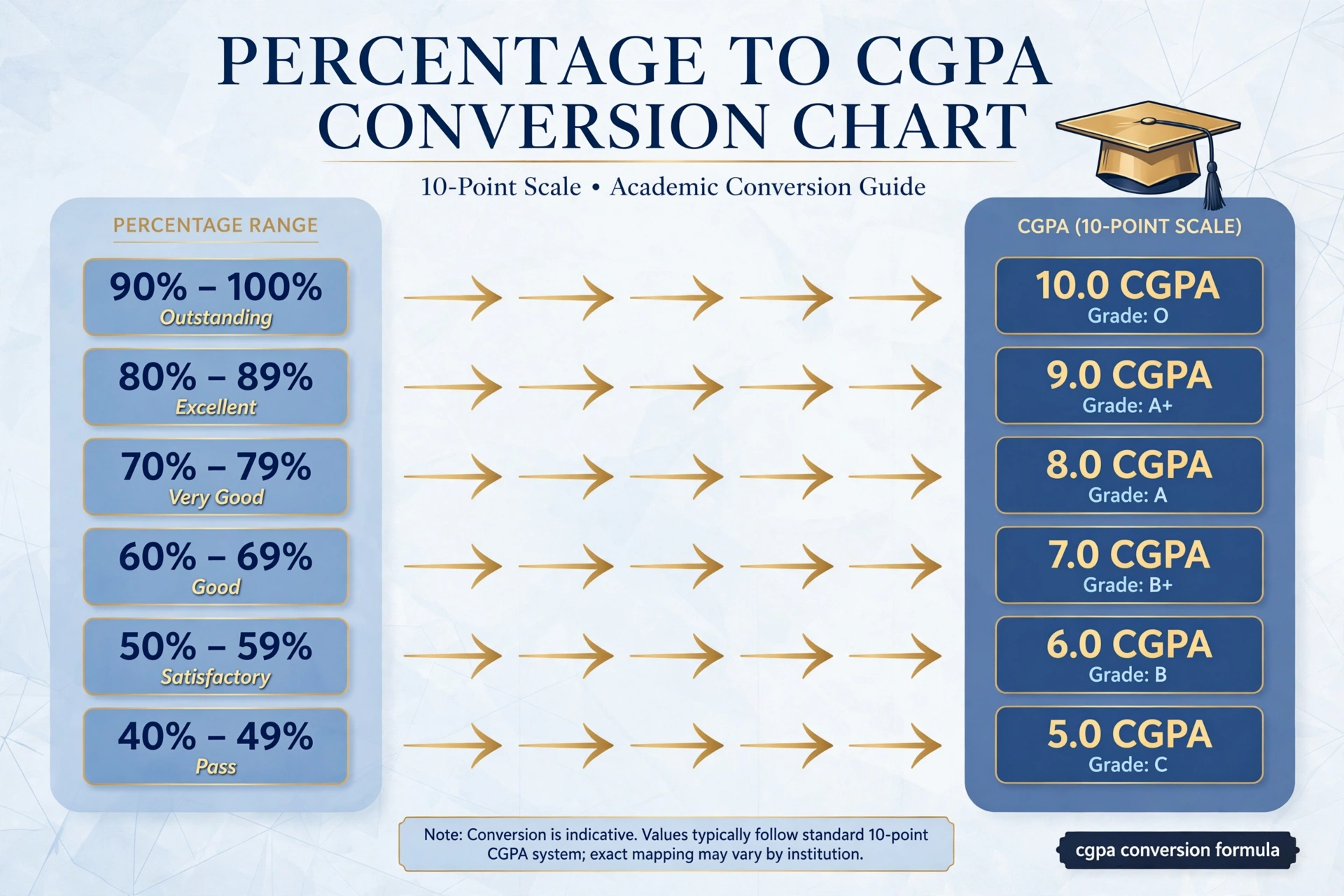
Sometimes you need to go the other way — your transcript shows CGPA and the form wants a percentage. Reverse the standard formula:
Percentage = CGPA × 9.5
So 8.0 CGPA becomes 76%, 9.0 CGPA becomes 85.5%, and 7.5 CGPA becomes 71.25%. The symmetry is exact because it is the same relationship read backwards. This reverse direction has its own dedicated treatment elsewhere; the key point here is that both directions must use the same institution’s formula — never convert one way with ÷ 9.5 and back with a different multiplier.
Alternative Formulas Used by Universities
The ÷ 9.5 standard is common, but it is not the only one. Several major university systems use their own conversions, and applying the wrong one can shift your result by half a CGPA point or more:
Anna University / VTU style: CGPA = (Percentage ÷ 10) + 0.75. Under this formula, 72.5% converts to 8.0 CGPA — noticeably different from the 7.63 that ÷ 9.5 would give.
Mumbai University style: CGPA = (Percentage + 7.5) ÷ 10. Here 72.5% also converts to 8.0 CGPA, but the formula behaves differently at the extremes.
Simple ÷ 10: Some institutions use a straight CGPA = Percentage ÷ 10. It is easy but unofficial in most Indian contexts — 85% becomes a flat 8.5.
WES (for study abroad): World Education Services does not apply a single division formula at all. It evaluates transcripts course by course against its own grade equivalencies, so a DIY conversion will not match a WES report.
The UGC’s Choice Based Credit System framework, which defines the 10-point grading scale Indian universities are expected to follow, is the authoritative backdrop for all of these — students can consult the official UGC guidelines to understand the scale their institution’s formula is built on.
Which Formula Should You Use?
Follow this decision order:
- The form itself. If the application specifies a conversion formula, use it. Nothing else matters.
- Your university’s official notification. Universities publish their conversion formula in academic regulations or on the transcript’s reverse side. That is your answer for anything official.
- Your board’s standard. For CBSE and most Indian boards with no other instruction, ÷ 9.5 is the accepted default.
- The receiving institution’s rule. For study-abroad or credential evaluation, check what the receiving body expects — many do the conversion themselves and prefer raw percentages.
What you should never do: average two formulas, pick the one that gives the higher number, or convert with one formula and “verify” with another. Consistency with the relevant authority is what makes a conversion defensible.
Converting for Study Abroad Applications
International applications add a layer of complexity because grading scales differ by country. US universities typically work on a 4.0 GPA scale, and there is no official Indian-government mapping from percentage to 4.0 GPA. WES and similar evaluators do their own course-by-course assessment, and universities often recalculate themselves.
The practical guidance: if the application asks for CGPA on the Indian 10-point scale, convert with your institution’s formula. If it asks for a 4.0-scale GPA, check whether the university provides its own conversion chart — many do for Indian applicants. If it accepts percentages, submit the percentage and skip the conversion entirely; an unnecessary conversion only introduces error. The site’s GPA calculator can help you work within the 4.0 system once you know which scale the application wants.
Common Mistakes Students Make
Using ÷ 10 out of habit. It feels natural, but it understates your CGPA under every official Indian formula. 85% is 8.95, not 8.5.
Mixing formulas across directions. Converting percentage → CGPA with ÷ 9.5 and then CGPA → percentage with × 10 produces a phantom loss. Both directions must invert the same formula.
Applying CBSE’s formula to university marks. Engineering universities with their own notified conversions (Anna, VTU, Mumbai) do not use ÷ 9.5. Using it anyway misrepresents your record.
Rounding too early. Round only the final CGPA to two decimals. Rounding intermediate steps can shift the result by a hundredth — trivial alone, but sloppy on an official form.
Converting when the form wants raw marks. Some applications ask for “percentage as per marksheet” — that means copy the number, not convert it. Read the field label carefully.
Forgetting that eligibility has two halves. Academic cutoffs are only part of most eligibility criteria; attendance requirements usually sit alongside them. Before submitting any application, it is worth confirming you also meet the 75% attendance criteria your institution enforces.
Quick-Reference Checklist
- Identify whose formula governs: the form, your university, or your board — in that order.
- Default to CGPA = Percentage ÷ 9.5 only when no authority specifies otherwise.
- Work with full precision; round the final answer to two decimals.
- Use the same formula in both directions; never mix multipliers.
- For study abroad, check whether the institution converts for you before doing it yourself.
- Keep a copy of the official formula source in case anyone questions your figure.
Frequently Asked Questions
What is 85% in CGPA?
Using the standard Indian formula (Percentage ÷ 9.5), 85% converts to 8.95 CGPA. Under a university-specific formula the answer differs — for example, some technical universities would compute it differently — so always check which formula applies to you.
Is the divide-by-9.5 formula universal?
No. It is the standard for CBSE and widely accepted across Indian boards, but many universities notify their own conversions, and international evaluators like WES use entirely different methods. Universal it is not; default it often is.
What is 75% in CGPA?
With the standard formula, 75 ÷ 9.5 = 7.89 CGPA. Students often guess 7.5, but the correct conversion is nearly four-tenths higher — a meaningful difference near cutoff boundaries.
Can my CGPA exceed 10?
No. On the 10-point scale, 10.00 is the ceiling. If your conversion produces more than 10 — say, 98 ÷ 9.5 = 10.32 — cap it at 10.00 and note the formula used. Percentages above 95% simply map to the top of the scale.
Which is better for job applications, percentage or CGPA?
Whichever the employer asks for. If both are accepted, use the one your institution reports officially — it is the most defensible. Converting an official percentage into an unofficial CGPA (or vice versa) adds a layer an employer might question.
Do I need to convert for a WES evaluation?
No — and you should not try. WES performs its own course-by-course evaluation and does not accept applicant-side conversions as substitutes. Submit your marksheets and transcripts as issued; WES handles the rest.


