 Skip to main content


A monthly attendance calculator answers a simple question that matters enormously: “How am I doing this month?” Students use it to check whether they are safely above their college’s attendance cutoff before exam eligibility lists are drawn up. Employees use it to keep a clean monthly record for appraisals. Parents use it to spot a child’s slipping attendance early, while there is still time to fix it.
This guide takes the tracker angle. Instead of a one-line formula page, it shows how to run a proper month-by-month attendance tracking system: how to mark each day, how to handle holidays and leave, how to read the monthly number, and how to use it to stay above the thresholds that actually affect academic and professional life. For the underlying percentage math itself, the companion attendance percentage calculator guide covers the formula in depth — this article is about the monthly tracking habit.
What a Monthly Attendance Tracker Actually Does
A monthly attendance tracker records each day of a calendar month as present, absent, on leave, or a holiday, then converts the marked days into a single monthly percentage. The output is a month-level summary: “In September, attendance was 91.7%.” That number becomes a data point in a longer series — October, November, December — and the series reveals trends that a single all-time percentage hides.
The real power of monthly tracking is early warning. An all-time attendance figure moves slowly; missing a week barely dents a full year’s number. A monthly figure reacts immediately. A student sitting at 82% for October can see the problem in October and correct course in November, instead of discovering the damage when the semester total is already locked.
Monthly Tracker vs the Average Attendance Formula: Know the Difference
Search results for monthly attendance mix two different intents, and confusing them produces wrong expectations. The average-attendance formula (average students present per day across a month) is an institutional statistic: it tells a school administrator how many students showed up on a typical day. It is computed from the attendance rate and the number of school days.
A monthly attendance tracker is a personal tool: it tells one student or employee what fraction of their own working days they attended this month. Same word “monthly,” completely different question. This guide owns the personal tracker intent. If the goal is the institutional average-days calculation, that belongs to a different formula and a different article.
The Monthly Attendance Formula
The tracker math is simple:
Monthly attendance % = (Days present / Total working days in the month) x 100
Total working days means days the person was expected to attend — present days plus absent days. Holidays, Sundays, and approved non-working days are excluded from both the numerator and the denominator. A month with 22 working days and 20 days present gives (20 / 22) x 100 = 90.9%.
The subtle part is not the division; it is deciding what counts as a working day. Get the day-marking right and the formula takes care of itself. Get it wrong — counting a festival holiday as an absence, for example — and the percentage punishes attendance that was never required.
How to Set Up Your Monthly Tracker: Step by Step
A monthly tracker needs nothing more than a calendar grid and a marking system. Here is the setup that works for students and employees alike:
- Create one page or sheet per month, with every calendar date in its own cell.
- Pre-mark the non-working days: Sundays, public holidays, and institutional breaks. These are excluded from the calculation.
- Each evening, mark the day: P for present, A for absent, L for approved leave, H for holiday if one was missed in step 2.
- At month end, count the P marks (days present) and the P + A marks (working days).
- Apply the formula: (P / (P + A)) x 100.
The daily-marking habit is the whole system. A tracker updated every evening takes thirty seconds and is always accurate. A tracker reconstructed from memory at month end is fiction. Attendance researchers at Attendance Works, the leading US authority on attendance data, consistently emphasize that timely, accurate daily attendance data is the foundation of every effective attendance strategy — the same principle applies to a personal monthly tracker.
Marking Days: Present, Absent, Holiday, Leave
Four marks cover every situation:
- Present (P): attended for the full required day or all required sessions. Counts in both numerator and denominator.
- Absent (A): a working day missed without the day being reclassified. Counts only in the denominator, which is what pulls the percentage down.
- Leave (L): an approved absence — sick leave with a certificate, sanctioned duty leave, approved vacation. Treatment varies: many trackers exclude approved leave from the denominator entirely (the day simply was not a working day for that person), while institutional records may count it as absent. Decide the rule at setup and apply it consistently all month.
- Holiday (H): no attendance expected. Excluded from the calculation completely.
Half-days deserve a decision too. Some trackers count two half-days as one full day; others mark a half-day as present if the person attended the required core sessions. Either convention works as long as it is consistent — inconsistency is what corrupts month-to-month comparisons.
Handling Holidays, Weekends, and Institutional Breaks
Months are not uniform, and the tracker must respect that. A month with a week-long festival break has fewer working days than a full month, and the percentage must be computed over the smaller denominator. This is a feature, not a bug: the monthly percentage always answers “of the days I was supposed to attend, how many did I attend?”
Three rules keep holiday handling clean. First, mark all known holidays before the month begins, so they never accidentally become absences. Second, when an unexpected holiday is declared mid-month (weather closures, for instance), re-mark the day as H rather than leaving it blank. Third, never “borrow” attendance from holidays — a holiday is neutral, not a bonus present day.
Worked Example 1: A Student’s Month
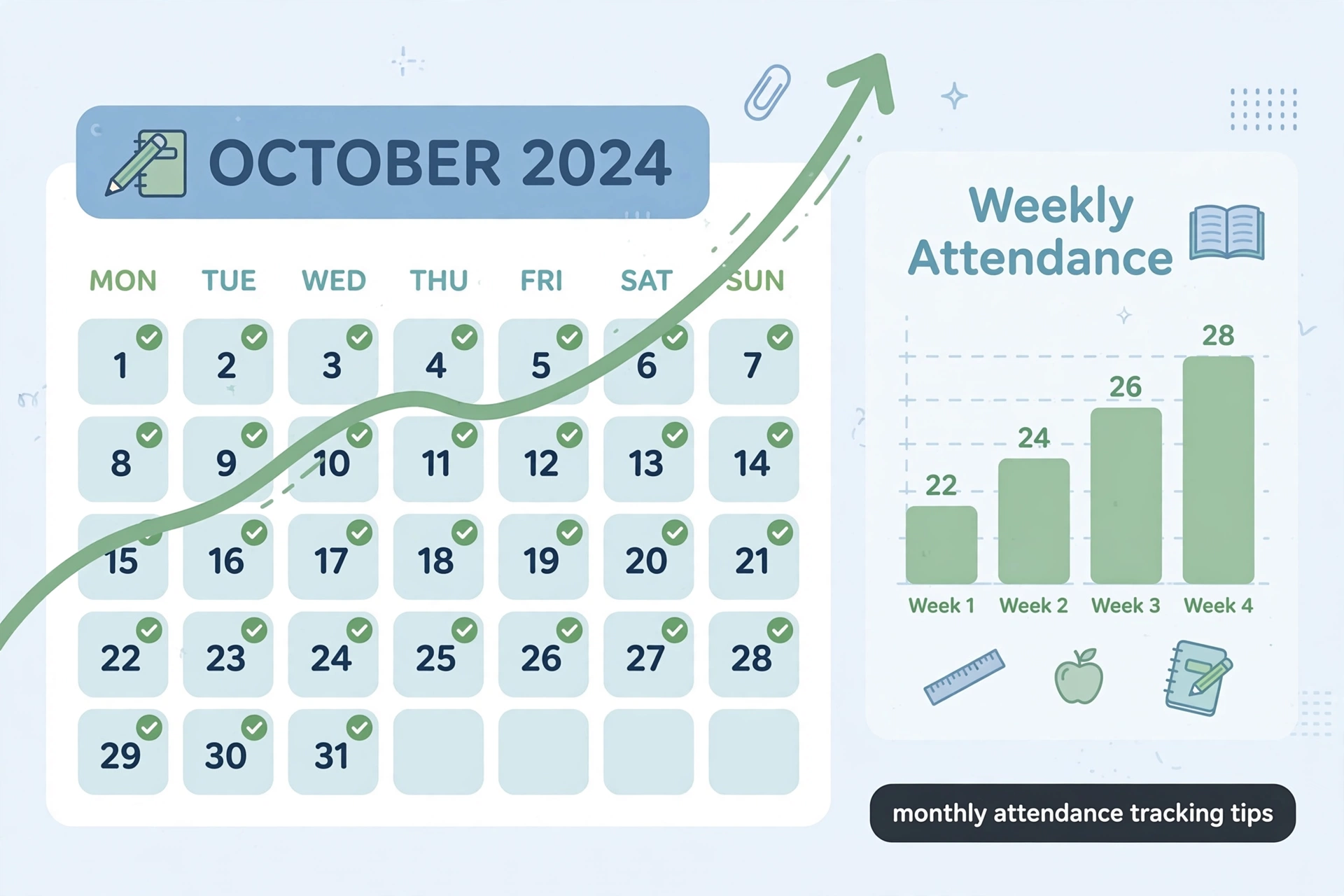
Consider a college student tracking October. The month has 31 days: 4 Sundays, 2 public holidays, and 1 institutional break day. Working days = 31 – 7 = 24.
Daily marking shows: 21 days present, 2 days absent (unwell, no certificate), 1 day of approved sick leave (excluded from the denominator per the student’s chosen rule).
Working days for the formula = 21 + 2 = 23. Monthly attendance = (21 / 23) x 100 = 91.3%.
The student is comfortably above the typical 75% college cutoff with room to spare. More importantly, the two unexcused absences are visible as a pattern to watch — if October’s 2 becomes November’s 5, the tracker flags it before the semester total suffers.
Worked Example 2: An Employee’s Month
An employee tracks September: 30 days, 4 Sundays (weekly off), 1 public holiday. Working days = 25. Marking shows 23 present, 1 casual leave (company policy counts approved leave as neutral, excluded), 1 unapproved absence.
Working days for the formula = 23 + 1 = 24. Monthly attendance = (23 / 24) x 100 = 95.8%.
For appraisal purposes, the employee can now state a precise monthly figure instead of a vague “good attendance.” The single unapproved absence is documented and explainable, and the approved leave is properly separated from it — a distinction that matters when managers review records.
The 75% Rule: Why Monthly Tracking Protects You
Most Indian colleges require 75% attendance for exam eligibility, and the rule is usually applied to the semester or annual total — which is exactly why monthly tracking is protective. A student who waits for the semester figure has no room to maneuver once it drops below the line. A student watching the monthly number gets three or four chances to correct course.
The math of recovery is unforgiving and worth understanding early. If a student ends October at 70% over 20 working days (14 present), reaching 75% by the end of November requires near-perfect attendance in the second month. The monthly tracker makes this visible while recovery is still possible. The full rules, condonation provisions, and consequences are covered in the guide to what the 75 percent attendance rule means for colleges — monthly tracking is how students stay on the right side of it.
Reading Your Monthly Result: Benchmarks That Mean Something
A monthly percentage is only useful with context. These benchmarks work for most students and employees:
- 95% and above: excellent. Roughly one absence or fewer in a full month.
- 90-94%: healthy. Normal minor illnesses and obligations fit here.
- 85-89%: watch zone. Fine for one month, but two consecutive months here signal a pattern.
- 75-84%: action zone for students under a 75% rule — the buffer is thinning.
- Below 75%: danger zone where exam eligibility or appraisal ratings are directly at risk.
Compare each month against the previous two, not just against the thresholds. A drop from 96% to 88% deserves attention even though 88% is “fine” — trends predict where the number is heading.
Tips to Keep Monthly Attendance High
Front-load the month. Absences cluster around month-ends (fatigue, events, travel), so treating the first two weeks as non-negotiable builds a buffer that absorbs the inevitable disruptions later.
Batch unavoidable appointments. Medical checkups, document work, and family obligations scheduled on the same day cost one absence instead of three spread across the month.
Separate the controllable from the uncontrollable in the tracker itself. A month at 88% because of a documented illness is a different story from 88% because of skipped classes — and understanding why attendance percentage matters in the first place keeps the motivation behind the marking habit.
Review on the last day of every month, without exception. The review takes five minutes: compute the percentage, note the trend, and set one concrete intention for next month. Trackers that are never reviewed become archives; trackers that are reviewed monthly become behavior.
Frequently Asked Questions
How is monthly attendance percentage calculated?
Divide days present by total working days in the month and multiply by 100. Working days exclude Sundays, holidays, and approved non-working days. For example, 20 present out of 22 working days is 90.9%.
Should holidays be counted in monthly attendance?
No. Holidays, Sundays, and institutional breaks are excluded from both the numerator and the denominator. They are days attendance was not expected, so they neither help nor hurt the percentage.
What is a good monthly attendance percentage?
95% or above is excellent, 90-94% is healthy, and anything below 85% for a student under a 75% rule deserves corrective action. Consistency across months matters more than any single month’s figure.
How is a monthly attendance tracker different from an average attendance formula?
A tracker measures one person’s attendance across a month (days present vs working days). An average attendance formula is an institutional statistic measuring how many students were present on a typical day. They answer different questions with different math.
How do I handle approved leave in my monthly tracker?
Decide one rule at setup and keep it all month. Most personal trackers exclude approved leave from the denominator (treating it as a non-working day). Institutional systems may count it as absent — follow the institution’s rule when the record is official.
Can monthly tracking really prevent attendance shortage?
Yes, because it converts a slow-moving semester total into fast monthly feedback. A weak month is visible while there are still months left to recover, instead of surfacing when eligibility lists are already finalized.
Should employees track monthly attendance too?
Absolutely. A monthly log gives precise figures for appraisals, separates approved leave from unapproved absence, and documents patterns (like frequent Monday absences) that vague memory cannot.


