 Skip to main content


Every school day begins the same way: before the lesson, before the learning, someone has to record who is actually in the room. Classroom attendance looks like the simplest administrative chore in teaching — a roll call, a register, a few taps in an app. But the teachers who treat it as mere paperwork miss what it really is: the earliest data a school collects about every student, every day.
This guide is written from the teacher’s side of the desk. It covers what classroom attendance means in practice, the methods teachers use to take it, how to keep it accurate without losing teaching time, how to read the patterns hidden in it, and how to turn those patterns into conversations that get students back into their seats.
What “Attendance” Means Inside a Classroom
In policy documents, attendance is binary — present or absent. In a real classroom, it is richer than that. A teacher’s daily record typically distinguishes several states: present, late (tardy), absent with excuse, absent without excuse, and sometimes partial attendance for students who arrive mid-lesson or leave early.
These distinctions matter because each state tells a different story. A student marked late three times a week has a transportation problem, not a motivation problem. A student absent every Monday may be dealing with something at home. The codes are not bureaucracy — they are the vocabulary the school uses to describe what is happening in students’ lives.
Most schools standardize the codes teachers may use, and teachers should learn their school’s exact definitions. Marking a student “present” when they arrived 25 minutes late, or “absent” when the school’s rule counts 15 minutes late as tardy, corrupts the data everyone downstream relies on.
Why Classroom Attendance Data Matters More Than It Looks
Attendance records feed more decisions than most teachers realize. They drive funding calculations in many systems, where schools receive money based on average daily attendance. They trigger truancy processes when absences accumulate. They appear on report cards and permanent records that follow students to the next school.
For the teacher, though, the most important use is instructional. Attendance is the first indicator of disengagement, and it arrives weeks before grades do. A student whose attendance slips from 98% to 85% over a month is sending a signal — about health, family stress, bullying, or simply losing the thread in class. Teachers who watch the trend can intervene while the problem is small. Teachers who only notice when the student fails the term have lost that window.
Research organizations that study this full-time, like Attendance Works, have documented how early attendance patterns predict later outcomes — which is exactly why the daily classroom record deserves more care than a rushed tick at the start of period one.
Methods of Taking Attendance: From Roll Call to RFID
Teachers have more options than the shouted roll call, and each method trades speed against accuracy differently.
Verbal roll call is the classic: read names, wait for responses. It is slow with large classes and easy to game — a friend answers for an absent student. Its one virtue is that it forces the teacher to learn names early in the year.
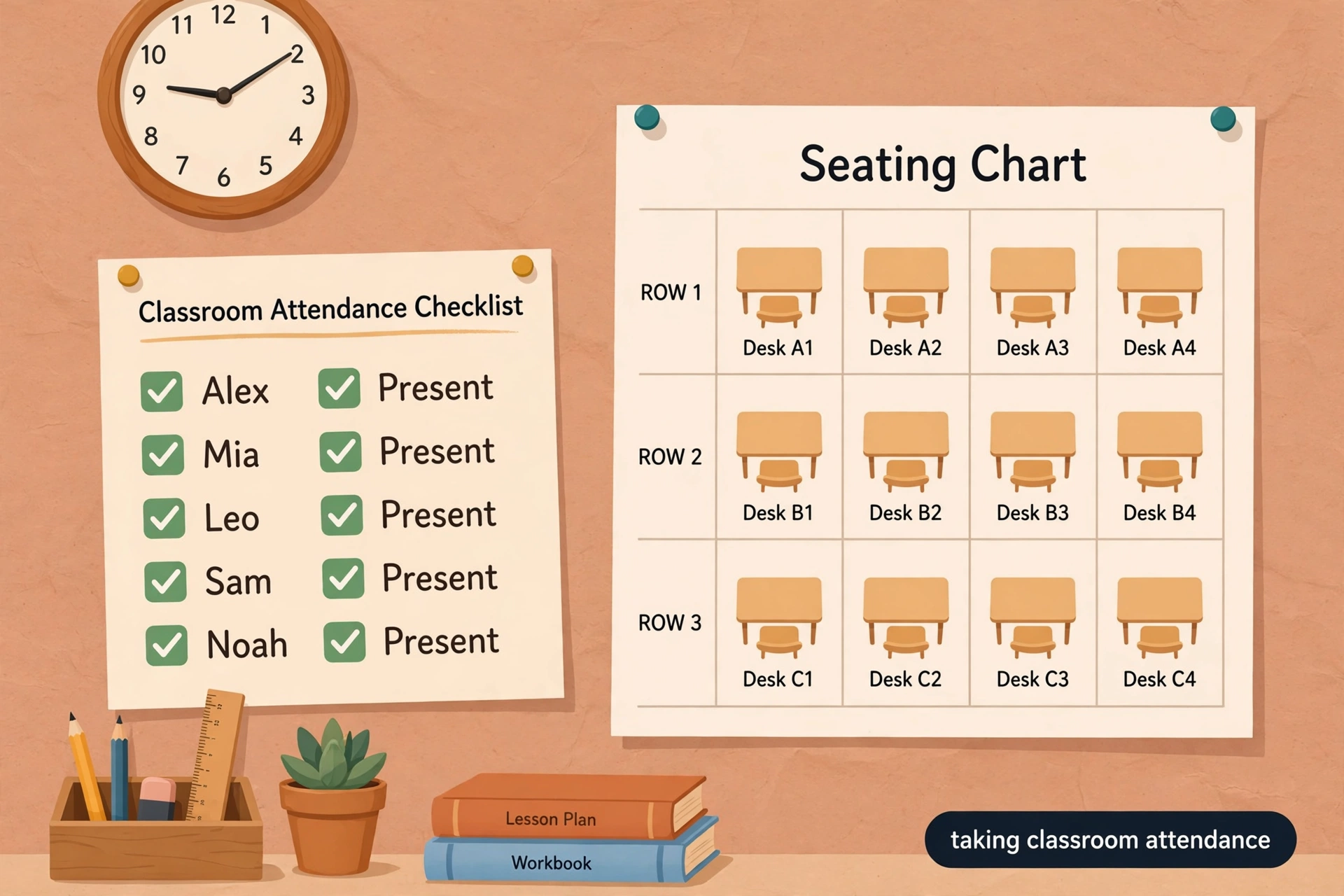
The seating chart method is faster. The teacher scans assigned seats and marks empty ones absent. It takes under a minute once seating is fixed, and it doubles as a classroom-management tool. Its weakness is substitute teachers and reshuffled rooms.
Paper sign-in sheets passed down the row are quick but the least reliable — signatures get skipped, forged, or duplicated.
Digital registers and school apps are now the norm in many schools. The teacher taps present/absent/late per student on a phone or laptop, and the data flows instantly to the office. Accuracy depends on the teacher actually completing the entry rather than batch-marking everyone present.
QR codes, RFID cards, and biometric systems automate check-in: students tap a card or scan a code on entry. These cut teacher time to near zero and are hard to fake, but they record entry to the room, not engagement — and they cost money to install.
The best method is the one the teacher will use consistently and accurately. A perfect system used sloppily beats no system, but a simple system used rigorously beats a fancy one used carelessly.
Excused vs Unexcused: The Daily Judgment Call
Every absence arrives with a story, and teachers are often the first to sort it. An excused absence is one the school accepts as legitimate — illness with a note, a family emergency, a medical appointment, a religious observance, a school-approved activity. An unexcused absence has no accepted reason.
The distinction matters enormously downstream: unexcused absences accumulate toward truancy thresholds, while excused ones generally do not. That makes the teacher’s initial coding genuinely consequential — which is why schools, not individual teachers, should define what counts as excused. A teacher’s job is to apply the school’s definitions consistently, document what the student or parent reported, and pass ambiguous cases to the office rather than deciding them alone.
Students and parents often do not know the difference between the two categories. A short explanation at the start of the year — what counts as excused, what documentation is needed, and what happens when absences pile up — prevents most disputes later. For the student’s side of these rules, the site’s guide to excused vs unexcused absence lays out the categories plainly.
The First Ten Minutes: Taking Attendance Without Losing the Lesson
Attendance should cost minutes, not lessons. Teachers who lose ten minutes to roll call every day surrender weeks of instruction over a year. The efficient routines share a few traits.
Take attendance at a fixed moment — the same point in every lesson. Students learn the rhythm, late arrivals become visible, and the teacher stops re-doing it. Many teachers take it while students complete a starter activity: the class writes, the teacher scans the room and taps the register. Two jobs, one time slot.
Handle latecomers with a system, not a confrontation. A sign-in slip by the door, a quiet nod, a tardy mark entered without breaking the lesson’s flow. The confrontation can wait for a private moment; the lesson cannot.
Never re-take attendance mid-lesson unless the school requires it. And build a substitute-proof routine: a printed seating chart with the marking codes explained, kept where any substitute can find it in thirty seconds.
Reading the Patterns: What Attendance Data Tells a Teacher
Individual absences are noise; patterns are signal. Teachers who review attendance weekly — not daily, which is too granular, and not termly, which is too late — start to see things.
The slide: a student’s attendance drifting downward over weeks. This is the classic early warning for disengagement, and it is the pattern most worth catching.
The weekday pattern: absent every Monday or Friday suggests weekend-related causes — work, family obligations, or avoidance of specific classes scheduled those days.
The subject pattern: present in the morning, absent after lunch. Something about the afternoon — a particular class, a social situation, fatigue — is pushing the student out.
The cluster: several students absent on the same days. Check for shared causes: a local event, transport disruption, or something happening in the school itself.
The sudden stop: a previously reliable student disappears entirely. This is the highest-urgency pattern and deserves same-day outreach, not a note in next week’s review.
None of these patterns diagnose the cause. They tell the teacher where to ask, not what the answer is.
Chronic Absence: What Teachers Can Spot Before Anyone Else
Chronic absence — typically defined as missing 10% or more of school days, which is about 18 days in a standard year — is the threshold where absence starts measurably harming learning. Teachers see it developing long before the office’s termly report flags it.
The teacher’s advantage is context. The data system sees “absent 12 days.” The teacher knows those 12 days cluster around math tests, or started the week the student’s parent lost a job, or coincide with a new seating arrangement next to a difficult peer. That context is what turns a statistic into an intervention.
When a student crosses into chronic-absence territory, the teacher’s most valuable move is usually not disciplinary — it is relational. A private conversation, a genuine “we miss you when you’re not here,” and a question about what would make coming easier. Punitive responses to absence driven by anxiety, illness, or family crisis tend to deepen the absence.
Talking to Students and Parents About Absences
These conversations go wrong when they sound like accusations. They go right when they sound like problem-solving.
With students, lead with the relationship: notice the absence, express that they were missed, ask what is going on. Avoid the trap of demanding justifications for each missed day — students who feel interrogated stop telling the truth. Instead, ask what would help: a catch-up plan, a seat change, a check-in routine.
With parents, share data, not judgments. “Aisha has missed 9 days this term, mostly Mondays” lands differently from “Aisha’s attendance is a problem.” Most parents do not realize how quickly absences accumulate — nine scattered days feels like “a few days off” until someone shows the total. Offer the school’s support options in the same conversation: counseling, transport help, academic catch-up.
Document these conversations briefly. A dated note — who, what was discussed, what was agreed — protects everyone if the situation escalates to formal truancy processes later. Students facing those processes often benefit from understanding how many unexcused absences are allowed before formal consequences begin.
Attendance Policies That Actually Work in a Classroom
A classroom attendance policy should fit on half a page and be explainable in three minutes on the first day. The effective ones share these features.
They state the expectation positively: “be here, be on time” rather than a list of punishments. They define the codes the teacher uses, so students know the difference between late and absent. They explain what happens after an absence — how to get missed work, not just the penalty for missing it. They connect attendance to learning honestly: not “attendance is 10% of your grade” as a threat, but the genuine point that missed discussion cannot be photocopied.
They also build in positive recognition. Schools that only punish absence teach students that attendance is about avoiding trouble. Teachers who notice and name good attendance — a quick acknowledgment of a student’s improved streak — teach that presence is valued. The research on this is consistent: recognition moves attendance more reliably than penalties.
And they stay consistent. The policy enforced for the quiet student and ignored for the disruptive one is not a policy; it is a preference. Students detect inconsistency instantly, and it costs the teacher more authority than any single absence.
What Classroom Records Feed Into
It helps teachers to know where their daily marks go. Attendance data typically flows into several systems: the school’s management information system, district or state reporting, funding calculations based on average daily attendance, truancy monitoring that counts unexcused absences against legal thresholds, and the student’s cumulative record.
This is why accuracy matters beyond the classroom. A teacher who batch-marks everyone present to save time is not just cutting a corner — they are falsifying the data that determines funding, triggers legal processes, and follows the student for years. The five honest minutes are worth it.
For students curious about how these percentages translate into consequences, the site’s explainer on what attendance percentages mean and why they matter covers the numbers side.
Frequently Asked Questions
How long should taking attendance take in a classroom?
With a seating chart or digital register, one to three minutes. If it regularly takes longer, the method — not the class — is usually the problem. Pair it with a starter activity so no teaching time is lost.
Should teachers mark a student present if they arrive halfway through?
Follow the school’s rule, which usually defines a cutoff (often 15–30 minutes) after which a late arrival counts as absent or partial. Whatever the rule, apply it the same way for every student.
What should a teacher do when a student is absent for many days in a row?
Reach out the same day the pattern becomes clear — a call or message home, a note to the counselor, and documentation of the attempt. Do not wait for the termly attendance report.
Can classroom attendance affect a student’s grades directly?
It depends on the school’s policy. Some schools factor attendance into grades; others keep them separate. Either way, the learning loss from absence affects grades indirectly through missed instruction.
How do teachers handle attendance on field trips or activity days?
Count it as a school day with its own register. Students on the trip are present; students who stayed behind need their own supervised attendance record. Never leave a gap in the record.
What is the difference between chronic absence and truancy?
Chronic absence counts all absences — excused and unexcused — typically at 10% or more of school days, and it is an academic warning measure. Truancy counts only unexcused absences against legal thresholds and can trigger formal intervention. Both start from the teacher’s daily marks.


