 Skip to main content


Every semester, thousands of Gujarat Technological University students open their results, see a number like 7.83 CPI, and immediately ask the same question: what is this as a percentage? Placement forms, higher-study applications, and government job portals all want a percentage, but GTU awards grades on a 10-point scale. The official GTU formula for converting CGPA to percentage is simple — Percentage = (CGPA − 0.5) × 10 — yet students get it wrong surprisingly often, usually by borrowing another university’s formula.
This guide covers the official GTU conversion method, explains SPI, CPI, and CGPA the way GTU actually uses them, walks through worked examples, and flags the mistakes that cost students marks on paper. Everything here follows GTU’s published grading system.
What Is GTU and How Does It Grade Students?
Gujarat Technological University (GTU), headquartered in Ahmedabad, is one of India’s largest affiliating technical universities, with hundreds of affiliated colleges offering engineering, pharmacy, management, architecture, and computer application programs. Because it oversees so many institutions, GTU uses a single standardized grading system so that a grade from any affiliated college means the same thing.
GTU evaluates students on a 10-point grading scale. Instead of awarding raw percentages on marksheets, it reports performance indices — SPI for a single semester and CPI for the cumulative record. Each course carries credits based on its teaching hours, and grades earned in courses are weighted by those credits. The result is a system designed for fairness across colleges, but it leaves students doing the percentage math themselves whenever a form demands it.
The Official GTU CGPA to Percentage Formula
GTU’s official conversion formula is:
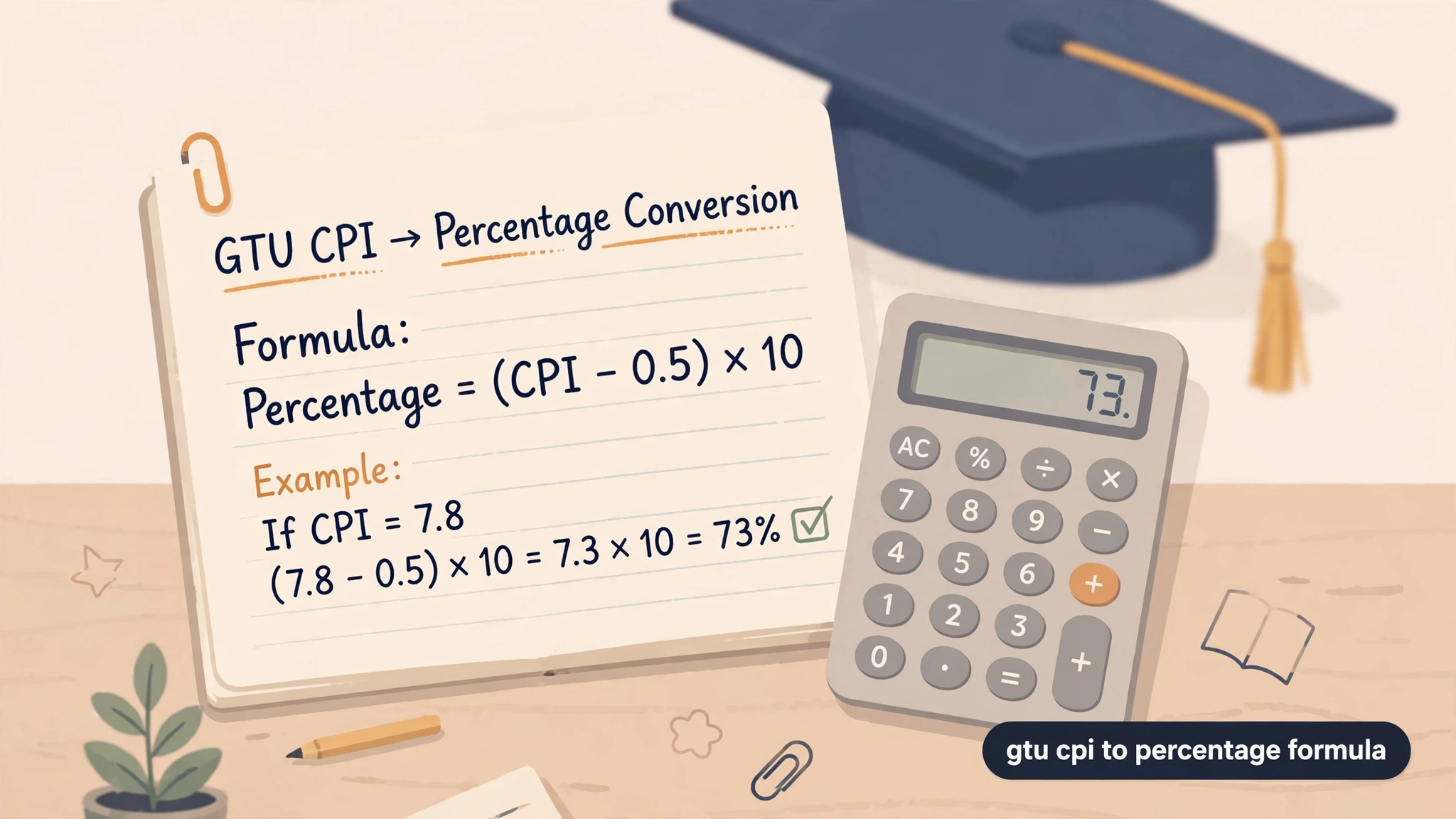
Percentage = (CGPA − 0.5) × 10
In words: subtract 0.5 from the CGPA, then multiply the result by 10. A CGPA of 8.0 becomes (8.0 − 0.5) × 10 = 75.0 percent. A CGPA of 9.2 becomes (9.2 − 0.5) × 10 = 87.0 percent.
The 0.5 correction factor exists because GTU’s grade-point scale does not start at zero for passing performance the way a pure proportional scale would. It aligns the 10-point index with the university’s historical percentage system so that converted figures match what students would have earned under percentage grading. This is also why the popular shortcuts fail: multiplying by 9.5 (the CBSE convention) or by 10 (the Anna University convention) gives a different number, and GTU does not recognize either.
Students should note that GTU prints its equivalence on official documents, and the university’s academic regulations remain the final authority. When a placement cell or verification agency checks a converted percentage, this is the formula they expect to see.
How to Convert CGPA to Percentage for GTU: Step by Step
The calculation takes less than a minute once the steps are clear.
Step 1: Find the final CGPA or CPI. Use the cumulative figure from the latest official result or transcript — not a single semester’s SPI, unless the form specifically asks for semester performance.
Step 2: Subtract 0.5. Take the CGPA and subtract 0.5. For a CGPA of 7.64, this gives 7.14.
Step 3: Multiply by 10. Multiply the result by 10. Continuing the example: 7.14 × 10 = 71.4 percent.
Step 4: Round sensibly. GTU results are typically reported to two decimal places. Round the percentage to two decimals (71.40%) or as the requesting form instructs. Never round the CGPA itself before converting — convert first, then round the answer.
Students who want to skip the manual math can verify their result with a CGPA calculator and then apply the GTU formula to the output.
GTU CGPA to Percentage Conversion Table
A ready reckoner saves time during form-filling season. The table below applies the official (CGPA − 0.5) × 10 formula across the full range.
| CGPA | Percentage | GTU Classification |
|---|---|---|
| 10.00 | 95.00% | First Class with Distinction |
| 9.50 | 90.00% | First Class with Distinction |
| 9.00 | 85.00% | First Class with Distinction |
| 8.50 | 80.00% | First Class with Distinction |
| 8.00 | 75.00% | First Class |
| 7.50 | 70.00% | First Class |
| 7.00 | 65.00% | First Class |
| 6.50 | 60.00% | First Class |
| 6.00 | 55.00% | Second Class |
| 5.50 | 50.00% | Second Class |
| 5.00 | 45.00% | Pass Class |
| 4.50 | 40.00% | Pass Class |
Keep this table as a quick reference, but always run the formula for CGPA values between the listed rows — interpolation by eye introduces small errors that add up on official forms.
GTU Grade Classifications Explained
GTU groups CGPA into classes that appear on transcripts and matter for eligibility:
First Class with Distinction (CGPA 8.5 and above). The top bracket. Many premium recruiters and postgraduate programs set their shortlisting bar here.
First Class (CGPA 6.5 to 8.49). A strong, employable bracket. Most campus placement eligibility criteria sit somewhere inside this range.
Second Class (CGPA 5.5 to 6.49). A passing performance with room for improvement. Some employers accept this bracket; others do not.
Pass Class (CGPA 4.5 to 5.49). The minimum for degree completion. Students here should focus on skill-building to compensate on job applications.
Below 4.5, the student is generally not eligible for the degree classification and must clear backlogs. These cutoffs explain why a few decimal points of CGPA carry real weight at GTU — the difference between 6.49 and 6.50 is the difference between Second Class and First Class.
SPI vs CPI vs CGPA at GTU: Clearing the Confusion
GTU’s three indices sound alike and get mixed up constantly.
SPI (Semester Performance Index) measures one semester only. It is the weighted average of grade points earned in that semester’s courses, weighted by course credits.
CPI (Cumulative Performance Index) measures the entire program up to the current semester. It weights every course taken so far by its credits. For most GTU students, CPI is the number that matters — it is what transcripts carry and what the percentage formula converts.
CGPA (Cumulative Grade Point Average) is the generic term other universities use for the same idea as CPI. At GTU, students will see CPI on official documents, but recruiters and guides often say CGPA. For conversion purposes, they are interchangeable: feed the cumulative index into (CGPA − 0.5) × 10.
The practical rule: convert the cumulative figure (CPI), not a single semester’s SPI, whenever a form asks for overall percentage. Converting an SPI answers a different question than the one being asked.
Worked Examples: GTU Conversion in Action
Example 1: A strong final-year student. Priya finishes with a CPI of 8.43. Subtract 0.5 → 7.93. Multiply by 10 → 79.30%. Her classification: First Class (just short of Distinction, which starts at 8.5 CPI).
Example 2: A mid-range student. Rahul’s CPI is 6.78. Subtract 0.5 → 6.28. Multiply by 10 → 62.80%. Classification: First Class.
Example 3: Checking the wrong formula’s damage. If Rahul had used the CBSE-style × 9.5 shortcut, he would have reported 64.41% instead of 62.80% — a 1.6-point overstatement that a verification check would flag. If he had used a straight × 10, he would have claimed 67.80%, overstating by a full 5 points. The official formula is the only safe choice.
For students converting semester-wise marks into grade points first, a grade GPA calculator handles the per-subject mapping before the GTU formula is applied.
6 Mistakes GTU Students Make When Converting CGPA to Percentage
1. Using another university’s formula. The × 9.5 and × 10 shortcuts belong to other systems. GTU’s correction factor is 0.5, and nothing else is accepted.
2. Converting SPI instead of CPI. Placement forms want the cumulative picture. A great final semester cannot rescue or represent the whole degree.
3. Rounding the CGPA before converting. Rounding 7.849 to 7.85 and then converting gives a slightly different percentage than converting 7.849 directly. Convert first, round last.
4. Forgetting that the formula applies to the 10-point scale only. GTU diploma or older percentage-system results should not be pushed through this formula at all.
5. Reporting the percentage without the CGPA. Many forms ask for both. Providing only the converted percentage looks evasive; providing both shows transparency.
6. Trusting random online converters blindly. Many generic converters default to × 9.5 or × 10. Unless the tool has a GTU-specific mode, do the (CGPA − 0.5) × 10 math manually or verify the tool’s formula first.
When Do You Need the Converted Percentage?
The converted percentage comes up in several real situations. Campus placement registrations are the most common — most recruiter portals have a mandatory percentage field. Higher-study applications, including GATE-adjacent processes and management program forms, ask for it too. Government job applications and public-sector eligibility checks typically specify percentage cutoffs (often 60%), so GTU students must convert before knowing whether they qualify. Scholarship renewals sometimes use percentage thresholds as well. In each case, attaching the CGPA alongside the converted percentage — and naming the formula — keeps the application clean and verifiable.
How GTU’s Formula Compares With Other Universities
Seeing GTU’s formula next to others shows why the “one formula fits all” idea fails. Anna University uses a straight CGPA × 10. Delhi University and CBSE use CGPA × 9.5. AKTU and SPPU use (CGPA − 0.75) × 10. Mumbai University uses a custom (7.1 × CGPA) + 11. A GTU student with 8.0 CGPA reports 75.00%; the same 8.0 at Anna University would be 80%. Neither is wrong — each university defines its own equivalence, and students must use their own university’s rule. The University Grants Commission requires universities to publish their conversion methodology, which is why checking GTU’s official regulations settles the question definitively.
College life is not only about grades, though. GTU students also need to meet attendance criteria to stay eligible for exams — the 75 percent attendance rule in colleges explains how that requirement works and what happens when attendance falls short.
Frequently Asked Questions
What is the official GTU CGPA to percentage formula?
Percentage = (CGPA − 0.5) × 10. Subtract 0.5 from the CGPA and multiply by 10. This is GTU’s published conversion method.
What is 8.5 CGPA in percentage at GTU?
(8.5 − 0.5) × 10 = 80.00%. An 8.5 CGPA also marks the threshold for First Class with Distinction at GTU.
Is GTU CPI the same as CGPA?
For conversion purposes, yes. CPI (Cumulative Performance Index) is GTU’s official term for the cumulative index shown on transcripts; CGPA is the generic name other universities use. Feed the cumulative figure into the formula either way.
Can I use CGPA × 9.5 for GTU?
No. The × 9.5 multiplier belongs to CBSE and similar systems. Using it for GTU overstates the percentage and will not match the university’s official equivalence.
Where is the GTU conversion formula officially published?
GTU publishes its grading and equivalence rules in its academic regulations and on official transcripts. The University Grants Commission requires universities to make their conversion methodology available, so the formula is a matter of public record.
What percentage do I need for First Class at GTU?
First Class starts at 6.5 CGPA, which converts to 60.00%. First Class with Distinction starts at 8.5 CGPA, or 80.00%.
Does the GTU formula work for diploma students?
GTU diploma programs follow the university’s grading regulations, so the same (CGPA − 0.5) × 10 equivalence applies wherever results are reported on the 10-point CPI scale. Students should still confirm against their program’s specific regulations.
The Bottom Line
Converting CGPA to percentage at GTU comes down to one formula — (CGPA − 0.5) × 10 — applied to the cumulative CPI, rounded only at the end. The students who get into trouble are the ones who borrow another university’s shortcut or convert a single semester’s SPI by mistake. Use GTU’s own rule, report both the CGPA and the converted percentage, and the number will survive any verification.


