 Skip to main content


Grade point averages travel well inside one education system and stall at its borders. A 3.6 GPA means something precise to an American admissions officer and nothing at all to an Indian recruiter asking for a percentage. Converting GPA to percentage bridges that gap — turning a scale-bound number into the universally understood language of “out of 100.”
This guide covers the GPA to percentage conversion for every major grading scale: the 4.0, 5.0, 7.0, and 10-point systems. It includes the formulas, ready-made conversion tables, worked examples, country-specific rules, and the mistakes that silently corrupt conversions. By the end, any GPA on any scale becomes a percentage with confidence.
What Does GPA to Percentage Conversion Mean?
GPA to percentage conversion translates a grade point average into its equivalent on a 0–100 scale. A GPA always belongs to a scale with a maximum — 4.0, 5.0, 7.0, or 10.0 — and the conversion expresses how far along that scale the GPA sits, as a percentage.
The conversion is interpretive, not official. No mathematical formula can reproduce exactly how a university maps its own grades, because grade bands, weighting, and rounding differ between institutions. What the formulas produce is the standard estimate that applications, recruiters, and credential evaluators expect to see as a self-reported figure. The official record always remains the transcript.
Understanding this distinction matters because it sets the right expectation: convert carefully, report honestly, and let institutions verify.
The Universal GPA to Percentage Formula
Every GPA to percentage conversion rests on one idea: what fraction of the maximum scale does the GPA represent? The universal formula is:
Percentage = (GPA ÷ Maximum GPA) × 100
A GPA of 3.0 on a 4.0 scale becomes (3.0 ÷ 4.0) × 100 = 75%. A GPA of 8.2 on a 10-point scale becomes (8.2 ÷ 10) × 100 = 82%.
This proportional method is the default when no institution-specific rule exists. It is simple, transparent, and defensible. Its limitation is that it assumes each grade point is worth the same — which is true mathematically but not always true in how institutions assign grades. Tiered letter-grade systems, where an A starts at 90 percent, do not map linearly. Still, for self-reporting and quick comparison, the universal formula is the accepted starting point everywhere.
Converting on the 4.0 Scale
The 4.0 scale dominates the United States and Canada, and it is the scale most study-abroad applicants encounter. The conversion is:
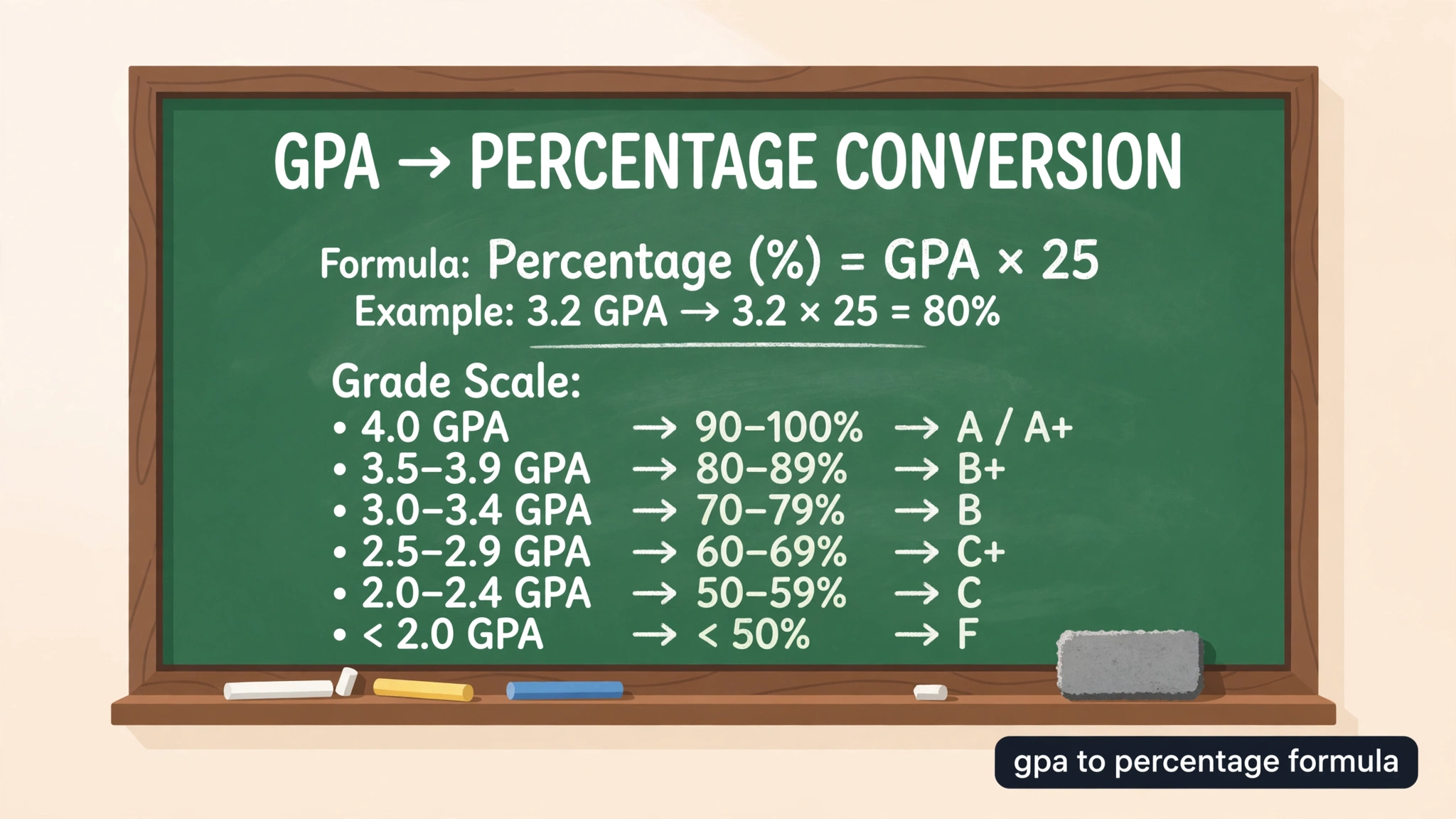
Percentage = (GPA ÷ 4.0) × 100, which simplifies to Percentage = GPA × 25
Common reference points: 4.0 → 100%, 3.7 → 92.5%, 3.5 → 87.5%, 3.3 → 82.5%, 3.0 → 75%, 2.7 → 67.5%, 2.5 → 62.5%, 2.0 → 50%.
One nuance: many North American institutions use tiered letter bands rather than pure proportionality. Under a strict tiered mapping, a 3.0 might represent the B band (80–89%) rather than exactly 75%. When a university publishes its own bands, those override the proportional math. When it does not, GPA × 25 is the standard estimate.
Students working with grade points regularly can speed up the underlying math with a grade GPA calculator before converting the result.
Converting on the 10-Point Scale (India)
India’s 10-point scale — used across universities, with CGPA as the cumulative measure — converts with a twist. Two conventions exist, and choosing the wrong one is the most common conversion error in the country.
The proportional method: Percentage = (GPA ÷ 10) × 100, or simply GPA × 10. An 8.2 becomes 82%.
The × 9.5 convention: Percentage = GPA × 9.5. An 8.2 becomes 77.9%. This multiplier comes from CBSE practice and is recognized by bodies including the University Grants Commission for institutions that adopt it.
Which one applies depends entirely on the institution. Many universities print their official multiplier on the transcript or in academic regulations — that printed rule wins. Individual universities also use custom formulas: some subtract a correction factor before multiplying by 10. Never assume × 10 or × 9.5 universally; check the specific institution’s rule first.
Converting on the 5.0 Scale
The 5.0 scale appears in parts of the Middle East, some European frameworks, and as a weighted high-school scale in some US districts. The conversion is:
Percentage = (GPA ÷ 5.0) × 100, or GPA × 20
A 4.2 becomes 84%; a 3.8 becomes 76%. The 5.0 scale is proportional by nature, so the universal formula applies cleanly here with no tiered-mapping complications in most cases.
One caution: weighted 5.0 high-school GPAs (where AP or honors courses earn bonus points) should be converted with care. Some credential evaluators prefer to unweight the GPA back to 4.0 first and then convert. When in doubt, report both the weighted figure and the scale so the reader can interpret it.
Converting on the 7.0 Scale (Australia)
Several Australian universities use a 7-point scale where 7 is a High Distinction. The conversion is:
Percentage = (GPA ÷ 7.0) × 100
A 6.0 becomes approximately 85.7%; a 5.0 becomes 71.4%; a 4.0 becomes 57.1%.
Australia’s scale maps to descriptive bands — High Distinction (85–100%), Distinction (75–84%), Credit (65–74%), Pass (50–64%) — which gives the conversion extra meaning. A GPA of 5.5 (≈78.6%) sits in Distinction territory, a useful framing for resumes targeting Australian employers.
GPA to Percentage Conversion Tables
Quick-reference tables for the two most-used scales. Find the GPA, read across for the percentage.
4.0 scale:
| GPA | Percentage | GPA | Percentage |
|---|---|---|---|
| 4.0 | 100% | 3.0 | 75% |
| 3.9 | 97.5% | 2.9 | 72.5% |
| 3.8 | 95% | 2.8 | 70% |
| 3.7 | 92.5% | 2.7 | 67.5% |
| 3.6 | 90% | 2.6 | 65% |
| 3.5 | 87.5% | 2.5 | 62.5% |
| 3.4 | 85% | 2.4 | 60% |
| 3.3 | 82.5% | 2.3 | 57.5% |
| 3.2 | 80% | 2.2 | 55% |
| 3.1 | 77.5% | 2.0 | 50% |
10-point scale (proportional × 10):
| GPA | Percentage | GPA | Percentage |
|---|---|---|---|
| 10.0 | 100% | 7.5 | 75% |
| 9.5 | 95% | 7.0 | 70% |
| 9.0 | 90% | 6.5 | 65% |
| 8.5 | 85% | 6.0 | 60% |
| 8.0 | 80% | 5.5 | 55% |
For institutions using the × 9.5 convention, multiply each 10-point percentage above by 0.95 — or simply compute GPA × 9.5 directly.
Worked Examples
Example 1: US student applying for an internship. Maya has a 3.6 GPA on a 4.0 scale. Percentage = (3.6 ÷ 4.0) × 100 = 90%. She reports “3.6/4.0 (≈90%)” — giving both numbers keeps it transparent.
Example 2: Indian student under the × 9.5 convention. Arjun’s university specifies the × 9.5 multiplier, and his CGPA is 8.2. Percentage = 8.2 × 9.5 = 77.9%.
Example 3: Same CGPA, proportional method. If Arjun’s university instead used the straight proportional rule, his 8.2 would be 82%. The 4.1-point gap between conventions shows why identifying the right rule matters more than the arithmetic.
Example 4: Australian applicant. Sophie has a 5.8 GPA on a 7-point scale. Percentage = (5.8 ÷ 7.0) × 100 ≈ 82.9% — comfortably in Distinction range.
Country-Wise Conversion Guide
India: 10-point scale; check whether the institution uses × 10, × 9.5, or a custom formula. The transcript usually states the rule.
United States and Canada: 4.0 scale; GPA × 25 is standard. Credential evaluators apply their own tables to foreign grades.
United Kingdom: Percentage-based degree classifications dominate (First Class at 70%+, Upper Second at 60–69%). GPA conversion is rarely requested; percentages are native.
Australia: 7-point scale at many universities; (GPA ÷ 7) × 100, interpreted against the HD/D/Credit/Pass bands.
Europe: The ECTS system uses letter grades (A–F) with institutional percentage mappings. Convert only if the target institution asks; many evaluate ECTS grades directly.
The pattern is consistent worldwide: the receiving institution’s convention outranks every generic formula.
University-Specific Formulas That Override the Generic Math
Many universities publish custom conversion formulas that replace the proportional default for their graduates. Common patterns include subtracting a correction factor before multiplying (as several Indian technical universities do), adding a constant to a scaled product, or using bespoke multipliers.
The practical workflow: check the back of the transcript first — universities are typically required to print their equivalence there. If nothing is printed, check the academic regulations or examination section of the university website. Only when no official rule exists should the generic proportional formula be used, and in that case it should be labeled as an estimate.
For students tracking cumulative performance across semesters before converting, a CGPA calculator organizes the multi-term math cleanly.
GPA vs CGPA: Which One Do You Convert?
GPA measures a single term; CGPA cumulates across all terms. Forms asking for “overall percentage” want the CGPA converted, not one good semester’s GPA. Converting a single term answers a different question and misrepresents the record.
That said, some applications ask for both term-wise and cumulative figures. In that case, convert each separately and label them clearly: “Semester GPA 3.4 (≈85%), Cumulative CGPA 3.2 (≈80%).” Clarity here prevents the verification headaches that vague reporting creates.
7 Mistakes That Ruin GPA to Percentage Conversions
1. Using the wrong scale maximum. Dividing a 10-point GPA by 4.0 (or vice versa) is the classic blunder. Confirm the scale before touching the math.
2. Assuming × 9.5 or × 10 universally. These are institution-specific conventions, not laws of nature. The transcript’s printed rule decides.
3. Confusing GPA with CGPA. A single strong semester converted and presented as the overall figure misrepresents the academic record.
4. Rounding the GPA before converting. Round only the final percentage. Early rounding compounds error, especially near classification boundaries.
5. Ignoring tiered grade bands. Where institutions use letter bands, the proportional formula is an approximation. Acknowledge it as such.
6. Mixing weighted and unweighted figures. Convert the figure the institution reports, and state whether it is weighted.
7. Presenting estimates as official. Self-converted percentages are estimates for forms and planning. Transcripts and credential evaluators produce the official numbers.
When Do You Actually Need a Percentage?
Converted percentages come up in specific, predictable situations. Job applications in percentage-based countries often have mandatory percentage fields. Government job eligibility frequently specifies percentage cutoffs. Scholarship forms may require it. Study-abroad applications sometimes ask international students to provide one alongside the original GPA. And credential evaluation reports themselves often include a converted figure.
In every case, the winning format is the same: original GPA, scale, converted percentage, method. “CGPA 8.2/10 (≈77.9% using × 9.5 convention)” tells the reader everything and hides nothing. Transparency converts a guess into a credible data point.
Grades are not the only number that follows students through school, either — what student attendance percentage means and why it matters covers the other metric institutions track closely.
Frequently Asked Questions
What is the formula to convert GPA to percentage?
Percentage = (GPA ÷ Maximum GPA) × 100. On a 4.0 scale this simplifies to GPA × 25; on a 10-point scale to GPA × 10 (unless the institution specifies otherwise, such as × 9.5).
What is 3.5 GPA in percentage?
On a 4.0 scale: (3.5 ÷ 4.0) × 100 = 87.5%. On a 10-point scale, a 3.5 would be unusual — scale context is essential, which is why the maximum must always be stated.
What is 8 CGPA in percentage?
It depends on the institution’s rule. Proportionally: 80%. Under the × 9.5 convention: 76%. Under a correction-factor formula like (CGPA − 0.5) × 10: 75%. Check the transcript.
Is GPA to percentage conversion the same everywhere?
No. While the proportional formula is universal math, institutions overlay their own conventions — × 9.5, correction factors, tiered bands — so the same GPA can convert differently in different systems.
Should I convert my GPA myself for applications?
Yes, for self-reported fields — but report the original GPA, the scale, and the method alongside the percentage. Let credential evaluators produce the official conversion.
Can a percentage exceed 100 after conversion?
No. If the math produces over 100%, the wrong scale maximum was used. A GPA can never exceed its scale’s maximum, so the percentage can never exceed 100.
Do employers verify converted percentages?
Serious ones do, usually by checking the transcript’s stated equivalence or asking a credential evaluator. This is why using the institution’s official rule — not the most flattering one — is the only safe approach.
The Bottom Line
Converting GPA to percentage is straightforward math wrapped in one critical judgment call: which rule applies. Start with the universal formula — (GPA ÷ maximum) × 100 — then check whether the institution overrides it with its own convention. Report the original figure, the scale, and the method every time. Do that, and the percentage will be accurate, defensible, and ready for any form.


