 Skip to main content


For Class 10 students in CBSE-affiliated schools, attendance is no longer just a school discipline matter — it is a board eligibility condition. The Central Board of Secondary Education requires a minimum of 75 percent attendance for students appearing in the Class 10 board examinations, and falling short without an approved reason can keep a student out of the exam hall entirely.
This guide explains the CBSE attendance rules for Class 10 in full: what the 75 percent rule means, how attendance is counted, what happens if a student falls below the threshold, the condonation process for genuine cases, how attendance connects to internal assessment, and what parents and students can do to stay safe. To keep a running check through the year, this site’s attendance percentage calculator turns present and total days into an instant percentage.
Quick Answer
What are the CBSE attendance rules for Class 10? CBSE requires Class 10 students to have at least 75 percent attendance, counted from the start of the academic session up to 1 January of the examination year, to be eligible for the board examinations. Falling short without an approved reason can keep a student out of the exam hall, although a shortage may be condoned for genuine reasons through the school.
The 75% Attendance Rule: What CBSE Requires
CBSE mandates that every student appearing for the Class 10 (and Class 12) board examinations must have at least 75 percent attendance during the academic session. This is not a suggestion or a school-level policy — it is a board-level eligibility criterion, and schools are required to track and report it.
The rule applies across the two-year learning cycle. For Class 10, that means Classes 9 and 10 are treated as a continuous two-year program rather than two isolated years. Regular classroom participation across this cycle matters because internal assessment is also tracked continuously, not assembled at the last minute.
Attendance is counted from the start of the academic session up to 1 January of the examination year. For students appearing in a given year’s board exams, everything from the session’s first day through 1 January counts toward the 75 percent calculation. Days after that cutoff do not change the eligibility figure, which is why the autumn months are the critical period for students hovering near the line.
How the 75% Is Calculated
The math is straightforward: divide the number of days the student was present by the total number of working days in the counted period, then multiply by 100.
Attendance percentage = (Days present / Total working days) x 100
A few practical points shape this calculation. Only working days count — Sundays, public holidays, and vacations are excluded from the denominator. If a student joins the school mid-session, the count typically starts from the date of admission, not the session’s start. And attendance is usually tracked subject-wise as well as overall in senior classes, though the headline eligibility figure is the overall percentage.
An example: if the counted period has 220 working days and a student was present for 170 of them, the attendance is (170 / 220) x 100 = 77.3 percent — above the threshold. At 160 days present, it becomes 72.7 percent — below the threshold, and the condonation process becomes the only path to the exam hall.
What Happens Below 75%: Essential Repeat and Other Consequences
Students who fall below 75 percent without condonation face serious consequences. The board places such students in the “Essential Repeat” category even if they are enrolled as regular candidates — meaning they cannot simply appear for the board exam as normal students. In practical terms, short attendance can cost a student the entire academic year.
The attendance rule is also linked to internal assessment. CBSE treats internal assessment as a compulsory, continuous two-year process. Students who skip internal assessments or fail to submit required work risk having their board results withheld even if they sit for the written exams. Attendance and assessment compliance travel together: a student who is absent too often typically misses the internal assessment components as well, compounding the problem.
It is also worth understanding the stakes clearly. Falling into Essential Repeat does not just delay the exam — it affects the student’s record, their timeline for Class 11 admission, and in some cases their confidence. The rule exists precisely to make these consequences real enough that attendance is taken seriously all year.
Condonation: When CBSE Forgives Short Attendance
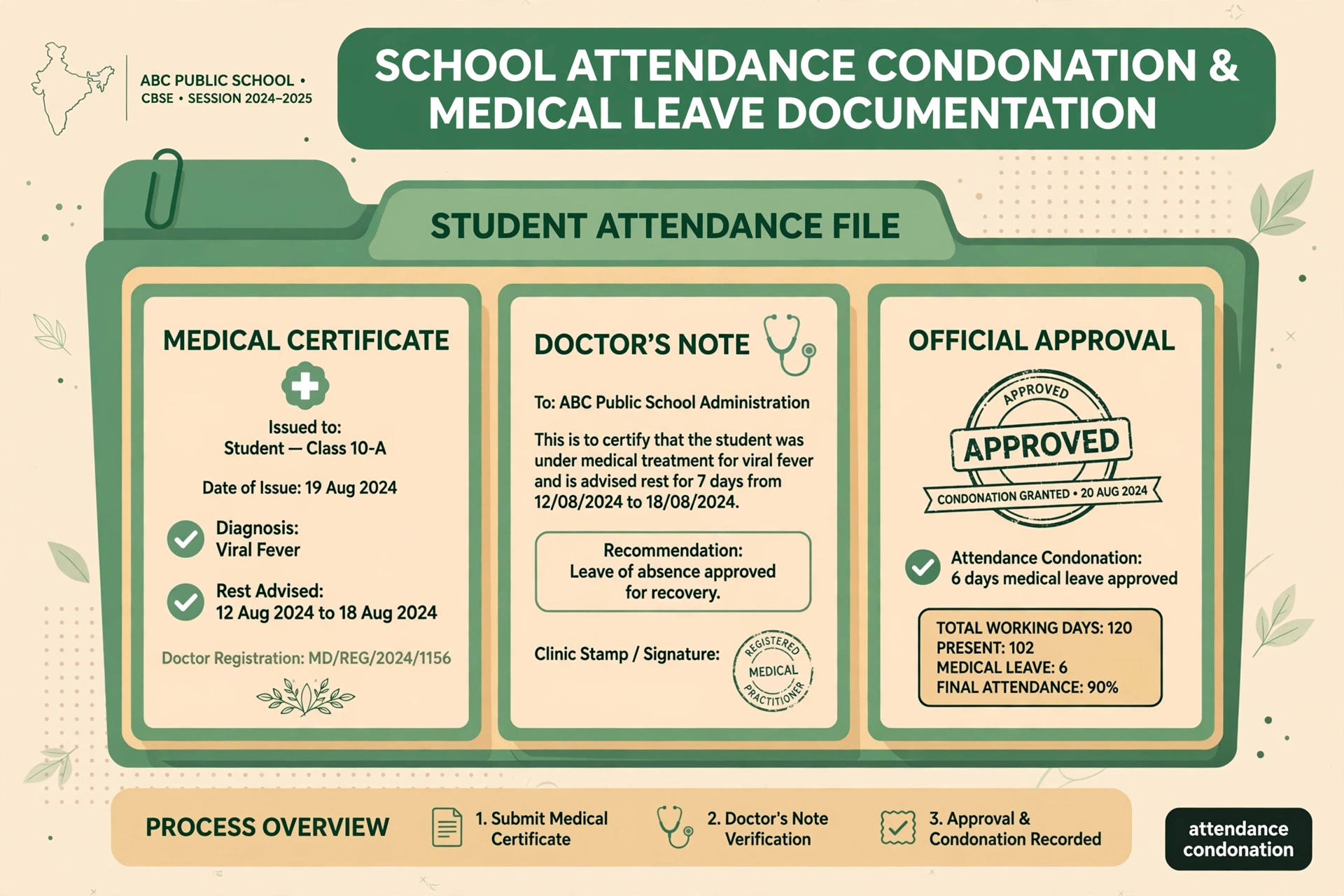
CBSE does not apply the rule blindly. The board can condone a shortage of up to 25 percent — in other words, a student with attendance between 50 and 75 percent may still be allowed to appear — but only for specific, documented reasons and only through a formal process.
The accepted grounds are narrow: medical emergencies supported by proper documentation, participation in national or international sports events, and other serious reasons that the board finds genuine. Casual absences, family functions, vacations, and vague “personal reasons” do not qualify. There is no separate relaxed band — the oft-rumored idea that 60 percent is “safe” has no basis in CBSE rules.
Critically, students do not apply for condonation themselves. The school forwards the case to the CBSE Regional Office with a parent’s request, the mandatory supporting documents, and the school’s recommendation in the board’s prescribed proforma. The process has hard deadlines: for a recent exam cycle, cases had to reach the Regional Office by early January, deficiencies were flagged within weeks, and approvals were issued by early February. Cases without complete mandatory documents are rejected outright, and no case is accepted after the deadline.
The lesson for parents: if a genuine medical or sports situation is eating into attendance, start the documentation immediately. Medical certificates, hospital records, and sports participation letters must be collected as events happen — reconstructing them in December is far harder and sometimes impossible.
Attendance and Internal Assessment: The Two-Year Link
One of the most significant recent shifts is CBSE’s emphasis that Classes 9–10 (and 11–12) form a two-year learning cycle, with internal assessment running continuously across it. This was designed to end the culture of last-minute preparation and dummy attendance, where students enrolled nominally but studied at coaching centers.
For Class 10 students, this means periodic tests, notebook submissions, and subject-enrichment activities across both years feed into the final assessment picture. A student with poor attendance will almost inevitably have gaps in these components too. Research on chronic absence consistently shows it depresses learning outcomes — the attendance monitoring guidance published by organizations like Attendance Works documents this link in detail. Schools have been directed to maintain daily attendance registers signed by class teachers and principals, with the possibility of random CBSE inspections verifying compliance.
The practical takeaway: attendance is not just about the final percentage. It is about being present for the assessments that build the internal marks. Missing school means missing both.
Special Cases: Sports, Medical, and Transfer Students
Students representing their school, state, or country in recognized sports or cultural events can receive exemptions under defined conditions — but the keyword is “defined.” The participation must be genuine and documented, and the school must process it through proper channels. Informal “sports quota” assumptions do not hold.
For prolonged medical situations, the documentation standard is high: proper medical certificates from recognized practitioners or hospitals, covering the exact period of absence. A single-line note from a clinic rarely suffices for a months-long gap.
Transfer students — those who change schools mid-session — should ensure their attendance records travel with them. The previous school’s attendance data feeds into the calculation, so get a proper transfer certificate and attendance record at the time of leaving, not months later.
Students studying abroad or in unusual circumstances should check with their school about the specific flexibilities CBSE allows, since these are handled case by case rather than by blanket rule.
How Parents Can Monitor and Protect Attendance
Parents are the early-warning system. Most schools now share attendance data through apps, SMS alerts, or parent-teacher meetings — use them. Do not wait for the December shock of discovering the percentage is at 68.
Set a personal threshold well above 75 — aim for 85 percent or higher as a household rule. The buffer absorbs the inevitable sick days, family emergencies, and unforeseen closures without dropping into the danger zone. A student at 85 percent can afford a two-week illness; a student at 76 percent cannot afford a long weekend.
Keep a simple monthly log at home: working days in the month, days present, running percentage. It takes five minutes and removes all guesswork. Students who track their own numbers tend to guard them more carefully — which is also why understanding what happens when attendance falls below 75 percent motivates better than any lecture.
If attendance is slipping, talk to the class teacher early. Schools would much rather help a family fix a developing problem in September than process a condonation case in January. And if the absences are for a genuine ongoing reason, begin assembling the condonation file immediately — medical records, letters, and the school’s guidance on the proforma.
Tips for Students: Staying Above the Line All Year
Treat attendance like a subject you cannot afford to fail — because that is literally what it is. Plan medical appointments and family travel around school days wherever possible. If you are unwell, get proper documentation from day one rather than hoping a short absence “won’t matter.” It all counts.
Understand the difference between absence types, since schools record them differently. Excused and unexcused absences are not the same thing in school records, and knowing which category an absence falls into helps you manage the record accurately.
For students involved in sports or cultural activities, coordinate with the school in advance. Get written acknowledgment of event participation before leaving, not after returning. And remember the two-year view: Class 9 attendance habits set the pattern for Class 10, when the stakes are highest.
Finally, treat the 1 January cutoff as a hard deadline in your planning. Everything from October through December counts disproportionately, because there is no time left to recover lost ground after the winter break. Students who build their buffer early — by staying regular from the session’s first month — never need to think about condonation at all.
Frequently Asked Questions
What is the minimum attendance required for CBSE Class 10 board exams?
CBSE requires a minimum of 75 percent attendance, counted from the start of the academic session up to 1 January of the examination year. Students below 75 percent can appear only if CBSE condones the shortage through the formal school-forwarded process.
Can I appear for the Class 10 board exam with 70 percent attendance?
Not automatically. Attendance between 50 and 75 percent can be condoned, but only for genuine reasons like medical emergencies or national-level sports participation, with full documentation forwarded by your school to the CBSE Regional Office. Casual absences are never condoned.
How does the school apply for attendance condonation?
The student does not apply directly. The school forwards the case to the CBSE Regional Office with the parent’s request, mandatory supporting documents, and the school’s recommendation in the board’s proforma. Strict deadlines apply — late or incomplete cases are rejected.
Does Class 9 attendance affect Class 10 board eligibility?
Yes, indirectly but importantly. CBSE treats Classes 9 and 10 as a two-year learning cycle with continuous internal assessment. Poor attendance in Class 9 creates assessment gaps and bad habits that carry into the Class 10 eligibility year.
What is the Essential Repeat category?
It is the category CBSE places students in when they fail to meet attendance or assessment conditions. Students in this category cannot appear as regular candidates and effectively must repeat the year. It applies even to otherwise enrolled regular students.
Are medical leaves counted as absent?
Yes — medical leave still counts as absence in the attendance percentage unless formally condoned. This is why documentation matters: a documented medical case can be condoned, but undocumented sick days simply lower the percentage.
Where can I read more about why attendance rules exist?
Education researchers and attendance advocacy groups publish extensive data showing that chronic absence is one of the strongest predictors of lower achievement — which is why boards like CBSE enforce the 75 percent rule so strictly rather than treating it as optional.


