 Skip to main content


SGPA — Semester Grade Point Average — is the number that defines each semester of college life. It decides placement eligibility, scholarship renewals, and how the final CGPA shapes up. Yet many students compute it wrong, usually for one reason: they treat it as a simple average when it is actually a weighted average. This guide explains the SGPA formula, walks through the calculation step by step with two fully worked examples, and flags the mistakes that cost students accurate numbers.
The SGPA Formula: The Quick Answer
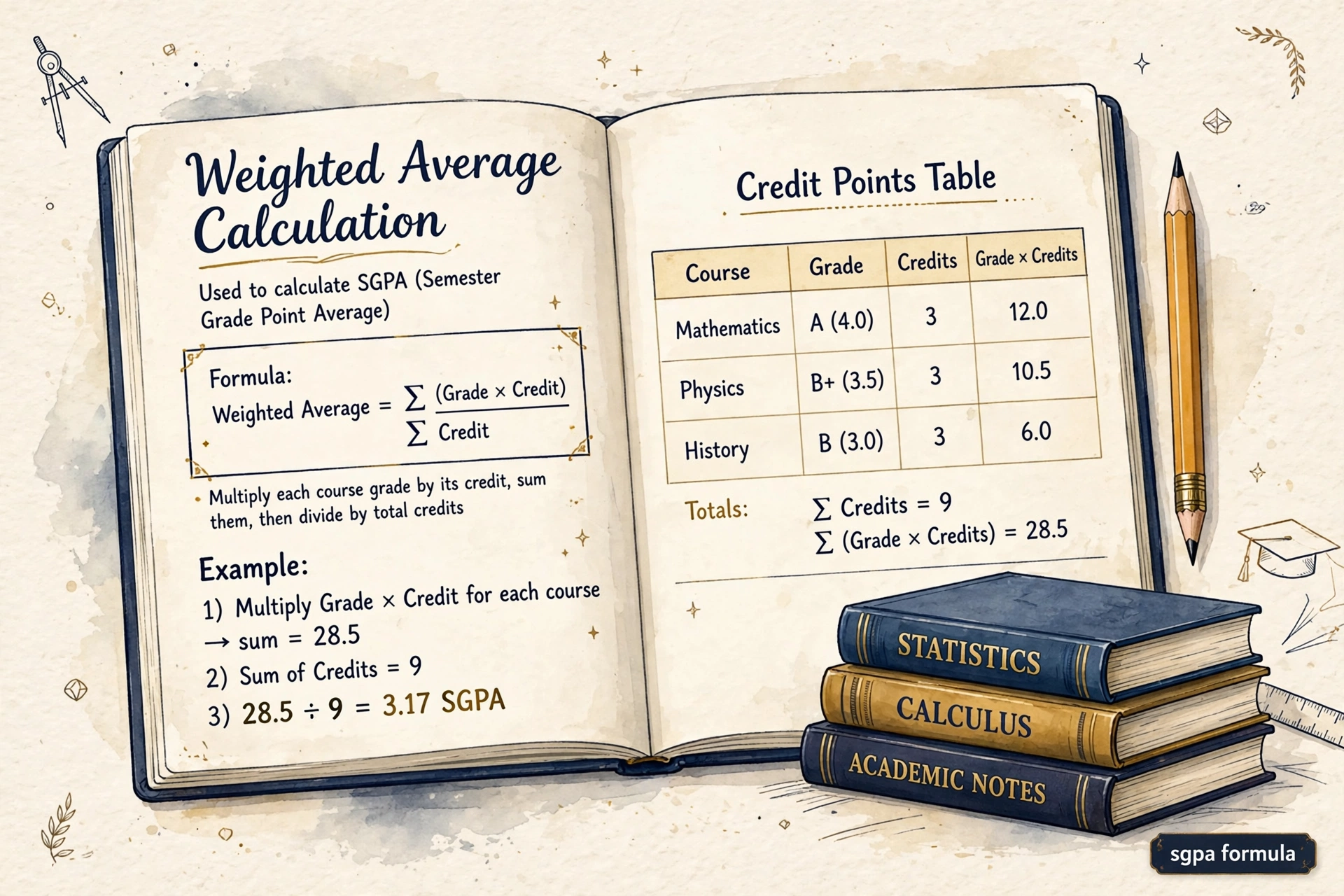
SGPA = (Sum of [Credits × Grade Points] for all subjects) ÷ (Total Credits)
In symbols: SGPA = Σ(Ci × Gi) / ΣCi, where Ci is the credit value of a subject and Gi is the grade point earned in it.
The key insight: each subject contributes in proportion to its credits. A 4-credit core subject moves the SGPA roughly four times as much as a 1-credit lab. Ignore credits, and the answer will be wrong.
What You Need Before You Start: The Three Inputs
Calculating SGPA requires three pieces of information for every subject in the semester:
1. The credit value of each subject
Credits measure a subject’s weight in the semester — roughly reflecting lecture hours, lab hours, and overall importance. A typical engineering semester might have subjects worth 4, 3, 2, or 1 credits. Credit values appear in the syllabus, on the marksheet, or in the university’s course catalog. Core theory subjects usually carry the most credits; labs, tutorials, and electives carry fewer.
2. The grade point earned in each subject
Universities convert marks or letter grades into grade points on (usually) a 10-point scale. The standard UGC-aligned table looks like this:
| Letter Grade | Meaning | Grade Point |
|---|---|---|
| O | Outstanding | 10 |
| A+ | Excellent | 9 |
| A | Very Good | 8 |
| B+ | Good | 7 |
| B | Above Average | 6 |
| C | Average | 5 |
| F | Fail | 0 |
The exact letter-to-point mapping varies by university — some use S/A/B/C/D/E notation, some start A+ at different marks — so students should always use their own institution’s official conversion table. The UGC’s model grading framework, published at ugc.gov.in, is the reference most Indian universities align with.
3. The list of subjects in the semester
Every subject counts, including labs, practicals, tutorials, and electives. A frequent error is leaving out a low-credit subject “because it hardly matters” — it matters a little, and more importantly, leaving it out of the denominator changes the math.
Step-by-Step: How to Calculate SGPA
With the inputs ready, the process has five steps:
Step 1 — List every subject with its credits. Write down each subject and its credit value.
Step 2 — Note the grade point for each subject. Convert each letter grade or marks to grade points using the university’s table.
Step 3 — Multiply credits by grade points for each subject. This gives the “credit points” (sometimes called weighted grade points) per subject.
Step 4 — Add up all the credit points. This is the numerator: the total weighted performance.
Step 5 — Add up all the credits and divide. Total credit points ÷ total credits = SGPA. Round to two decimal places, which is the standard presentation on marksheets.
That is the whole method. The worked examples below show it in action.
Worked Example 1: An Engineering Semester
Consider a student with five subjects:
| Subject | Credits (C) | Grade | Grade Point (G) | C × G |
|---|---|---|---|---|
| Engineering Mathematics | 4 | A | 8 | 32 |
| Physics | 4 | O | 10 | 40 |
| Chemistry | 3 | A+ | 9 | 27 |
| Programming Lab | 2 | B+ | 7 | 14 |
| Workshop Practice | 1 | B | 6 | 6 |
| Total | 14 | — | — | 119 |
SGPA = 119 ÷ 14 = 8.50
Notice how the 4-credit subjects dominate: Mathematics and Physics together contribute 72 of the 119 credit points — over 60% of the result. This is the weighted average at work.
Worked Example 2: An Arts/Commerce Semester
Now a different program with different credit patterns:
| Subject | Credits (C) | Grade | Grade Point (G) | C × G |
|---|---|---|---|---|
| Microeconomics | 5 | A+ | 9 | 45 |
| Business Statistics | 4 | A | 8 | 32 |
| Financial Accounting | 4 | B+ | 7 | 28 |
| Business Communication | 2 | O | 10 | 20 |
| Environmental Studies | 2 | B | 6 | 12 |
| Total | 17 | — | — | 137 |
SGPA = 137 ÷ 17 = 8.06 (137 ÷ 17 = 8.0588…, rounded to two decimals)
Two observations: first, the O grade in a 2-credit subject added only 20 points — a good grade in a small subject cannot rescue weak performance in big ones. Second, rounding follows standard rules: 8.0588 becomes 8.06.
Why SGPA Uses a Weighted Average: The Simple-Average Trap
The single most common SGPA mistake is computing a simple average of grade points. Using Example 1’s grade points (8, 10, 9, 7, 6):
Simple average = (8 + 10 + 9 + 7 + 6) ÷ 5 = 40 ÷ 5 = 8.00
But the correct weighted SGPA is 8.50 — half a point higher. The simple average undervalues this student because it gives the 1-credit Workshop the same influence as 4-credit Mathematics.
The error can go the other way too. A student with strong grades in small subjects and weak grades in large ones will get an inflated number from a simple average — and an unpleasant surprise when the official marksheet arrives. The rule is absolute: credits always weight the average; there are no exceptions.
How to Find Your Credits and Grade Points
Students sometimes stall at Step 1 and 2 because they cannot locate the inputs. Here is where each lives:
- Credits — Printed in the syllabus against each course code, shown on most semester marksheets, and listed in the university’s course catalog or student portal. In CBCS-pattern universities, a typical theory course is 4 credits (3 lectures + 1 tutorial), labs are 1–2 credits.
- Grade points — Derived from the letter grade on the marksheet via the university’s grading table. Some marksheets print the grade point directly next to each grade, which removes all guesswork.
- Theory + practical + tutorial — All three components carry credits and all three count. Tutorials attached to a theory subject are usually bundled into that subject’s credit total rather than listed separately.
If any figure is genuinely unavailable — an elective’s credits, say — the department office or academic section can confirm it in minutes. Guessing at credit values is how wrong SGPAs are born.
What Happens When You Fail a Subject
Failed subjects need special handling in the calculation:
- A failed subject gets a grade point of 0, but its credits still count in the denominator. This is what makes failures so damaging: the subject drags the average down with full weight while contributing nothing.
- Example: adding a failed 4-credit subject (0 points) to Example 1 changes the math to 119 ÷ 18 = 6.61 — a drop of nearly two full points from 8.50.
- Absent (AB) is typically treated like a fail: 0 grade points, credits counted.
- When a backlog is cleared in a later attempt, universities have their own rules for how the improved grade feeds into records — some replace the old entry, some cap the grade. The academic regulations, not this guide, are the authority there.
The practical lesson: from a pure SGPA standpoint, a low passing grade in a high-credit subject hurts far less than a fail. Damage control matters.
SGPA vs CGPA: The Relationship
SGPA and CGPA are related but distinct:
- SGPA covers one semester. It is the building block.
- CGPA (Cumulative Grade Point Average) accumulates all completed semesters.
How exactly SGPAs combine into CGPA depends on the university. Two common methods:
- Simple average of SGPAs — (SGPA₁ + SGPA₂ + … + SGPAₙ) ÷ n. Used when semesters carry equal weight.
- Credit-weighted recomputation — All subjects across all semesters are pooled with their credits, and the SGPA formula is applied to the entire pool. This is more accurate when semesters have different credit totals.
Students tracking their trajectory should know which method their university uses — the two can differ by a few hundredths, which occasionally matters at cutoff boundaries. For running the cumulative numbers, a dedicated CGPA calculator handles either method, and those working on the American 4.0 scale can use a GPA calculator.
There is one more input to SGPA that students underestimate: showing up. Grade points are earned in classrooms as much as in exam halls, and consistent attendance compounds into better understanding, better internal marks, and fewer surprises. The link between the two is explored in the guide to why student attendance percentage matters.
A Quick Mental-Check Method
Before trusting any SGPA figure — self-calculated or portal-generated — run this thirty-second sanity check. First, confirm the total credits look right for the semester (most semesters total between 16 and 24 credits; a total of 9 or 40 signals a data entry problem). Second, glance at the weighted average intuitively: if most credits sit in subjects graded A or above, the SGPA should land near 8 or higher; if the big-credit subjects are B-range, expect something in the 6s or 7s. Third, compare against the previous semester — a swing of more than 1.5 points in either direction deserves a recheck of the inputs, not because it is impossible, but because large swings usually trace back to a misread credit value or a grade point taken from the wrong table. This habit catches the errors that formulas cannot.
7 Common SGPA Calculation Mistakes
- Using a simple average — The classic error. Always weight by credits.
- Forgetting labs and practicals — Every credited component counts, including the 1-credit lab.
- Using another university’s grade table — Letter-to-point mappings differ. Use only the official table.
- Excluding failed subjects from the denominator — Failures count their credits at 0 points. That is precisely why they hurt.
- Mixing SGPA with CGPA — One semester’s figure is not the cumulative figure. Label them correctly.
- Rounding too early — Round only the final SGPA to two decimals, not the intermediate credit-point totals.
- Guessing credit values — A wrong credit on a core subject skews everything. Confirm from the syllabus.
Frequently Asked Questions
What is the formula to calculate SGPA?
SGPA = (Sum of [Credits × Grade Points] for each subject) ÷ (Total Credits). Multiply each subject’s credits by its grade point, add all the results, and divide by the total credits.
What is the difference between SGPA and CGPA?
SGPA measures performance in a single semester, while CGPA accumulates performance across all completed semesters. Each semester’s SGPA is a building block of the running CGPA.
Can I calculate SGPA without credits?
Not accurately. Credits are the weights in the formula, and without them only a simple (and usually wrong) average is possible. Credit values are listed in the syllabus, on the marksheet, or in the student portal.
How do I convert SGPA to percentage?
It depends on the university. Common formulas include SGPA × 9.5 (CBSE-pattern) and (SGPA × 10) − 7.5 (used by some universities). Always use the institution’s official conversion rule.
What happens to SGPA if I fail a subject?
The failed subject contributes 0 grade points but its credits still count in the denominator, which pulls the SGPA down sharply — especially for high-credit subjects.
Is 8 SGPA good?
On the 10-point scale, 8.0 is generally considered strong — it clears most placement eligibility cutoffs and indicates consistent above-average performance. Context matters: cutoffs and classifications vary by institution.
Do elective subjects count in SGPA?
Yes. Every credited subject in the semester — core, elective, lab, tutorial — enters the calculation with its credit weight.


