 Skip to main content


If you have ever typed your age, height, and weight into a calorie calculator and wondered where its answer comes from, here is the open secret: there is no magic inside. Almost every calorie calculator on the internet runs the same two-step math. First it estimates your basal metabolic rate, or BMR. Then it multiplies that number by an activity factor to get your total daily energy expenditure, or TDEE. Once you understand those two steps, you can calculate your TDEE from your BMR by hand, with nothing more than a phone calculator and five spare minutes.
This guide walks through the entire process: what each number means, the exact formulas, worked examples for men and women, how to pick the right activity multiplier, the common mistakes, and what to do with your result. If you would rather skip the arithmetic, you can plug your numbers into this site’s TDEE calculator and get the same answer in seconds.
What TDEE and BMR Mean, in Plain Words
Two acronyms, two very different numbers. Mixing them up is the first mistake most people make, so it is worth getting the definitions straight before any math begins.
BMR: Your Body’s Idle Fuel Burn
Your basal metabolic rate is the number of calories your body would burn in 24 hours if you did absolutely nothing at all — lying still, awake but motionless, in a comfortable room, with digestion at rest. It powers the non-negotiable work of staying alive: your heartbeat, your breathing, your brain activity, your body temperature, and the constant repair of cells and tissues. For most adults, BMR accounts for roughly 60 to 75 percent of all calories burned in a day, which is exactly why every TDEE calculation starts here.
TDEE: Your Full-Day Fuel Burn
Your total daily energy expenditure is the complete picture. It starts with BMR and adds everything else your body does: walking to the bus, fidgeting at your desk, digesting lunch, carrying groceries, and your evening workout. TDEE is the number that matters for real life, because nobody lies motionless for 24 hours. If you eat exactly your TDEE in calories day after day, your weight stays roughly stable. Eat consistently less and you lose weight; eat consistently more and you gain.
The Core Formula: TDEE = BMR × Activity Multiplier
The entire calculation fits on a single line:
TDEE = BMR × activity multiplier
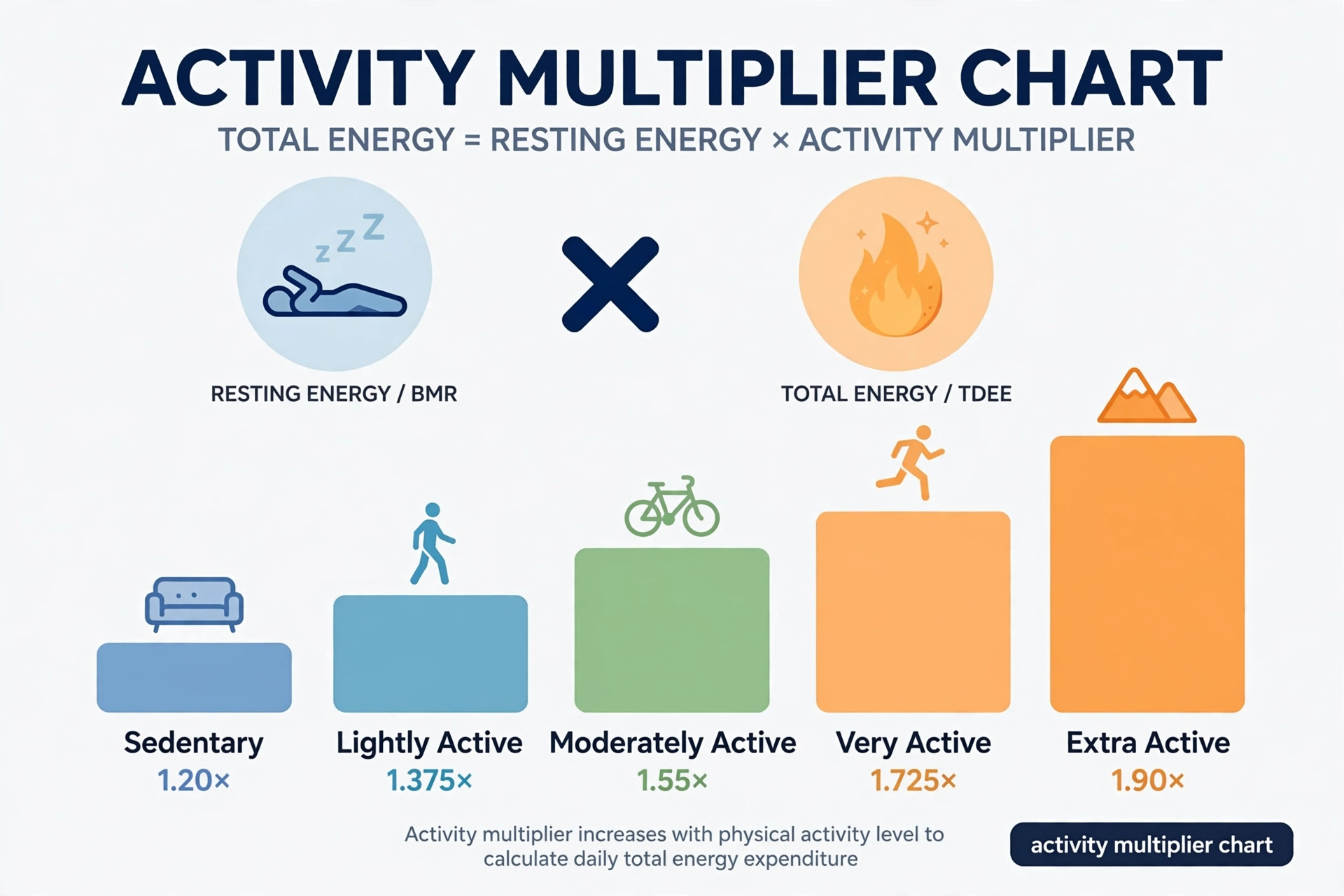
The activity multiplier is a number between 1.2 and 1.9 that represents how active your lifestyle is. A desk worker who never exercises uses 1.2; a nurse who is on her feet all day and trains most evenings might use 1.725. Everything else falls somewhere in between.
Step 1: Calculate Your BMR With the Mifflin-St Jeor Equation
Researchers have proposed several BMR formulas over the decades, but the one dietitians and modern calculators trust most is the Mifflin-St Jeor equation, published in 1990 and later validated as the most accurate option for the general population. It needs just four inputs: weight in kilograms, height in centimeters, age in years, and biological sex. Healthline’s detailed guide to calculating basal metabolic rate walks through the same equation with extra context on what the numbers mean for everyday health.
The Formula for Men
Men: BMR = (10 × weight in kg) + (6.25 × height in cm) − (5 × age in years) + 5
The result is in calories per day.
The Formula for Women
Women: BMR = (10 × weight in kg) + (6.25 × height in cm) − (5 × age in years) − 161
The only difference is the final constant: plus 5 for men, minus 161 for women, reflecting average differences in muscle mass and body composition.
Worked Example: A 30-Year-Old Man
Let us run the numbers for a hypothetical example: a 30-year-old man who weighs 80 kg and is 180 cm tall.
- 10 × 80 = 800
- 6.25 × 180 = 1,125
- 5 × 30 = 150
- BMR = 800 + 1,125 − 150 + 5 = 1,780 calories per day
His body burns about 1,780 calories daily just keeping him alive — before a single step, weight lifted, or meal digested.
Worked Example: A 28-Year-Old Woman
Now a 28-year-old woman who weighs 65 kg and is 165 cm tall:
- 10 × 65 = 650
- 6.25 × 165 = 1,031.25
- 5 × 28 = 140
- BMR = 650 + 1,031.25 − 140 − 161 = 1,380 calories per day (rounded)
Step 2: Pick the Right Activity Multiplier
This is the step that causes more errors than the formula itself. The standard activity multipliers, used by nearly every calculator, are:
| Activity level | Multiplier | What it describes |
|---|---|---|
| Sedentary | 1.2 | Desk job, little or no exercise |
| Lightly active | 1.375 | Light exercise 1–3 days per week |
| Moderately active | 1.55 | Moderate exercise 3–5 days per week |
| Very active | 1.725 | Hard exercise 6–7 days per week |
| Extra active | 1.9 | Very hard training plus a physical job |
How to Choose Honestly: The Step Most People Get Wrong
Here is the uncomfortable truth: most people overestimate their activity level, often by a full category. Three gym sessions a week on top of a desk job is lightly active, not very active. A practical rule of thumb is to pick one level lower than your first instinct, live with it for two or three weeks while tracking your weight, and adjust from there. Your multiplier should describe your average week, rest days included — not your best week, and not the week you are planning to have once you get motivated.
Step 3: Multiply Your BMR by the Activity Factor
The final step is simple multiplication. Take the BMR from Step 1 and multiply it by the activity factor from Step 2.
Continuing the earlier examples:
- The 30-year-old man with a BMR of 1,780, who exercises moderately four days a week: 1,780 × 1.55 = 2,759 calories per day. His TDEE is roughly 2,760.
- The 28-year-old woman with a BMR of 1,380, who is lightly active: 1,380 × 1.375 = 1,898 calories per day (rounded).
A Full Worked Example From Scratch
One more complete calculation, start to finish, to lock in the method. Consider a 45-year-old woman who weighs 70 kg, is 170 cm tall, works a desk job, and walks briskly three times a week.
Step 1 — BMR: (10 × 70) + (6.25 × 170) − (5 × 45) − 161 = 700 + 1,062.5 − 225 − 161 = 1,376.5 calories (about 1,377).
Step 2 — activity multiplier: brisk walking three times a week with a desk job is lightly active, so the multiplier is 1.375.
Step 3 — TDEE: 1,377 × 1.375 = 1,893 calories per day (rounded) — her maintenance level.
If You Know Your Body Fat: The Katch-McArdle Option
The Mifflin-St Jeor equation uses total body weight, which means it can misjudge people at the extremes — the very muscular or the very lean. If you know your body fat percentage from a reliable measurement (a DEXA scan or a skilled caliper test, not a bathroom scale’s estimate), the Katch-McArdle formula uses lean body mass instead:
BMR = 370 + (21.6 × lean body mass in kg), where lean mass = weight × (1 − body fat ÷ 100)
For example, an 85 kg man at 15% body fat has 72.25 kg of lean mass, giving a BMR of 370 + (21.6 × 72.25) = 1,931 calories — noticeably higher than Mifflin-St Jeor would estimate for him, because muscle is metabolically expensive to maintain. Once you have the BMR, the TDEE step is identical: multiply by your activity factor.
7 Mistakes That Wreck TDEE Calculations
Small errors compound fast. These are the seven that show up most often:
- Confusing BMR with TDEE. Your BMR is not a calorie target. Eating at your BMR while living a normal active life creates an accidental deficit of several hundred calories.
- Choosing too high an activity multiplier. This is the number-one error. When in doubt, round down and adjust based on real weight trends.
- Mixing up units. The formula needs kilograms and centimeters. Pounds and inches must be converted first: divide pounds by 2.205 to get kilograms, and multiply inches by 2.54 to get centimeters.
- Forgetting to recalculate after weight change. A smaller body burns fewer calories. Recalculate every time your weight shifts by about 5 kg, or your “maintenance” number will quietly become a surplus.
- Treating the result as exact. Every BMR equation is an estimate with a margin of error around 10%. Your true TDEE is the number at which your weight stays stable over several weeks.
- Using BMR as the base for a deficit. Fat-loss calories should be subtracted from TDEE, not from BMR. Subtracting 500 from BMR instead of TDEE can push intake dangerously low.
- Changing the multiplier every week. Pick a level, hold it steady for three weeks, watch the scale trend, and only then adjust. Constant tweaking just adds noise.
What to Do With Your TDEE Number
A TDEE figure sitting on a notepad changes nothing. Here is how to put it to work for the three most common goals.
For Fat Loss
Subtract 300 to 500 calories from your TDEE. That range typically produces a loss of about 0.5% of body weight per week — fast enough to see progress, slow enough to preserve muscle.
For Muscle Gain
Add 200 to 300 calories to your TDEE. This lean surplus supports new muscle growth while limiting fat gain.
For Weight Maintenance
Eat at roughly your TDEE. Track your weight for a few weeks: if the trend line is flat, your calculated TDEE matches your real one. If it creeps up or down, nudge your intake by 100 to 200 calories and watch again.
When to Recalculate Your TDEE
Recalculate when your weight changes by about 5 kg in either direction, when your activity pattern changes meaningfully (a new job, a new training program, an injury), or every eight to twelve weeks as a routine check. If you train regularly, tracking your workout attendance percentage alongside your weight trend can reveal whether missed sessions — not miscalculated calories — are behind a plateau. Students juggling gym goals with coursework may find that exam-season sedentariness quietly lowers their expenditure — and the same site that hosts the calorie math also offers a GPA calculator for keeping the academic side of life on track.
Frequently Asked Questions
Can I calculate TDEE from BMR without knowing my activity level?
Not accurately. The activity multiplier is half the equation, and guessing it wrong by one category can shift your TDEE by 200 to 300 calories. If you truly have no idea, start with the sedentary multiplier of 1.2, track your weight for three weeks, and adjust upward if you are losing weight unintentionally.
Is the Mifflin-St Jeor equation accurate?
For the general population, validation studies have found it the most accurate of the common BMR equations, usually landing within about 10% of lab-measured values. It is less reliable for the very muscular, the very lean, the elderly, and the obese, where alternatives like Katch-McArdle earn their keep.
Why does my fitness tracker show a different TDEE?
Trackers estimate burn from movement sensors and heart rate, and their algorithms vary widely in quality. They are useful for day-to-day trends but are often off by 15 to 25% on absolute numbers. The formula method gives you a steadier baseline; trust the scale trend most.
Should I eat back the calories I burn exercising?
Generally no, at least not at first. Your activity multiplier already includes your exercise, so adding exercise calories on top double-counts them. If you consistently feel drained or your performance drops, add 100 to 200 calories and reassess rather than trying to chase exact burn figures.
How is TDEE different from maintenance calories?
They are the same thing in practice. Maintenance calories are simply the calories that maintain your weight, and TDEE is the estimated number of calories you burn — so eating at TDEE maintains weight by definition. The terms are used interchangeably in most fitness and nutrition writing.
How often should I recalculate my TDEE?
Every eight to twelve weeks as routine maintenance, or sooner if your weight changes by about 5 kg or your activity pattern changes significantly.


