 Skip to main content



Anyone who has tried to plan meals around a fitness goal has run into the same question: how many calories does the body actually need each day? Guessing leads to frustration — eating too little stalls energy and workouts, eating too much stalls fat loss. The Harris Benedict calculator answers that question with a number grounded in one of the oldest and most studied equations in nutrition science.
This guide walks through exactly how to use a Harris Benedict calculator: what each input means, how the tool computes results behind the scenes, how to read the numbers it returns, and how to turn those numbers into a practical eating plan. The focus here is on using the tool well, not on the history of the equation itself.
What a Harris Benedict Calculator Actually Does
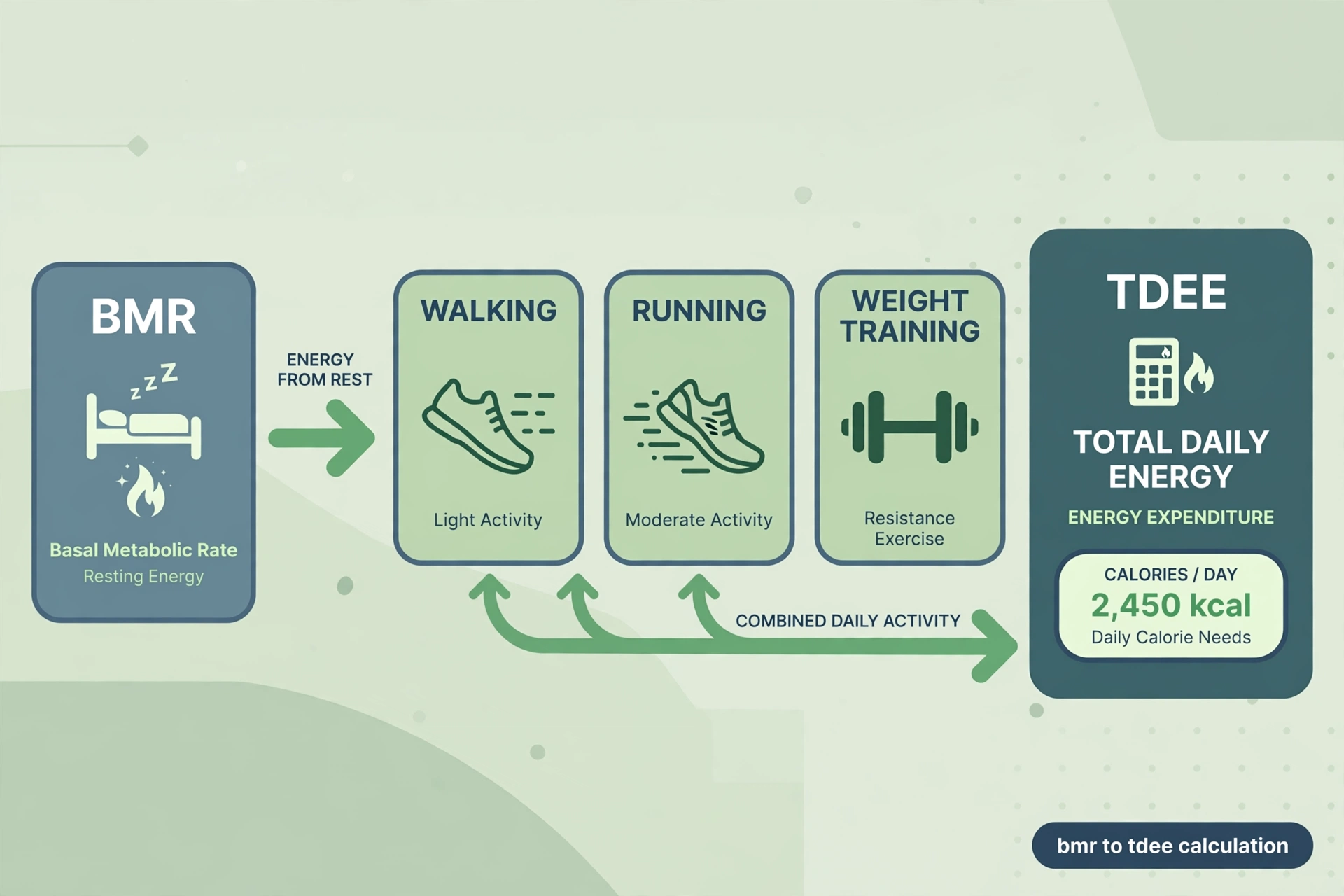
A Harris Benedict calculator takes five personal inputs — sex, age, height, weight, and activity level — and returns two numbers: basal metabolic rate (BMR) and total daily energy expenditure (TDEE).
BMR is the number of calories the body burns at complete rest in a day, just keeping the lungs breathing, the heart beating, and the brain running. TDEE is the bigger, more useful number: BMR plus everything burned through daily movement and exercise. TDEE is the maintenance line — eat at it and weight stays roughly stable, eat below it and weight trends down, eat above it and weight trends up.
The calculator uses the revised Harris-Benedict equations (the 1984 Roza-Shizgal revision, which most modern tools default to) rather than the original 1919 version. Readers who want the companion tool that works directly from these numbers can use the site’s TDEE calculator after finishing this walkthrough.
The 5 Inputs the Calculator Needs
Every Harris Benedict calculator asks for the same five things. Entering them accurately is the difference between a useful estimate and a misleading one.
1. Sex
The equations differ for men and women because average body composition differs. Most calculators offer male and female options. Selecting the correct one matters — the two formulas can produce results several hundred calories apart for the same height and weight.
2. Age
Age is entered in years. Metabolism gradually slows with age, mainly because muscle mass tends to decline, so the equation subtracts a small amount per year. Entering an accurate age keeps the estimate honest; rounding by a decade either way shifts the result more than most people expect.
3. Height
Height can usually be entered in centimeters or in feet and inches. Precision matters less here than with weight, but it should still be a real measurement rather than a guess from years ago. One inch of error changes BMR by roughly 5 calories — small, but it adds up alongside other rounding.
4. Weight
Weight is the most influential input. It can be entered in kilograms or pounds, and it should be a current morning weight, measured after waking and before eating, for consistency. Because the equation multiplies weight by a coefficient above 9 (for women) or 13 (for men), every kilogram of error moves the BMR estimate by 9–13 calories.
5. Activity Level
This is where most users go wrong. The calculator offers five standard levels, and choosing honestly is critical:
- Sedentary — little or no exercise, desk job, minimal daily movement.
- Lightly active — light exercise or sports 1–3 days per week.
- Moderately active — moderate exercise or sports 3–5 days per week.
- Very active — hard exercise or sports 6–7 days per week.
- Extra active — very hard daily exercise, physical labor, or training twice a day.
The classic mistake is selecting “moderately active” for three casual gym sessions, or “very active” for a job that involves standing. When in doubt, users should pick the lower level — it is easier to adjust upward after two weeks of tracking than to wonder why the estimate overshoots.
Step-by-Step: Running Your First Calculation
Using the calculator takes about a minute. Here is the exact sequence:
- Select sex. Choose the option that matches the equation the user wants applied.
- Enter age in years. Type the current age as a whole number.
- Enter height. Use centimeters or feet/inches, whichever the tool accepts, and double-check the unit toggle — this is the most common unit mistake.
- Enter weight. Use kilograms or pounds, again verifying the unit toggle matches the number typed.
- Choose activity level. Pick the description that best matches a typical week, erring toward the lower option if between two.
- Click calculate. The tool displays BMR and TDEE instantly, often with a breakdown of calorie targets for weight loss, maintenance, and weight gain.
That is the whole interaction. The value of this guide is in everything around it: understanding what the tool computed, and what to do with the answer.
The Formulas Working Behind the Button
Curious users often want to know what the calculator did with their numbers. The revised Harris-Benedict equations are:
For men: BMR = 88.362 + (13.397 × weight in kg) + (4.799 × height in cm) − (5.677 × age in years)
For women: BMR = 447.593 + (9.247 × weight in kg) + (3.098 × height in cm) − (4.330 × age in years)
Once BMR is computed, the calculator multiplies it by the activity factor to get TDEE:
| Activity Level | Multiplier |
|---|---|
| Sedentary | BMR × 1.2 |
| Lightly active | BMR × 1.375 |
| Moderately active | BMR × 1.55 |
| Very active | BMR × 1.725 |
| Extra active | BMR × 1.9 |
So TDEE = BMR × activity multiplier. A BMR of 1,700 with a moderately active lifestyle gives a TDEE of 1,700 × 1.55 = 2,635 calories per day. Authoritative explainers of these formulas, such as Healthline’s guide to the Harris-Benedict equation, confirm the same structure and multipliers used across reputable calculators.
Worked Example 1: Moderately Active Man
Consider a 30-year-old man, 180 cm tall, weighing 75 kg, exercising moderately 4 days a week.
Step 1 — BMR: BMR = 88.362 + (13.397 × 75) + (4.799 × 180) − (5.677 × 30) BMR = 88.362 + 1,004.775 + 863.82 − 170.31 BMR = 1,786.65 calories/day
Step 2 — TDEE: TDEE = 1,786.65 × 1.55 = 2,769 calories/day
The calculator would report BMR ≈ 1,787 and TDEE ≈ 2,769. To maintain weight, he eats around 2,769 calories. For gradual fat loss, a common approach is TDEE minus 300–500 calories, or roughly 2,270–2,470 per day.
Worked Example 2: Lightly Active Woman
Consider a 45-year-old woman, 165 cm tall, weighing 68 kg, walking and doing light yoga 2 days a week.
Step 1 — BMR: BMR = 447.593 + (9.247 × 68) + (3.098 × 165) − (4.330 × 45) BMR = 447.593 + 628.796 + 511.17 − 194.85 BMR = 1,392.71 calories/day
Step 2 — TDEE: TDEE = 1,392.71 × 1.375 = 1,915 calories/day
Her maintenance line is about 1,915 calories. Notice how much the activity multiplier matters: had she selected “moderately active,” the tool would have returned 2,158 — a 243-calorie difference from one dropdown choice. That gap is larger than most snacks, which is why honest activity selection is the highest-leverage input.
How to Read the Results Page
Most Harris Benedict calculators display more than two numbers. Here is how to interpret each section:
- BMR — the at-rest baseline. Useful as a sanity check and as the foundation for everything else, but not a daily eating target on its own.
- TDEE — the maintenance calorie target. This is the headline number for meal planning.
- Weight-loss target — usually TDEE minus 15–20%, or TDEE minus 500 calories. Sustainable fat loss typically aims for 0.5–1% of body weight per week.
- Weight-gain target — usually TDEE plus 10–15%, aimed at lean muscle gain with minimal fat gain.
- Per-goal breakdowns — some tools split targets into mild, moderate, and aggressive rates of change.
Users should treat these as starting estimates, not prescriptions. The right move is to eat at the suggested target for two to three weeks, track weight trend and energy, and then adjust by 100–200 calories based on what actually happens.
Turning TDEE Into a Daily Eating Plan
A calorie target only works if it survives contact with real meals. Three practices make the number usable:
- Anchor protein first. Whatever the calorie target, setting protein around 1.6–2.2 grams per kilogram of body weight supports muscle and satiety during fat loss and provides the building material during muscle gain.
- Track for two weeks before judging. Daily weight fluctuates with water, glycogen, and meal timing. The weekly average trend is the signal; any single day is noise.
- Adjust in small steps. If weight is not moving after two consistent weeks, shift intake by 150–200 calories rather than making dramatic cuts. Large cuts are harder to sustain and more likely to cost muscle.
People juggling academic schedules alongside fitness goals sometimes find it useful to think of calorie planning the way students plan study targets — for instance, the same structured approach used to calculate an attendance percentage works for tracking weekly calorie adherence: actual versus target, expressed as a percentage.
6 Common Input Mistakes That Skew Results
- Wrong unit toggle. Typing pounds into a kilograms field (or inches into centimeters) produces wildly wrong BMRs. Always verify the unit before calculating.
- Overstated activity. The most frequent error. A desk worker who lifts three times a week is lightly active, not very active.
- Outdated weight. Using a weight from months ago instead of a current morning weight shifts every downstream number.
- Ignoring body composition. Two people at the same height and weight can have different metabolic rates if one carries much more muscle. Very muscular or very lean users should treat the estimate as a starting point and adjust from real-world tracking.
- Recalculating daily. BMR and TDEE are planning numbers, not daily diagnostics. Recomputing after every meal creates noise, not insight.
- Treating the result as medical advice. The calculator estimates energy needs for healthy adults. People with metabolic conditions, hormonal disorders, or specific medical nutrition needs should work with a qualified professional rather than relying on a formula alone.
When to Recalculate Your Numbers
The estimate has a shelf life. Users should run the calculator again when:
- Body weight changes by more than about 5% in either direction.
- Activity level genuinely changes — a new training program, a switch from desk work to physical work, or an injury that reduces movement.
- Age ticks into a new decade, since the age term slowly lowers BMR over time.
- A fat-loss phase stalls for more than three weeks despite consistent tracking, which may mean the old TDEE no longer matches the new, lighter body.
A quarterly recalculation is a sensible rhythm for most people: often enough to stay accurate, infrequent enough to avoid obsessing over the numbers.
Harris-Benedict vs. Other Calculator Methods
Users sometimes notice different calculators giving different TDEEs for identical inputs. That happens because tools may use different equations — Mifflin-St Jeor, Katch-McArdle, or Cunningham, each with its own assumptions. The Harris-Benedict calculator remains popular because its inputs are simple (no body-fat percentage required) and its estimates have been validated across decades of use.
For most healthy adults, the differences between reputable equations are smaller than the error introduced by misjudging activity level. Picking one equation, entering honest inputs, and adjusting from real-world results beats calculator-hopping every time. Students tracking fitness alongside academics can also use the grade and GPA calculator to keep coursework on track.
Frequently Asked Questions
What does a Harris Benedict calculator tell you?
It estimates two numbers from five inputs (sex, age, height, weight, activity level): basal metabolic rate, the calories burned at rest, and total daily energy expenditure, the calories needed to maintain current weight.
Is the Harris-Benedict equation accurate?
For healthy adults it is a well-validated estimate, typically within about 10–15% of lab-measured metabolic rate. The 1984 revised version used by modern calculators is more accurate for contemporary populations than the 1919 original.
Which activity level should be selected?
Users should choose the description matching a genuinely typical week and round down when torn between two levels. Overestimating activity is the single most common reason calculator results overshoot real calorie needs.
How often should the calculation be repeated?
Recalculation makes sense after meaningful weight change, a real shift in activity level, or a fat-loss plateau lasting several weeks. Quarterly recalculation suits most people.
Can the calculator be used for weight loss planning?
Yes. Subtracting roughly 300–500 calories from the TDEE gives a moderate fat-loss target. Users should track the weight trend for two to three weeks and then fine-tune, rather than treating the first number as final.
Does the calculator work for athletes?
It provides a reasonable starting estimate, but very muscular individuals may burn more than the formula predicts because the equation does not account for body composition. Athletes should adjust based on performance and weight trends.
Why do different Harris Benedict calculators show slightly different results?
Some tools use the original 1919 coefficients while others use the revised 1984 coefficients, and rounding conventions differ. Sticking with one trusted calculator and adjusting from real-world tracking matters more than the small differences between tools.


