 Skip to main content


APJ Abdul Kalam Technological University (KTU) — Kerala Technological University to most students — runs one of India’s most searched grading systems. Every semester, thousands of KTU students look for a KTU calculator to convert their subject grades into SGPA, combine semester SGPAs into CGPA, and turn that CGPA into a percentage for placements and applications. The formulas are not difficult, but KTU’s grade table has quirks (S, A+, FE, Ab) that generic calculators mishandle.
This guide is the general KTU calculator reference: the complete grade table, the SGPA and CGPA formulas with worked examples, the percentage conversion (including the honest answer to the x10 versus (CGPA-0.75)x10 debate), scheme-change notes, and what each grade really means for a student’s record. For the reverse-direction math, the site’s CGPA calculator handles cumulative figures on any scale.
What Is a KTU Calculator?
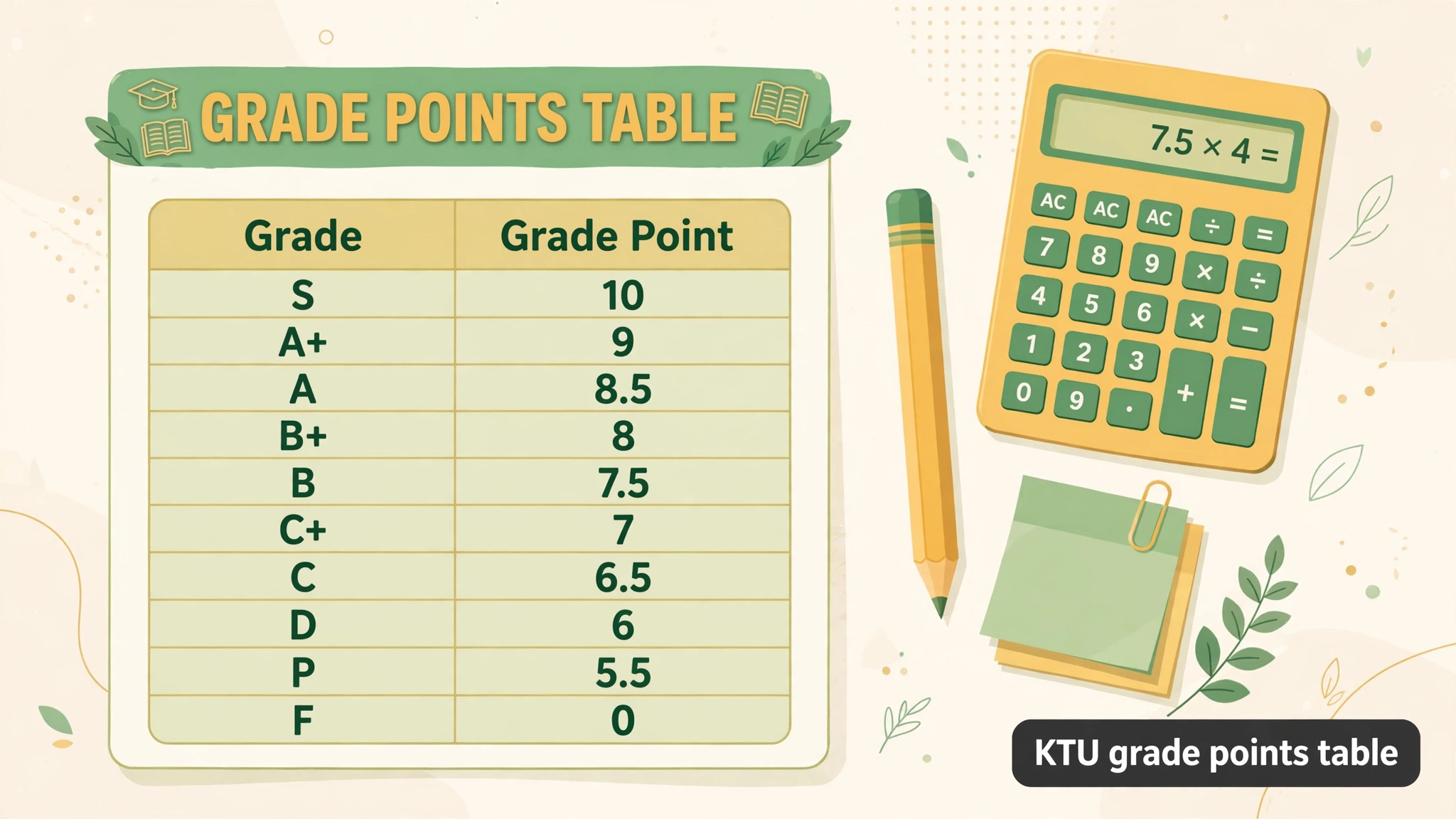
A KTU calculator is a grade calculator configured for KTU’s specific rules: its letter grades (S through F, plus FE and Ab), its grade-point values (S = 10 down to P = 5.5), its credit-weighted SGPA and CGPA formulas, and its percentage conversion. A generic SGPA tool that assumes A = 10 or uses a different grade ladder will silently produce wrong KTU numbers.
In practice, “KTU calculator” usually means three calculators in one: an SGPA calculator for a single semester, a CGPA calculator combining all completed semesters, and a percentage converter for the final figure. This guide covers all three, in the order students actually need them.
The KTU Grading System: Complete Grade Table
KTU grades each course on a letter scale mapped to grade points. CIE is Continuous Internal Evaluation and ESE is the End Semester Examination; the final grade reflects the combined assessment.
| Grade | Grade Point | Marks Range |
|---|---|---|
| S | 10 | 90% and above |
| A+ | 9.0 | 85% to below 90% |
| A | 8.5 | 80% to below 85% |
| B+ | 8.0 | 75% to below 80% |
| B | 7.5 | 70% to below 75% |
| C+ | 7.0 | 65% to below 70% |
| C | 6.5 | 60% to below 65% |
| D | 6.0 | 55% to below 60% |
| P | 5.5 | 50% to below 55% |
| F (Fail) | 0.0 | Below 50% overall (CIE + ESE), or below 40% in ESE |
| FE | 0.0 | Failed due to eligibility criteria not met, or failed in CIE-only courses |
| Ab | 0.0 | Absent from ESE (deferred or absent but meeting eligibility) |
Two things stand out. First, only S earns a full 10 — KTU reserves the top grade point for 90%+ performance, unlike systems where A = 10. Second, the failing grades carry real consequences beyond a zero: F, FE, and Ab each signal a different kind of failure (academic, eligibility, or absence), and students must understand which one appears on their record.
How to Calculate KTU SGPA
SGPA (Semester Grade Point Average) covers one semester. The formula:
SGPA = Sum of (Grade points x Credits) for all courses / Total credits in the semester
Worked example — a semester with five courses:
| Course | Credits | Grade | Grade Point | Credits x GP |
|---|---|---|---|---|
| Mathematics | 4 | A | 8.5 | 34.0 |
| Physics | 3 | B+ | 8.0 | 24.0 |
| Chemistry | 3 | C+ | 7.0 | 21.0 |
| English | 2 | S | 10.0 | 20.0 |
| Programming Lab | 3 | B | 7.5 | 22.5 |
Total grade points = 34 + 24 + 21 + 20 + 22.5 = 121.5. Total credits = 4 + 3 + 3 + 2 + 3 = 15. SGPA = 121.5 / 15 = 8.1.
Note how the S in the small 2-credit English course contributes less than the A in 4-credit Mathematics. Credit weighting is the whole game: a strong grade in a heavy course outweighs a perfect grade in a light one. Students planning effort around SGPA should always rank courses by credits first.
How to Calculate KTU CGPA
CGPA (Cumulative Grade Point Average) combines every completed semester, weighted by each semester’s total credits. It is not a simple average of SGPAs:
CGPA = Sum of (SGPA x Semester credits) for all semesters / Total credits completed
Worked example — three semesters:
| Semester | SGPA | Credits | SGPA x Credits |
|---|---|---|---|
| 1 | 7.5 | 18 | 135.0 |
| 2 | 8.0 | 20 | 160.0 |
| 3 | 7.0 | 16 | 112.0 |
Total = 135 + 160 + 112 = 407. Total credits = 18 + 20 + 16 = 54. CGPA = 407 / 54 = 7.54.
A simple average of the three SGPAs would give 7.5 — close here, but the gap widens when semesters carry very different credit loads or when one semester is much stronger than the others. Always weight by credits.
KTU CGPA to Percentage: The Official Method
KTU’s commonly cited conversion is the direct one:
Percentage = CGPA x 10
The student from the CGPA example: 7.54 x 10 = 75.4%. Clean, simple, and widely published as KTU’s recommended method across university guidance pages and official calculator references.
The x10 vs (CGPA – 0.75) x 10 Confusion, Resolved Honestly
Students researching this topic will find some sources claiming KTU uses Percentage = (CGPA – 0.75) x 10, the formula associated with VTU and Anna University. This guide will not pretend the disagreement does not exist — but here is the honest resolution:
- KTU’s own widely published guidance and most KTU-specific references use CGPA x 10.
- The (CGPA – 0.75) x 10 formula is the UGC-recommended conversion under the Choice Based Credit System, documented in the UGC’s CBCS framework at ugc.gov.in, and officially used by VTU and Anna University — not KTU.
- Some third-party KTU calculators apply the UGC formula, which is where the confusion comes from.
The practical rule: use x10 for KTU unless the student’s own marksheet, transcript, or the current KTU academic regulations state otherwise. When a placement form or application asks for the conversion formula, writing “CGPA x 10 (KTU)” alongside the number removes all ambiguity. And if any official KTU document contradicts this, the document wins — regulations evolve, and the university’s current text is always the final authority.
2019 Scheme vs 2024 Scheme: What Students Should Know
KTU periodically revises its academic regulations, and students must calculate under the scheme they were admitted to. The 2019 scheme and the newer 2024 scheme differ in curriculum structure, course groupings, and some evaluation details. The core SGPA/CGPA mathematics — credit-weighted grade-point averaging — carries over, but grade definitions, pass criteria, and the treatment of specific course types can shift between schemes.
Three practical consequences follow. First, never mix grade tables across schemes: confirm which scheme’s regulation document governs the student’s batch. Second, when using any KTU calculator tool, check which scheme it implements — tools built for the 2019 scheme may mis-handle 2024-scheme course structures. Third, for anything the regulation leaves ambiguous (the exact percentage conversion wording, for instance), the scheme-specific academic handbook for the student’s admission year is the document that settles it.
What Counts: CIE, ESE, and the F / FE / Ab Grades
Understanding the three zero-grades prevents nasty surprises:
- F (Fail) means the student did not meet the passing standard: below 50% in the combined CIE + ESE total, or below 40% in the ESE alone. The course must be repeated or cleared per regulations, and it contributes 0.0 grade points.
- FE means failure rooted in eligibility — the student did not meet attendance or CIE requirements to even qualify properly, or failed in a CIE-only course. It also carries 0.0, but it signals a process failure rather than purely an academic one.
- Ab means absent from the ESE — the student deferred the exam or was absent while still meeting eligibility criteria. It records 0.0 for the semester’s calculation but leaves the door open differently than an F.
The FE grade is the one that ties grades to attendance most directly: students who fall short of KTU’s attendance eligibility can end up with FE grades regardless of how well they might have performed. Grade calculators compute numbers; eligibility rules decide whether the student gets to use them.
What Is a Good CGPA at KTU?
KTU’s degree classifications give the answer in the university’s own terms: First Class is typically awarded at a CGPA of 6.0 and above. In practical placement terms, recruiters in Kerala’s engineering circuit commonly treat 7.0+ as comfortable, 7.5+ as strong, and 8.5+ as excellent — though cutoffs vary by company and year.
Two things matter more than the raw number. First, the trajectory: a CGPA rising from 6.8 to 8.2 across semesters tells a better story than a flat 7.6. Second, backlogs: a high CGPA with uncleared F grades is weaker than a slightly lower CGPA with a clean record. Employers read transcripts, not just the headline number.
Students comparing across systems — say, a KTU CGPA against a friend’s 4.0-scale GPA — should use a grade GPA calculator set to the correct scale for each side rather than eyeballing the conversion.
KTU Attendance and Exam Eligibility: The Other Half of the Record
KTU enforces attendance eligibility for appearing in end-semester examinations, and this is where many students’ calculator-perfect plans fall apart. Falling below the required attendance threshold can produce FE grades — zeros that no SGPA formula can rescue after the fact.
The defense is the same monthly tracking discipline this site’s attendance guides teach: mark every day, watch the monthly percentage, and never let the semester figure be a surprise. The detailed rules, condonation provisions, and recovery math are covered in the guide to what the 75 percent attendance rule means for colleges. For KTU students, grades and attendance are not two separate topics — the FE grade fuses them into one.
Frequently Asked Questions
What is the formula for KTU SGPA?
SGPA = Sum of (Grade points x Credits) for all courses in the semester / Total semester credits. Use KTU’s grade table (S = 10, A+ = 9, A = 8.5, B+ = 8, B = 7.5, C+ = 7, C = 6.5, D = 6, P = 5.5, F/FE/Ab = 0).
How is KTU CGPA calculated?
CGPA = Sum of (SGPA x Semester credits) for all completed semesters / Total credits completed. It is a credit-weighted average, not a simple average of SGPAs.
How do I convert KTU CGPA to percentage?
KTU’s commonly cited method is Percentage = CGPA x 10. A 7.54 CGPA becomes 75.4%. Confirm against the student’s marksheet or current KTU regulations, as some third-party tools apply the UGC-style (CGPA – 0.75) x 10 formula instead.
What is the difference between F, FE, and Ab grades at KTU?
F is academic failure (below passing marks). FE is failure tied to eligibility — attendance or CIE requirements not met, or failure in CIE-only courses. Ab records absence from the ESE while meeting eligibility. All three carry 0.0 grade points.
Is 7.5 a good CGPA in KTU?
Yes. First Class starts at 6.0, and 7.5 sits comfortably above it — generally considered strong for placements. 8.5+ is excellent.
Does the 2024 scheme change how SGPA is calculated?
The core credit-weighted formula carries over, but students must use the regulation document for their admission scheme. Grade definitions and evaluation details can differ between the 2019 and 2024 schemes.
Can I use a generic SGPA calculator for KTU?
Only if it lets you enter KTU’s exact grade-point values. Generic tools that assume A = 10 or use a different grade ladder will compute wrong KTU SGPAs. Always verify the grade table the tool uses.


