 Skip to main content


Every year, thousands of students stare at a marksheet showing 87 percent and wonder what that means on a GPA scale. Universities abroad ask for GPA, scholarships ask for GPA, and application forms rarely explain how to convert percentage to GPA correctly. The honest answer is that there is more than one method, and the right one depends on which scale the receiving institution uses. This guide covers every major method, shows worked examples, and explains when not to convert at all.
The Quick Answer: How to Convert Percentage to GPA
The fastest method is the proportional formula:
GPA = (Percentage / 100) x maximum GPA
On the common 4.0 scale, that becomes GPA = Percentage / 25. So 80 percent becomes 3.2, and 92 percent becomes 3.68. This is the method most conversion guides start with — but it is not the only one, and some universities prefer a different approach, which this guide covers in full below.
Why Students Need Percentage-to-GPA Conversion
Most Indian schools and many institutions across Asia, Africa, and the Middle East report results as percentages. Meanwhile, the United States, Canada, and parts of Europe report academic performance on GPA scales — usually 4.0, sometimes 5.0 or 10.0. When a student applies to a foreign university, a scholarship program, or an international employer, someone on the other side needs both numbers to speak the same language.
Conversion also matters for self-assessment. A student with 76 percent might not realize that is roughly a 3.0 on a 4.0 scale — a perfectly respectable number that meets the minimum requirement of many graduate programs. Knowing the conversion removes a lot of unnecessary anxiety from the application process.
Method 1: The Proportional Formula (Most Common)
The proportional method assumes a straight-line relationship between percentage and GPA. It is the simplest approach and the one most online calculators use.
GPA = (Percentage / 100) x Scale Maximum
Worked examples on the 4.0 scale:
- 95 percent: (95 / 100) x 4.0 = 3.8
- 82 percent: (82 / 100) x 4.0 = 3.28
- 70 percent: (70 / 100) x 4.0 = 2.8
- 58 percent: (58 / 100) x 4.0 = 2.32
The same formula adapts to any scale. On a 5.0 scale, multiply by 5 instead of 4: 82 percent becomes (82 / 100) x 5.0 = 4.1. On a 10.0 scale, it becomes 8.2 — which, not coincidentally, is how percentage relates to the 10-point CGPA systems used in India.
The proportional method is quick and transparent, which is why it dominates. Its weakness is that it treats every percentage point identically, while real grading systems often do not — the difference between 89 and 90 percent can matter more than the difference between 79 and 80.
Method 2: The Grade-Band Method (Letter Grades First)
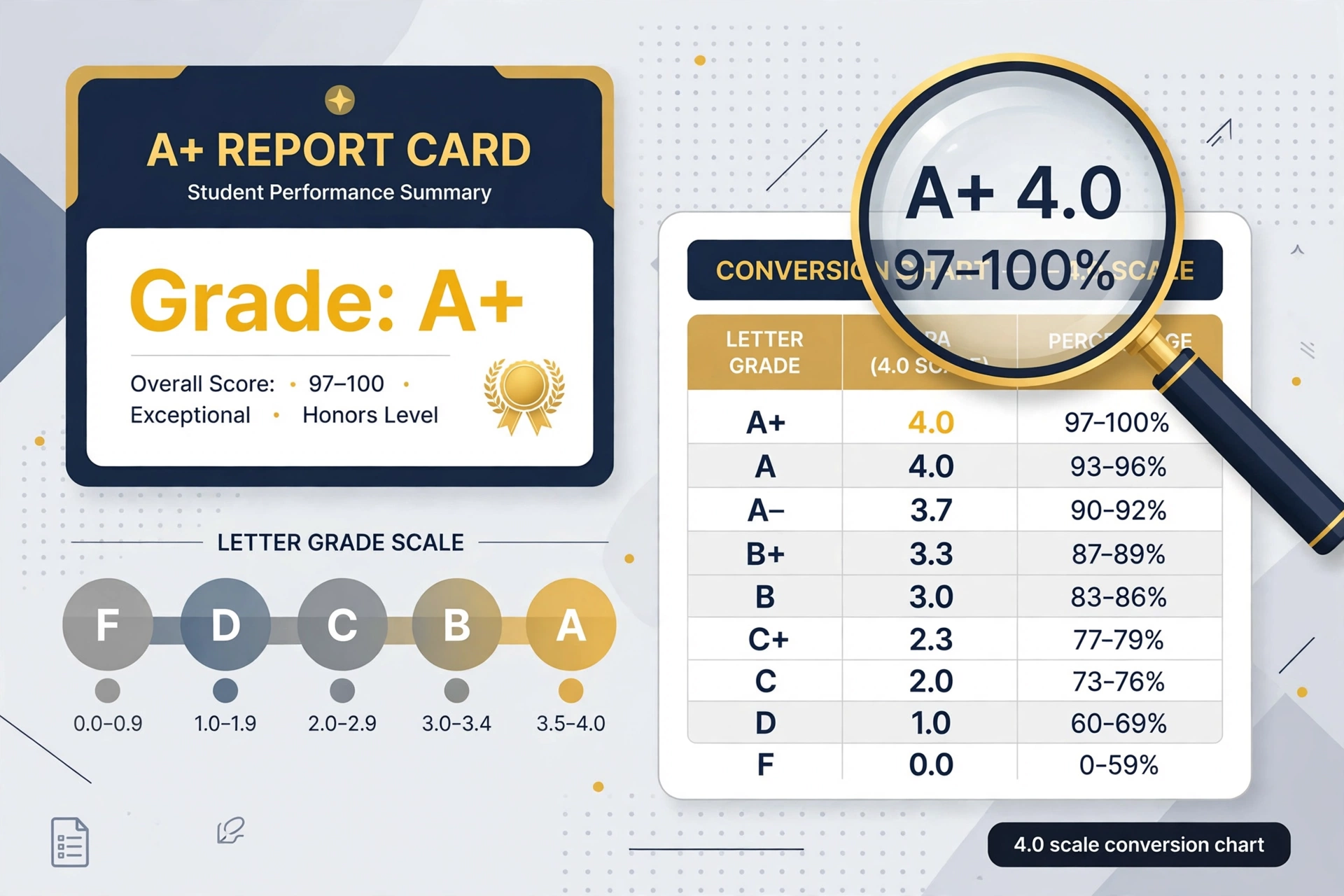
Many US high schools and universities do not convert raw percentages directly. Instead, they map percentage ranges to letter grades first, and then map letter grades to GPA values. A typical band table looks like this:
| Percentage Range | Letter Grade | GPA (4.0 scale) |
|---|---|---|
| 93-100 | A | 4.0 |
| 90-92 | A- | 3.7 |
| 87-89 | B+ | 3.3 |
| 83-86 | B | 3.0 |
| 80-82 | B- | 2.7 |
| 77-79 | C+ | 2.3 |
| 73-76 | C | 2.0 |
| 70-72 | C- | 1.7 |
| 67-69 | D+ | 1.3 |
| 65-66 | D | 1.0 |
| Below 65 | F | 0.0 |
Notice how this method can produce a different answer from the proportional formula. Under the proportional method, 89 percent equals 3.56. Under the grade-band method, 89 percent is a B+, which equals 3.3. That gap matters on applications, which is why students should always check which method the receiving institution prefers before converting.
Some institutions use a simpler band structure without plus and minus grades:
| Percentage Range | Grade Point |
|---|---|
| 90-100 | 4.0 |
| 80-89 | 3.0 |
| 70-79 | 2.0 |
| 60-69 | 1.0 |
| Below 60 | 0.0 |
This coarser version is common in quick-reference guides, though it is less precise.
Method 3: Converting to the 10-Point Scale (Indian GPA)
Indian students converting for domestic purposes — or explaining their scores to someone familiar with the Indian system — usually need the 10-point scale rather than the 4.0 scale. The standard CBSE-derived conversion is:
GPA (10-point) = Percentage / 9.5
So 85 percent becomes 8.95 on the 10-point scale, and 93.1 percent becomes 9.8. This is the reverse of the well-known CGPA-to-percentage formula (Percentage = CGPA x 9.5), and it comes from the CBSE’s finding that the average score of students in the top grade band sits near 95 percent.
Some universities use a straight division by 10 instead (85 percent = 8.5 GPA). Students should confirm which multiplier their institution uses — 9.5 is the CBSE convention, but it is not universal.
The (Percentage / 20) – 1 Shortcut
A lesser-known shortcut for the 4.0 scale circulates in student forums:
GPA = (Percentage / 20) – 1
For 89 percent: (89 / 20) – 1 = 4.45 – 1 = 3.45. This formula is mathematically equivalent to the proportional method shifted slightly, and it produces reasonable results for percentages between roughly 60 and 100. It is a handy mental-math trick, but for official purposes the standard proportional formula is the safer choice because it is the one most institutions recognize.
Conversion Table: Percentage to GPA at a Glance
For quick reference, here is the proportional conversion on the 4.0 scale alongside the 10-point scale:
| Percentage | GPA (4.0) | GPA (10-point) |
|---|---|---|
| 95 | 3.80 | 10.0 |
| 90 | 3.60 | 9.47 |
| 85 | 3.40 | 8.95 |
| 80 | 3.20 | 8.42 |
| 75 | 3.00 | 7.89 |
| 70 | 2.80 | 7.37 |
| 65 | 2.60 | 6.84 |
| 60 | 2.40 | 6.32 |
| 55 | 2.20 | 5.79 |
| 50 | 2.00 | 5.26 |
Students can also cross-check their results with a GPA calculator to make sure the converted number lines up with their actual grade points.
Weighted vs. Unweighted GPA: What Changes
So far this guide has dealt with unweighted GPA, where every course counts equally. Many high schools also report weighted GPA, which adds extra points for honors, AP, or advanced courses — often on a 5.0 scale instead of 4.0.
Converting a percentage to a weighted GPA is trickier because the weighting rules differ by school. A common approach: convert the percentage to unweighted GPA first, then add the school’s weighting bonus (often +0.5 or +1.0 for advanced courses, averaged across the transcript). Students should never invent a weighted GPA for an application — if the school does not provide one, report the unweighted conversion and let the admissions office do its own weighting.
What Counts as a “Good” Converted GPA?
Context turns a number into a meaning. On the 4.0 scale:
- 3.7 and above (roughly 92%+): excellent — competitive for top graduate programs
- 3.3 to 3.6 (roughly 82-90%): strong — meets most program minimums comfortably
- 3.0 to 3.2 (roughly 75-80%): solid — meets the minimum for many US graduate schools
- 2.5 to 2.9 (roughly 62-72%): below the typical 3.0 cutoff for competitive programs
- Below 2.5: weak for graduate admissions, though work experience can compensate
These are rough benchmarks, not rules. Admissions decisions weigh test scores, statements of purpose, recommendations, and experience alongside grades.
Common Percentage-to-GPA Mistakes
Using the wrong scale. Converting to a 4.0 scale when the university asked for the 10-point scale (or vice versa) is the most common error. Always read the application instructions first.
Mixing methods mid-application. Reporting a proportional 3.56 on one form and a grade-band 3.3 on another creates inconsistency that can raise questions. Pick one method and stick with it.
Converting when told not to. Many universities explicitly instruct international applicants to report grades exactly as they appear on the transcript. In that case, converting is not helpful — it is disobedient. If the form says “report as printed,” report as printed.
Rounding aggressively. A 3.24 is not a 3.3, and admissions offices notice inflated rounding. Round to two decimal places at most, and round honestly.
Forgetting about the UGC framework. Indian students should know that the University Grants Commission recommends a 10-point grading system for higher education, with letter grades from O (Outstanding, 10 points) down through A+, A, B+, B, C, and P (Pass, 4 points). The official UGC guidelines describe this structure in detail, and it is the authoritative reference when anyone questions the 10-point scale.
When Should You Not Convert at All?
Conversion is a convenience, not a requirement. Skip it when the application explicitly asks for original grades, when the university does its own credential evaluation (many use services like WES), or when the conversion would misrepresent the result — for example, when a percentage reflects a particularly tough grading curve that a flat formula cannot capture. In those cases, attach the transcript and, if possible, a grading-scale explanation from the school.
Frequently Asked Questions
How do I convert 75% to GPA?
Using the proportional formula on the 4.0 scale: (75 / 100) x 4.0 = 3.0. On the 10-point scale: 75 / 9.5 = 7.89.
What is 85% in GPA?
Proportionally, 85 percent equals 3.4 on the 4.0 scale. Under the grade-band method, 85 percent is a B, which equals 3.0. The method matters — check which one the institution uses.
Is percentage divided by 25 the correct GPA formula?
Percentage / 25 is exactly the proportional formula for the 4.0 scale, since (Percentage / 100) x 4 simplifies to Percentage / 25. It is correct for proportional conversion but does not replicate grade-band systems.
How do I convert percentage to GPA on a 10-point scale?
Divide the percentage by 9.5, following the CBSE convention. For example, 90 percent becomes 9.47. Some institutions use division by 10 instead, so confirm with the specific university.
Do US universities accept self-converted GPA?
Many do for initial screening, but competitive programs often re-evaluate transcripts themselves or require a professional credential evaluation. Self-conversion is an estimate — label it as such and never alter the underlying grades.
What GPA do I need to study abroad?
It varies widely, but many US graduate programs set a 3.0 minimum on the 4.0 scale (roughly 75 percent proportionally). Top programs often expect 3.5 or higher. Always check the specific program’s published requirements.
Can I convert my GPA back to percentage?
Yes — just reverse the formula. On the 4.0 scale: Percentage = GPA x 25. On the 10-point scale: Percentage = GPA x 9.5. The site’s CGPA calculator and the main calculator homepage can help verify conversions in both directions.
A Final Word on Converting Percentage to GPA
Percentage-to-GPA conversion looks like simple arithmetic, but the method chosen changes the answer — and the answer changes how an application reads. The safest approach is a short checklist: identify the scale the institution wants, use the method it recognizes, keep the math transparent, and never convert when the form asks for original grades. Done that way, a converted GPA becomes a useful bridge between two grading worlds rather than a source of confusion. Double-checking the result with a calculator and keeping a copy of the conversion steps alongside the application keeps everything clean and defensible.


