 Skip to main content


Every semester ends the same way: the result arrives as an SGPA — say 8.5 — and then a placement form, a scholarship application, or a postgraduate portal asks for a percentage instead. Converting SGPA to percentage is a two-minute job once the right formula is known, but using the wrong formula is one of the most common grade errors students make. This guide covers the standard conversion formula, why it differs from the CGPA formula, the university-specific variants, a full reference table, and the mistakes to avoid.
What SGPA Is (and Is Not)
SGPA stands for Semester Grade Point Average. It measures academic performance for a single semester, calculated as the credit-weighted average of grade points earned across that semester’s subjects:
SGPA = Σ (Grade Points × Credits) ÷ Σ Credits
A subject with more credits pulls the SGPA more than a light subject — which is why two students with the same letter grades can have different SGPAs. SGPA is not the same as CGPA: CGPA averages performance across all semesters of the degree, while SGPA covers just one. And neither is a percentage. Percentage is simply marks out of 100 — a different scale that recruiters, government forms, and foreign universities still demand. That demand is the whole reason conversion exists.
The Standard Formula: Percentage = (SGPA × 10) − 7.5
For most Indian universities following UGC-aligned grading, the official conversion is:
Percentage = (SGPA × 10) − 7.5
So an SGPA of 8.5 becomes (8.5 × 10) − 7.5 = 85 − 7.5 = 77.5%. An SGPA of 9.0 becomes 82.5%, and 7.0 becomes 62.5%. Students who want to verify the semester math behind their grades can cross-check with this site’s GPA calculator before converting.
Why 7.5? Where the Formula Comes From
The 7.5 offset is not arbitrary. Under the UGC’s choice-based credit system, grade points map to marks bands, and the formula was calibrated so that the conversion reproduces the percentage a student would most plausibly have earned. In effect, (SGPA × 10) stretches the 10-point scale to 100, and subtracting 7.5 corrects for the fact that grade bands start above zero — a student with the minimum passing grade points does not have 50%+ marks. The UGC’s official guidelines lay out the grading framework this conversion is built on.
SGPA vs CGPA: Why the Formulas Differ
This is the single biggest source of conversion errors. CGPA-to-percentage most commonly uses CGPA × 9.5 (the CBSE convention), while SGPA-to-percentage uses (SGPA × 10) − 7.5. They are different formulas because they come from different authorities and different grading designs — the 9.5 factor belongs to the school-board world, the −7.5 offset to the UGC university framework.
The practical consequence: applying the CGPA formula to an SGPA of 8.5 gives 80.75%, but the correct university conversion gives 77.5% — a 3.25-point overstatement. On a placement form with a 75% cutoff, that error is the difference between eligible and rejected. Students should always match the formula to the quantity: SGPA gets the −7.5 formula; CGPA gets whatever the degree-awarding university publishes (often ×9.5). The CGPA calculator on this site handles the cumulative side of the same problem. Side by side, the two conversions look like this:
| SGPA | CGPA | |
|---|---|---|
| Covers | One semester | The entire degree |
| Standard formula | (SGPA × 10) − 7.5 | CGPA × 9.5 (CBSE convention) |
| 8.5 becomes | 77.5% | 80.75% |
| Set by | UGC-aligned university rules | Board / university convention |
Step-by-Step Conversion With Worked Examples
The process, done by hand:
- Note the SGPA from the semester marksheet — for example, 8.4.
- Multiply by 10: 8.4 × 10 = 84.
- Subtract 7.5: 84 − 7.5 = 76.5%.
Two more, to build the habit:
- SGPA 7.2 → 72 − 7.5 = 64.5%
- SGPA 9.3 → 93 − 7.5 = 85.5%
The arithmetic is trivial; the only real decision is confirming the university uses this formula (next section) rather than one of its variants.
University-Wise Conversion Rules
Several major universities publish their own SGPA conversions. The differences look small on paper, but across a degree they decide eligibility for cutoffs, scholarships, and higher-education applications. The table below shows the most widely used:
| University | Formula | 8.0 SGPA becomes |
|---|---|---|
| AKTU, JNTU, Osmania (UGC standard) | (SGPA × 10) − 7.5 | 72.5% |
| VTU | (SGPA − 0.75) × 10 | 72.5% |
| Savitribai Phule Pune University | (SGPA − 0.75) × 10 | 72.5% |
| Mumbai University | SGPA × 9.5 | 76.0% |
| Anna University | (SGPA × 10) − 7.5 | 72.5% |
Note that VTU’s (SGPA − 0.75) × 10 is algebraically identical to (SGPA × 10) − 7.5 — just written differently. Mumbai University is the genuine outlier with its ×9.5 rule. When in doubt, the examination regulations or the back of the marksheet settle it.
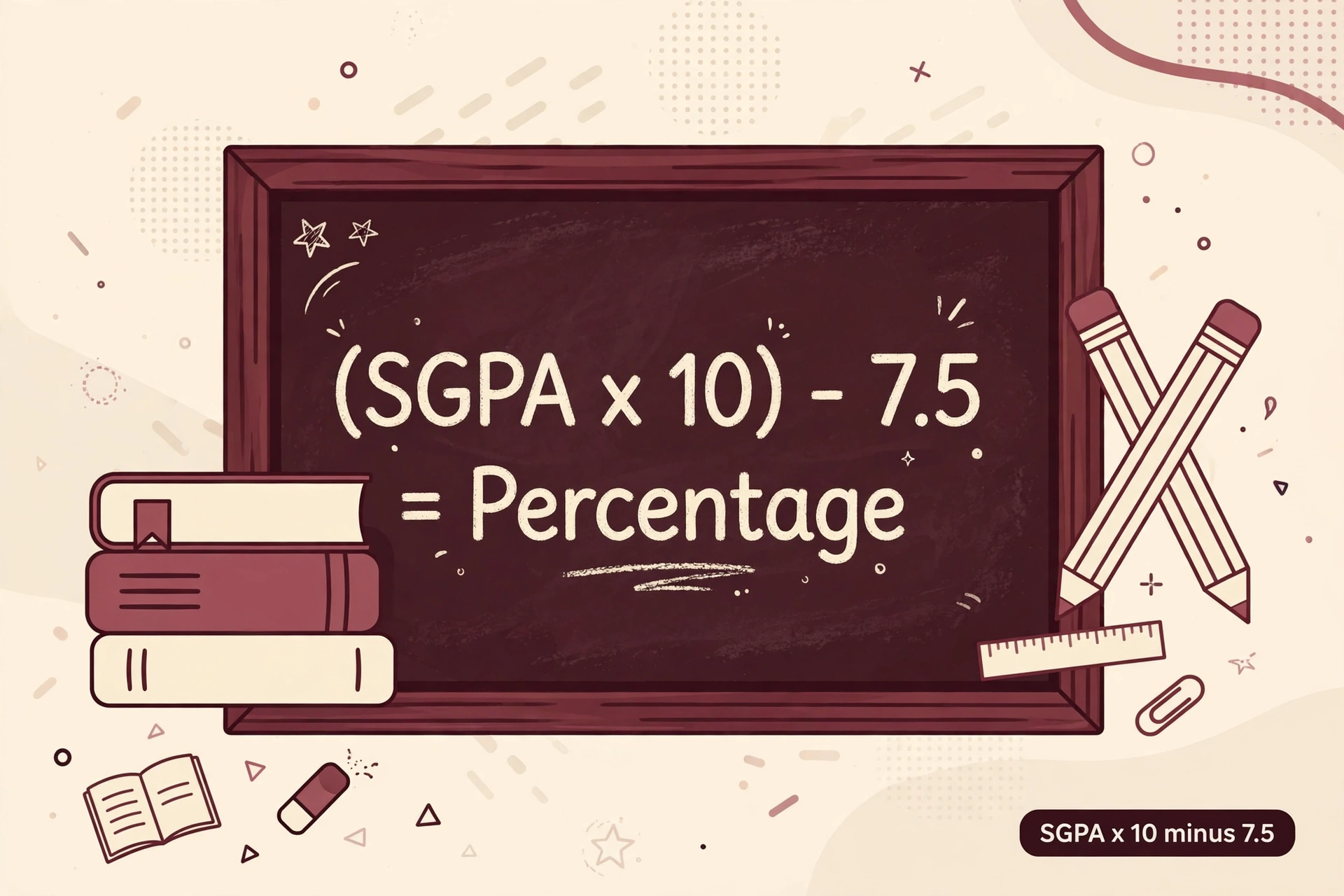
The standard UGC-aligned formula: multiply SGPA by 10, then subtract 7.5.
Full SGPA to Percentage Conversion Table
Quick reference using the standard (SGPA × 10) − 7.5 formula:
| SGPA | Percentage | Performance band |
|---|---|---|
| 10.0 | 92.5% | Outstanding |
| 9.5 | 87.5% | Excellent |
| 9.0 | 82.5% | Excellent |
| 8.5 | 77.5% | Very good |
| 8.0 | 72.5% | Very good |
| 7.5 | 67.5% | Good |
| 7.0 | 62.5% | Good |
| 6.5 | 57.5% | Average |
| 6.0 | 52.5% | Average |
| 5.5 | 47.5% | Pass |
| 5.0 | 42.5% | Pass |
Each full point of SGPA is worth exactly 10 percentage points — a convenient mental shortcut.
A Full Worked Example: From Subject Grades to Percentage
Seeing the whole chain — grades to SGPA to percentage — removes any mystery. Take a semester with five subjects:
| Subject | Credits | Grade | Grade Points | Credit Points |
|---|---|---|---|---|
| Mathematics | 4 | A+ | 9 | 36 |
| Physics | 4 | A | 8 | 32 |
| Chemistry | 3 | A+ | 9 | 27 |
| English | 2 | B+ | 7 | 14 |
| Lab | 2 | O | 10 | 20 |
| Total | 15 | 129 |
SGPA = 129 ÷ 15 = 8.6. Convert: (8.6 × 10) − 7.5 = 86 − 7.5 = 78.5%.
Notice how the 4-credit subjects dominate: the A+ in Mathematics (36 credit points) matters more than the O in the 2-credit lab (20 credit points). This is why SGPA rewards focus on high-credit subjects — and why the percentage that comes out the other end is only as meaningful as the credit weighting behind it.
Converting Back: Percentage to SGPA
Sometimes the reverse is needed — a form gives a percentage cutoff and the student wants the SGPA equivalent. Rearranging the formula:
SGPA = (Percentage + 7.5) ÷ 10
A 75% placement cutoff becomes (75 + 7.5) ÷ 10 = 8.25 SGPA. A 60% cutoff becomes 6.75 SGPA. This reverse check is handy for setting semester targets: it tells the student exactly what SGPA they must hit to clear the percentage bar recruiters set.
When You Actually Need the Conversion
Three situations drive almost all SGPA-to-percentage conversions:
- Campus placements. Recruiters like TCS, Infosys, and Wipro historically set 60%+ cutoffs and ask for percentages on application forms, not SGPAs. Converting correctly determines eligibility.
- Higher education. MBA programs, MTech admissions, and especially study-abroad applications require percentage-format academics. Foreign credential evaluators expect the university’s official conversion, not a guess.
- Government and PSU jobs. SSC, banking, and public-sector applications ask for percentage marks in qualifying degrees.
In all three cases, the converted figure should follow the university’s official formula, and students should keep the regulation or conversion certificate handy in case it is questioned.
Common Mistakes to Avoid
Using the CGPA ×9.5 formula for SGPA. The most frequent error, and it inflates the result by several points.
Converting SGPA when CGPA is asked for. Some forms ask for aggregate performance across the degree — that is CGPA, converted with the university’s CGPA rule, not the semester SGPA.
Averaging semester percentages. To get an overall percentage across semesters, do not average the converted percentages — average the underlying credits and grade points (i.e., compute CGPA first), then convert once.
Rounding mid-calculation. Convert with full precision, then round the final percentage to whatever the form requires.
Ignoring the university variant. Mumbai University students using the standard formula undersell themselves by 3.5 points; standard-formula students using Mumbai’s rule oversell. Match the formula to the university.
Trusting a random online converter. Many generic converters default to ×9.5 or ×10 without asking which university awarded the SGPA. A converter that does not ask for the university is not authoritative — use the formula from the university’s own regulations.
Forgetting revaluation updates. If a revaluation changes a subject grade after the SGPA is issued, the converted percentage changes too. Recompute before using the figure on any new form.
Tips to Keep Your SGPA (and Percentage) High
Conversion only reports performance; the performance itself comes from the semester’s habits. Credit-weighted subjects deserve proportional effort — a 4-credit core subject moves the SGPA twice as much as a 2-credit elective. A practical rhythm helps: convert the SGPA to percentage at the end of every semester and log it alongside the SGPA itself. Over four years, that log becomes the academic record most forms actually ask for — and spotting a downward trend in semester three leaves time to fix it before placements. Small, consistent habits (weekly revision, attempting every internal assessment, clearing doubts early) compound across semesters exactly the way credit points compound within one. Consistent class engagement matters twice over: it drives understanding and protects internal assessment marks, and students can explore the student calculators hub on this site to keep both grades and attendance math under control through the term.
Frequently Asked Questions
What is the formula to convert SGPA to percentage?
The standard UGC-aligned formula is Percentage = (SGPA × 10) − 7.5. Multiply the SGPA by 10 and subtract 7.5. Always confirm the university does not publish its own variant first.
What is 8.5 SGPA in percentage?
Using the standard formula: (8.5 × 10) − 7.5 = 77.5%. Under Mumbai University’s ×9.5 rule it would be 80.75% — another reason to check the university’s official formula.
Is SGPA to percentage conversion the same as CGPA to percentage?
No. SGPA typically converts with (SGPA × 10) − 7.5, while CGPA most commonly converts with CGPA × 9.5 under the CBSE convention (though universities vary). Mixing them up is the most common conversion error.
Which universities use a different SGPA formula?
Mumbai University uses SGPA × 9.5. VTU and Savitribai Phule Pune University use (SGPA − 0.75) × 10, which is mathematically the same as the standard formula. Most other Indian universities follow the standard (SGPA × 10) − 7.5.
How do I convert percentage back to SGPA?
Use SGPA = (Percentage + 7.5) ÷ 10. A 75% cutoff equals 8.25 SGPA — useful for setting semester targets against recruiter cutoffs.
Do employers accept converted percentages?
Yes, provided the conversion follows the degree-awarding university’s official formula. Keep the university’s conversion regulation or certificate available; some verification processes ask for it.
What SGPA do I need for a 75% placement cutoff?
Using the reverse formula, SGPA = (75 + 7.5) ÷ 10 = 8.25. A student targeting recruiters with a 75% cutoff should aim for an SGPA of at least 8.25 each semester — a concrete, plannable target.


