 Skip to main content


Students of Savitribai Phule Pune University quickly discover that converting an SGPA into a percentage is not as simple as multiplying by 10. SPPU uses its own official, range-based conversion formulas — published in a university circular — where the formula itself changes depending on which SGPA bracket a student falls into. Using the wrong formula, or a generic one borrowed from another university, produces a percentage that will not match the official record.
This guide lays out SPPU’s official SGPA-to-percentage formulas exactly as the university defines them, with worked examples for every grade bracket, the complete SPPU grading and class-award tables, and clear answers to the questions students ask most: which formula applies to their SGPA, how SGPA conversion differs from CGPA conversion, and when a formal conversion certificate is needed.
SGPA to Percentage SPPU: The Quick Answer
SPPU converts SGPA to percentage using official range-based formulas, not a single multiplier. The formula depends on the SGPA bracket:
| SGPA Range | Formula | Grade |
|---|---|---|
| 9.50 and above | Percentage = 20 × SGPA − 100 | O |
| 8.25 to 9.49 | Percentage = 12 × SGPA − 25 | A+ |
| 6.75 to 8.24 | Percentage = 10 × SGPA − 7.5 | A |
| 5.75 to 6.74 | Percentage = 5 × SGPA + 26.25 | B+ |
| 5.25 to 5.74 | Percentage = 10 × SGPA − 2.5 | B |
| 4.75 to 5.24 | Percentage = 10 × SGPA − 2.5 | C |
| 4.00 to 4.74 | Percentage = 6.6 × SGPA + 13.6 | D/P |
The method: find which row the SGPA falls into, then apply that row’s formula. An SGPA of 8.20, for instance, sits in the 6.75–8.24 bracket, so the percentage is 10 × 8.20 − 7.5 = 74.5%.
Why SPPU Uses Range-Based Formulas Instead of One Multiplier
Most students expect a single conversion like “multiply by 10” because that is how several other Indian universities do it. SPPU’s approach is more precise: each formula is a straight-line segment calibrated so that the percentage curve stays continuous across grade boundaries. In plain terms, the university designed the pieces to join up smoothly — an SGPA at the top of one bracket converts to nearly the same percentage as an SGPA at the bottom of the next.
This piecewise design also mirrors how SPPU awards grades. Because each grade band (O, A+, A, and so on) covers a different SGPA width, a single multiplier would distort percentages at the extremes — overstating them for top scorers and understating them near the pass mark. The range-based system keeps every student’s converted percentage proportional to where they actually sit on the grading scale. Students converting grades under other universities’ systems can use a general CGPA calculator that handles multiple conversion conventions.
How to Convert SGPA to Percentage: Step-by-Step
Converting an SGPA takes three steps and about thirty seconds:
Step 1: Note the exact SGPA. Use the figure printed on the official grade card, keeping two decimal places. Rounding the SGPA before converting can push it into the wrong bracket near a boundary.
Step 2: Find the correct SGPA bracket. Compare the SGPA against the ranges in the table above. Boundary values belong to the higher bracket — for example, an SGPA of exactly 9.50 uses the O-grade formula (20 × SGPA − 100), and exactly 8.25 uses the A+ formula.
Step 3: Apply the bracket’s formula. Substitute the SGPA and compute. Keep one decimal place in the answer, which is the standard presentation on most application forms.
A handy sanity check: the percentage should always rise as the SGPA rises, and it should land between roughly 40% (at SGPA 4.00) and 100% (at SGPA 10.00). Anything outside that range signals an arithmetic slip or the wrong bracket.
Worked Examples for Every SGPA Bracket
SGPA 9.80 (O bracket): 20 × 9.80 − 100 = 196 − 100 = 96.0%. A near-perfect semester converts to a near-perfect percentage, as expected.
SGPA 9.00 (A+ bracket): 12 × 9.00 − 25 = 108 − 25 = 83.0%. Note how the A+ formula gives a lower percentage than a flat ×10 would — this is the calibration at work.
SGPA 8.20 (A bracket): 10 × 8.20 − 7.5 = 82 − 7.5 = 74.5%. This is the most common bracket for strong students, and the formula here is the simplest to remember.
SGPA 7.50 (A bracket): 10 × 7.50 − 7.5 = 75 − 7.5 = 67.5%. A first-class SGPA converts to a percentage in the high sixties.
SGPA 6.00 (B+ bracket): 5 × 6.00 + 26.25 = 30 + 26.25 = 56.25%. The B+ bracket uses the gentlest slope of all the formulas.
SGPA 5.00 (C bracket): 10 × 5.00 − 2.5 = 50 − 2.5 = 47.5%. Near the pass region, every tenth of an SGPA point moves the percentage by a full point.
SGPA 4.50 (D/P bracket): 6.6 × 4.50 + 13.6 = 29.7 + 13.6 = 43.3%. The lowest bracket’s formula keeps the percentage anchored just above 40%.
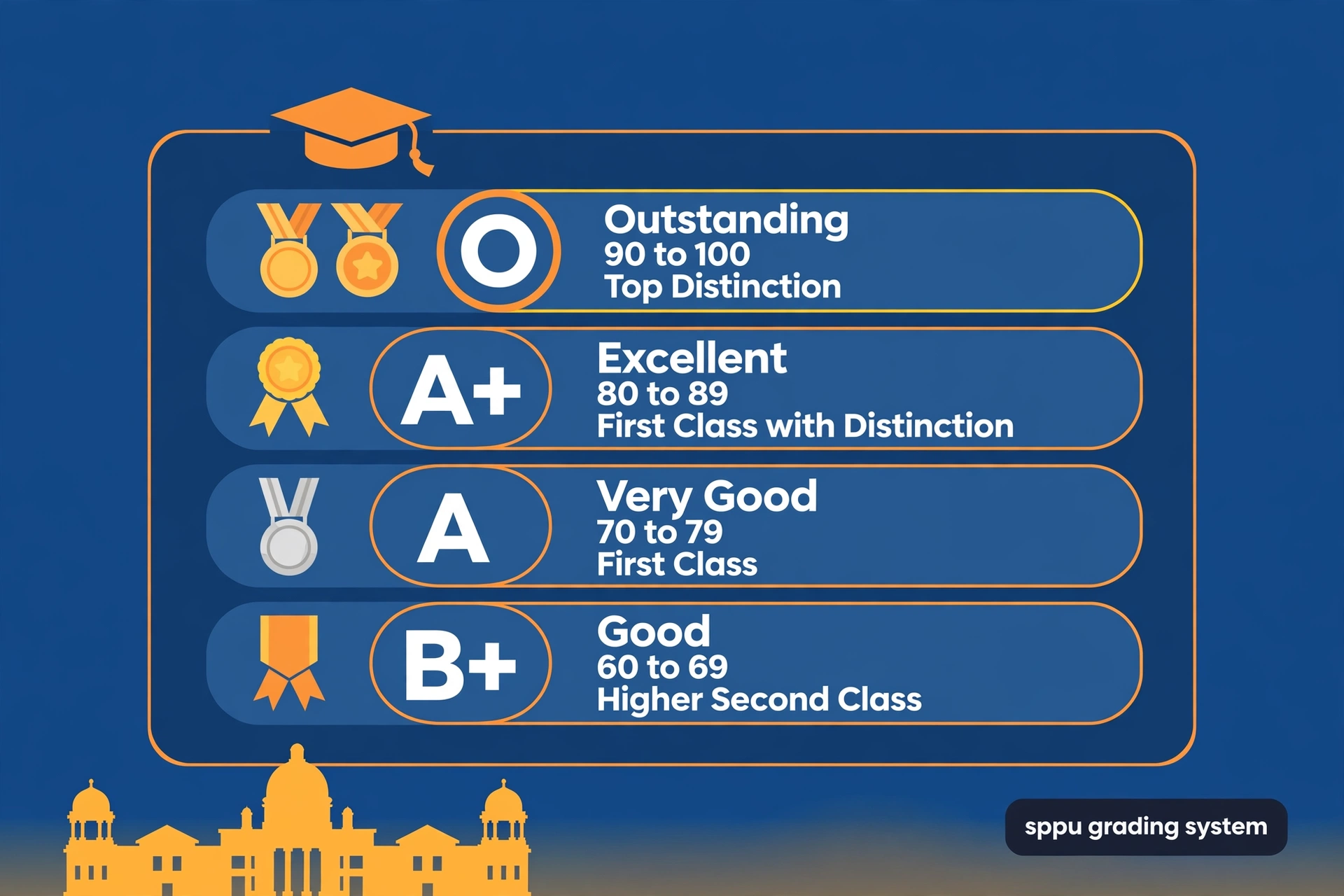
The SPPU grading system maps each SGPA range to a letter grade and degree class.
The Complete SPPU Grading Table
The conversion formulas sit on top of SPPU’s grade structure. Each SGPA range maps to a letter grade and grade point:
| SGPA Range | Grade | Grade Point | Meaning |
|---|---|---|---|
| 9.50 and above | O | 10 | Outstanding |
| 8.25 – 9.49 | A+ | 9 | Excellent |
| 6.75 – 8.24 | A | 8 | Very Good |
| 5.75 – 6.74 | B+ | 7 | Good |
| 5.25 – 5.74 | B | 6 | Above Average |
| 4.75 – 5.24 | C | 5 | Average |
| 4.00 – 4.74 | D/P | 4 | Pass |
| Below 4.00 | F | 0 | Fail |
Notice the uneven band widths: the A band spans 1.5 SGPA points while B+ spans only 1.0. These widths are exactly why a single multiplier cannot do the conversion job fairly. India’s universities operate within the national 10-point grading framework overseen by the University Grants Commission, though each university — SPPU included — notifies its own conversion circulars.
Class Awarded: What Your SGPA Means for Your Degree
Beyond the percentage, SPPU awards a degree class based on the SGPA. Employers and admissions offices often ask for this classification directly:
| SGPA Range | Class Awarded |
|---|---|
| 7.75 and above | First Class with Distinction |
| 6.75 to 7.74 | First Class |
| 6.25 to 6.74 | Higher Second Class |
| 5.50 to 6.24 | Second Class |
The distinction threshold at 7.75 is the number ambitious students watch most closely. An SGPA of 7.74 earns a First Class; 7.75 earns First Class with Distinction — a meaningful line on a resume, and one more reason to compute conversions from the exact, unrounded SGPA.
SGPA vs CGPA: Which One Converts to Your Final Percentage?
SGPA measures a single semester; CGPA accumulates across all completed semesters. When a form asks for “semester percentage,” convert the SGPA. When it asks for “aggregate” or “overall percentage,” convert the CGPA using SPPU’s CGPA conversion formula.
The two conversions use the same family of range-based formulas, so students sometimes apply the SGPA table to a CGPA value or vice versa. The arithmetic is identical in structure, but the label on the result must match the input: SGPA in, semester percentage out; CGPA in, aggregate percentage out. Mixing the labels is one of the most common errors on placement and higher-studies forms. Students who need to combine semester SGPAs into a CGPA first can run the numbers on a grade GPA calculator before converting.
The Simplified Formula: (SGPA − 0.75) × 10
Students will encounter a simpler formula cited on many websites: Percentage = (SGPA − 0.75) × 10. It is worth understanding what this is — a handy approximation, not the official method.
In the heart of the A bracket, the approximation matches the official formula exactly: at SGPA 7.50, both give 67.5%. Near the top end it drifts: at SGPA 9.80, the simplified formula gives 90.5% while the official O-bracket formula gives 96.0%. Near the bottom it drifts the other way. For rough, everyday estimates the shortcut is fine, but for anything official — resumes, applications, verification — the range-based formulas are the only correct choice.
A further caution: some older discussions reference different SPPU formulas tied to earlier admission batches and schemes. Conversion rules can change between regulation years, so students should always verify against the circular applicable to their own batch, available through their college or SPPU’s examination section.
When Do You Actually Need the Percentage?
SGPA-to-percentage conversion comes up in a handful of predictable situations. Placement registration portals almost always ask for percentage rather than grade points. Government job applications and competitive examinations require percentages in prescribed formats. Applications for MS programs abroad typically want both the CGPA and its percentage equivalent. Scholarship forms, education loan applications, and internship portals round out the list.
In all of these, consistency matters more than the number itself: the percentage on the form should be traceable to the official formula applied to the official SGPA. A number that cannot be reproduced from the grade card invites uncomfortable questions during document verification. For other student utilities beyond conversions, the homepage gathers the site’s free calculators in one place.
Conversion Certificates: When You Need Official Proof
For high-stakes uses — foreign university admissions, visa documentation, and some government recruitments — a self-computed percentage may not be enough. SPPU and its affiliated colleges can issue a formal certificate stating the conversion formula applicable to the student’s batch. Employers and universities that insist on “attested” conversions will accept this certificate where a handwritten calculation would be rejected.
Students should request the certificate well before deadlines, since issuance goes through the college office and can take days. Keeping a copy of the relevant university circular alongside the grade card is also wise; it lets any verifying authority reproduce the conversion independently.
Frequently Asked Questions
What is the official SPPU formula for SGPA to percentage? SPPU uses range-based formulas notified in its official circular: 20 × SGPA − 100 for SGPA 9.50 and above, 12 × SGPA − 25 for 8.25–9.49, 10 × SGPA − 7.5 for 6.75–8.24, 5 × SGPA + 26.25 for 5.75–6.74, 10 × SGPA − 2.5 for 4.75–5.74, and 6.6 × SGPA + 13.6 for 4.00–4.74.
What percentage is 8.2 SGPA in SPPU? An SGPA of 8.20 falls in the A bracket (6.75–8.24), so the percentage is 10 × 8.20 − 7.5 = 74.5%.
Is the SGPA to percentage formula the same as the CGPA formula at SPPU? The formulas follow the same range-based structure, but they apply to different inputs. Convert SGPA when a semester percentage is needed and CGPA when an aggregate percentage is needed, and label the result accordingly.
Can I just multiply my SPPU SGPA by 10? No. SPPU does not use a flat ×10 conversion. Multiplying by 10 overstates percentages at the top end and understates them near the pass mark compared with the official formulas.
What class is awarded for 7.8 SGPA at SPPU? An SGPA of 7.8 earns First Class with Distinction, since the distinction threshold starts at 7.75.
Does SPPU round off the converted percentage? Percentages are conventionally presented to one decimal place. More importantly, the SGPA itself should not be rounded before conversion, because rounding near a bracket boundary can change which formula applies.
Where can I verify the official conversion formula for my batch? Through the SPPU examination section’s circulars or the college office. Conversion rules can vary between regulation years, so confirming the circular applicable to the admission batch is always worthwhile.


