 Skip to main content


“My TDEE is 2,300 calories.” It sounds precise and scientific — but what does that number actually mean? What is a calorie in the first place, where do those 2,300 go during your day, and most importantly, what should you eat once you know the number?
This guide explains TDEE calories as a concept: what the calorie figure represents, how to read it, and how to turn it into eating targets for fat loss, muscle gain, or maintenance. It is about understanding and using the number, not about the mechanics of calculating it.
What Does “TDEE Calories” Actually Mean?
When someone says their TDEE is 2,300 calories, they mean their body burns approximately 2,300 calories of energy in a typical 24-hour day. Every heartbeat, every breath, every step, every bite digested — all of it draws from that daily energy budget.
The number is personal. A 25-year-old athletic man might have a TDEE of 3,000 calories; a 55-year-old sedentary woman might sit near 1,700. Your TDEE calories reflect your body size, composition, age, sex, and how much you move. Two people can eat the same meals and get completely different results because their TDEE calories differ.
Crucially, your TDEE is your maintenance intake. Eat roughly that many calories day after day and your weight stays stable. Eat less and you lose weight; eat more and you gain. Every diet strategy on earth is, at bottom, a way of positioning your intake relative to your TDEE calories.
What Is a Calorie, Really?
A calorie is a unit of energy. Technically, one calorie is the energy needed to raise one gram of water by one degree Celsius. In nutrition, what we call “calories” are actually kilocalories (kcal) — one food calorie equals 1,000 scientific calories. So when a label says 250 calories, it means 250 kilocalories of energy your body can extract from that food.
Your body is an engine that runs on this energy. It cannot create energy from nothing and cannot destroy it — every calorie you burn had to come from food (or from stored body fat), and every calorie you eat either gets burned or stored. Your TDEE is simply the “burned” side of that ledger for one day.
Where Your TDEE Calories Go: The Four Components
Your daily calorie burn is not one process — it is four streams of expenditure added together. Understanding the split helps you see which levers you can actually pull.
Basal Metabolic Rate (BMR) — 60 to 70 percent. The energy cost of staying alive: breathing, circulating blood, maintaining body temperature, brain function, cell repair. For a 2,300-calorie TDEE, roughly 1,400 to 1,600 calories go here. You cannot change this much day to day, though building muscle raises it gradually.
Thermic Effect of Food (TEF) — 8 to 10 percent. Digesting, absorbing, and processing food costs energy. Protein costs the most to digest (20 to 30 percent of its calories), followed by carbohydrates (5 to 10 percent) and fat (0 to 3 percent). On a 2,300-calorie intake, TEF accounts for roughly 200 calories.
Non-Exercise Activity Thermogenesis (NEAT) — 10 to 20 percent. All movement that is not formal exercise: walking, standing, fidgeting, cleaning, taking stairs. NEAT varies enormously between people — it is the reason two desk workers can have TDEEs hundreds of calories apart.
Exercise Activity Thermogenesis (EAT) — 5 to 15 percent. Structured workouts and sports. For most people this is the smallest slice, which surprises many gym-goers: an hour of training might burn 300 to 500 calories against a 2,300-calorie day.
The takeaway: most of your TDEE calories are burned without you thinking about it. That is why diet matters more than exercise for weight change — you cannot easily out-train the 70 percent your body spends just existing.
How to Read Your TDEE Number
Got your number from a calculator? Here is how to interpret it. If your TDEE is 2,300 calories:
- Eating ~2,300/day → weight stays roughly stable (maintenance).
- Eating ~1,800/day → a 500-calorie deficit, roughly 0.5 kg of fat loss per week.
- Eating ~2,800/day → a 500-calorie surplus, supporting muscle gain (with training).
Treat the number as the center of a range, not a laser line. Daily intake naturally fluctuates, and your true expenditure varies day to day. Hitting within 100 to 200 calories of your target consistently matters far more than nailing the exact figure.
To get your own number, run your stats through this site’s free TDEE calculator — then come back here to learn what to do with it.
Calorie Deficit: Using TDEE Calories for Fat Loss
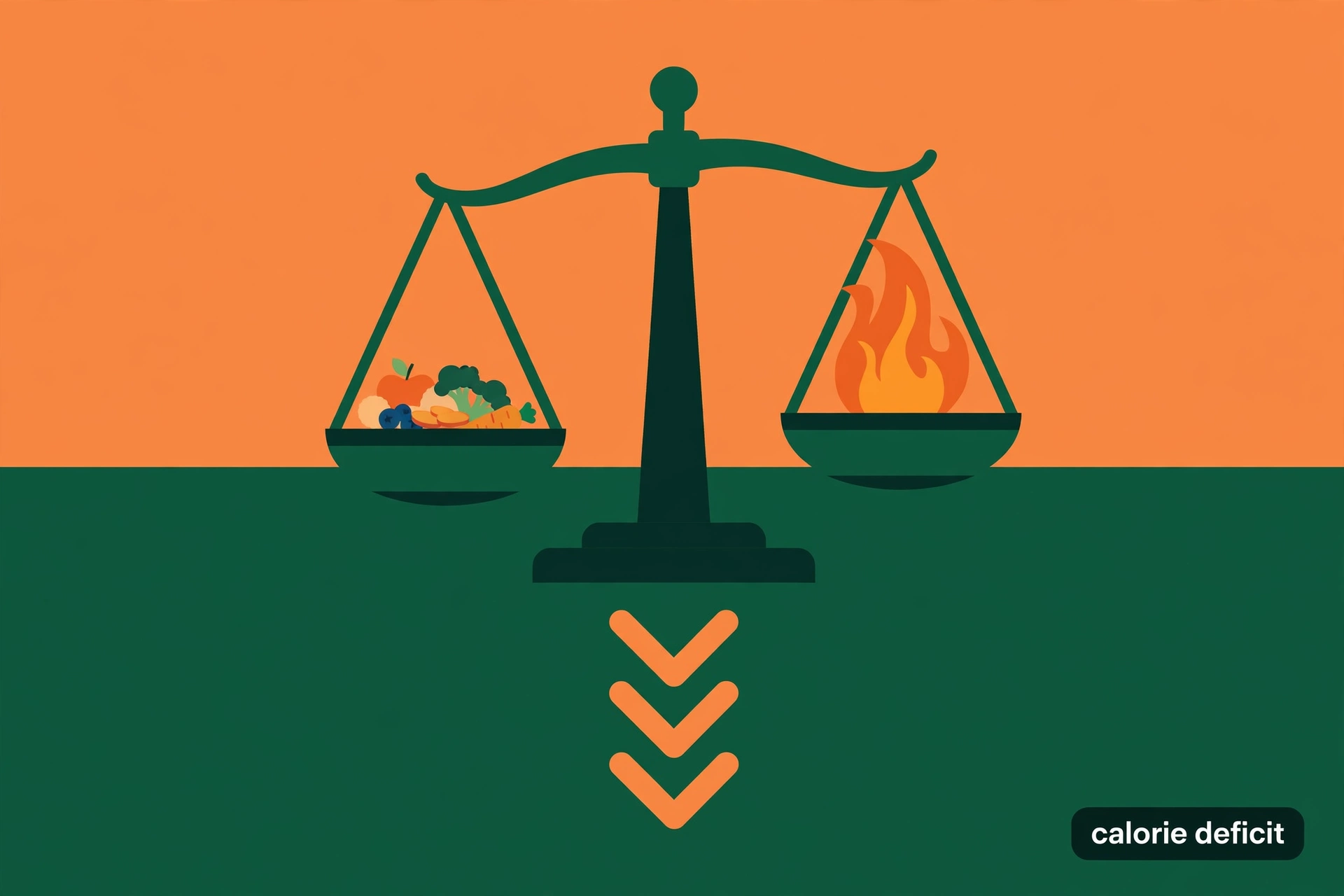
A calorie deficit means eating less than your TDEE calories. Your body covers the shortfall by burning stored fat, and that is how fat loss happens — there is no other mechanism.
How big should the deficit be? The standard guidance is 300 to 500 calories below TDEE per day, producing roughly 0.3 to 0.5 kg of fat loss per week. This pace preserves muscle, keeps energy reasonable, and is sustainable for months.
What about aggressive deficits? Deficits of 750 to 1,000 calories produce faster loss but bring real costs: greater muscle loss, hormonal disruption, fatigue, and a much higher chance of rebound. They are occasionally used under professional supervision for people with significant weight to lose, but they are not a DIY strategy.
Protein protects your muscle. During a deficit, eating roughly 1.6 to 2.2 grams of protein per kilogram of body weight daily helps ensure the weight you lose is fat, not muscle. Combined with resistance training, this is the difference between “weight loss” and “fat loss.”
Expect adaptation. After several weeks in a deficit, your TDEE calories drift downward — you move less unconsciously, and your body becomes more efficient. Plateaus after 4 to 8 weeks are normal, not failure. The fix is usually a small further reduction or a brief diet break at maintenance, not panic.
Calorie Surplus: Using TDEE Calories for Muscle Gain
A calorie surplus means eating more than your TDEE calories. With proper resistance training, the extra energy (plus extra protein) builds new muscle tissue.
How big should the surplus be? A modest surplus of 250 to 500 calories above TDEE is the sweet spot for most people. Muscle grows slowly — even in ideal conditions, beginners gain perhaps 0.25 to 0.5 kg of muscle per month — so a giant surplus mostly adds fat, not extra muscle.
The lean bulk vs. aggressive bulk debate. A lean bulk (small surplus, minimal fat gain) suits most people. Aggressive bulking (large surplus) is really only defensible for very lean hard-gainers or strength athletes in a dedicated mass phase, and even then the extra fat must be dieted off later.
Training is non-negotiable. A surplus without progressive resistance training does not build muscle — it just builds fat. The calories are the raw material; the training is the instruction to build.
Maintenance: Eating Exactly at Your TDEE
Maintenance — eating at your TDEE calories — is underrated. It is the phase where you keep your weight stable while getting stronger, improving fitness, or simply living without dietary stress. Many people reach a goal weight and then keep dieting out of habit; learning to eat at maintenance is a skill worth practicing deliberately.
Maintenance is also the smart default during stressful life periods, injury recovery, or when diet fatigue sets in. You can always return to a deficit or surplus later. A few months at maintenance consolidates your results and restores your relationship with food.
Why TDEE Calories Change From Day to Day
Your TDEE is not a fixed constant — it is a moving average. Real daily expenditure shifts with:
- Activity. A rest day versus a 15,000-step day can differ by 400+ calories.
- Sleep. Poor sleep measurably reduces next-day energy expenditure and increases hunger.
- Stress and illness. Both raise expenditure slightly (your immune system is expensive to run) while often reducing movement.
- Food intake itself. Eating more raises TEF; prolonged dieting lowers overall expenditure through adaptation.
- Body composition changes. Gaining muscle raises your burn; losing weight lowers it.
This variability is why weekly averages beat daily perfection. Judge your intake against your average TDEE across the week, not against any single day.
Average TDEE Calories: Men vs Women
Research using gold-standard measurement methods gives useful ballparks. A well-known study published in the American Journal of Clinical Nutrition found average TDEE around 2,443 kcal per day for non-obese men and 1,939 kcal per day for women — though individual variation is wide.
The gap comes mostly from differences in average body size and muscle mass, not from any fundamental metabolic inefficiency. A muscular, active woman can easily out-burn a sedentary man. These averages are reference points, not prescriptions — your own estimate from a calculator, adjusted against real-world results, beats any population average. The National Institutes of Health (NIH) funds and publishes much of the foundational research on human energy expenditure for readers who want the primary science.
Adjusting Your Calories When Progress Stalls
Sooner or later, everyone stalls. The scale stops moving for three or four weeks despite consistent eating. Here is the rational response protocol:
- Verify consistency first. Track honestly for a week — most “stalls” are tracking drift, not metabolic mystery.
- Check activity. NEAT quietly declines during diets. A daily step target guards against this.
- Adjust by 100 to 200 calories. In a fat-loss stall, reduce intake slightly or add activity. In a muscle-gain stall, add 100 to 200 calories.
- Consider a diet break. One to two weeks at maintenance TDEE can restore energy, hormones, and adherence before resuming.
- Recalculate. If your weight changed significantly, your TDEE changed with it — update the number.
What not to do: slash 1,000 calories overnight, add two hours of cardio, or declare the whole approach broken after ten days.
Calories Are Not Everything: Macros and Food Quality
Two diets at identical calories can produce different outcomes. Protein intake determines how much muscle you keep while losing fat. Fiber and food volume determine how full you feel. Micronutrients determine how well you function. And minimally processed foods make hitting calorie targets easier because they are more filling per calorie.
Think of it as a hierarchy: first get calories right relative to your TDEE (this drives weight change), then get protein right (this drives body composition), then worry about the finer details. Most people who struggle are failing at level one while obsessing over level three.
Beyond nutrition tools, this site’s homepage hosts the full set of free calculators — including a grade GPA calculator — handy when your fitness tracking crosses over into academic tracking, as it does for student athletes managing both training and attendance.
Frequently Asked Questions
What are TDEE calories?
TDEE calories are the total number of calories your body burns in 24 hours — your resting metabolism plus digestion, daily movement, and exercise combined. The figure represents your maintenance intake.
How many TDEE calories does the average person burn?
Roughly 2,000 to 2,500 for men and 1,600 to 2,000 for women, with wide individual variation. Research averages sit near 2,443 kcal/day for non-obese men and 1,939 for women, but your personal number depends on your size, composition, and activity.
Should I eat my TDEE calories to lose weight?
No — eat below them. A deficit of 300 to 500 calories under your TDEE produces steady fat loss of about 0.3 to 0.5 kg per week. Eating exactly at TDEE maintains your weight.
Do TDEE calories include exercise?
Yes. TDEE includes all activity — both formal exercise and everyday movement — on top of your resting metabolism and digestion. That is what the “total” means.
Why is my TDEE so low?
Usually one of three reasons: a small body size, low muscle mass, or genuinely low daily activity (especially low NEAT like step count). Age and sex play smaller roles. Increasing daily movement is the fastest lever.
Can TDEE calories change over time?
Yes. Weight loss lowers TDEE, muscle gain raises it, activity changes shift it daily, and metabolic adaptation during prolonged dieting reduces it. Recalculate every month or two during active goal phases.
Is it bad to eat far below my TDEE?
Yes, generally. Very large deficits cost muscle, disrupt hormones, tank energy, and usually end in rebound. Stick to 300–500 below TDEE unless working with a qualified professional.


