 Skip to main content


Few numbers matter more in a VIT student’s life than the CGPA. It decides which companies they can sit for in placements, whether they qualify for a semester abroad, and sometimes even how their resume gets sorted before a human ever reads it. Yet many students only discover how their CGPA is actually calculated in their final year, when every decimal point has already been locked in.
This guide explains exactly how the VIT CGPA calculator works. It covers the 10-point grading system VIT uses, the semester GPA formula, the multi-semester CGPA formula, fully worked examples, how special grades like N1 and N2 affect the number, and how to convert CGPA to percentage. Whether they are a freshman estimating their first semester or a senior planning a final push, this is the complete reference.
What Is CGPA at VIT?
CGPA stands for Cumulative Grade Point Average. At VIT (Vellore Institute of Technology), it is the single number that summarizes a student’s academic performance across every semester they have completed.
VIT uses a credit-based evaluation system. Every course carries a certain number of credits depending on its workload, and every grade a student earns carries grade points. The CGPA blends both: it weights each grade by the credits of its course, so a 4-credit core subject moves the number more than a 1-credit lab.
The CGPA at VIT runs on a 10-point scale. A perfect record gives a CGPA of 10.0, and the number drops as grades fall. Unlike a simple average of semester GPAs, the VIT CGPA accounts for the fact that semesters can carry different credit loads.
VIT’s 10-Point Grading System
Before using any VIT CGPA calculator, the first thing to understand is the grade-to-point mapping. VIT follows India’s credit-based grading framework, whose broad guidelines are set by the University Grants Commission, and awards letter grades that map to fixed grade points:
| Grade | Meaning | Grade Points |
|---|---|---|
| S | Outstanding | 10 |
| A | Excellent | 9 |
| B | Good | 8 |
| C | Average | 7 |
| D | Pass | 6 |
| E | Pass (low) | 5 |
| F | Fail | 0 |
There are also special grades that appear on transcripts in specific situations:
- N1 means the student failed a course component. It carries 0 grade points.
- N2 means the student was debarred from the final assessment due to low attendance. It carries 0 grade points.
- N3 means the student was absent for the final assessment. It carries 0 grade points.
- N4 means the student was debarred for malpractice. It carries 0 grade points.
- P is used for pass/fail courses. It carries no grade points and is excluded from the calculation entirely.
The N grades all contribute zero points while their credits still count in the denominator, which is why a single N grade can damage a semester GPA far more than a low pass grade. Students should treat attendance and exam rules as seriously as the academics themselves.
How Semester GPA Works at VIT
The semester GPA (sometimes called SGPA) is the building block of the CGPA. It measures performance in one semester only.
Semester GPA = Sum of (Grade Points x Course Credits) for all courses / Total Credits of the semester
Here is a worked example for one semester:
| Course | Credits | Grade | Grade Points | Weighted Points |
|---|---|---|---|---|
| Mathematics I | 4 | A (9) | 9 | 36 |
| Physics | 3 | B (8) | 8 | 24 |
| Programming | 4 | S (10) | 10 | 40 |
| English | 2 | C (7) | 7 | 14 |
| Lab I | 1 | A (9) | 9 | 9 |
Total weighted points: 36 + 24 + 40 + 14 + 9 = 123 Total credits: 4 + 3 + 4 + 2 + 1 = 14
Semester GPA = 123 / 14 = 8.79
Notice how the 4-credit S in Programming contributes 40 points while the 2-credit C in English contributes only 14. This is the entire logic of credit weighting: heavier courses pull harder on the result.
The VIT CGPA Formula (Multi-Semester)
Once semester GPAs are known, the CGPA combines them across all completed semesters. This is where many students make their first mistake: they simply average their semester GPAs. That only works if every semester carries the same credits. At VIT, they usually do not.
CGPA = Sum of (Semester GPA x Semester Credits) for all semesters / Total Credits of all semesters
An equivalent way to write it:
CGPA = Sum of (Grade Points x Course Credits) for every course taken so far / Sum of all credits taken so far
Both formulas give the same answer. The second version just skips the semester-GPA intermediate step.
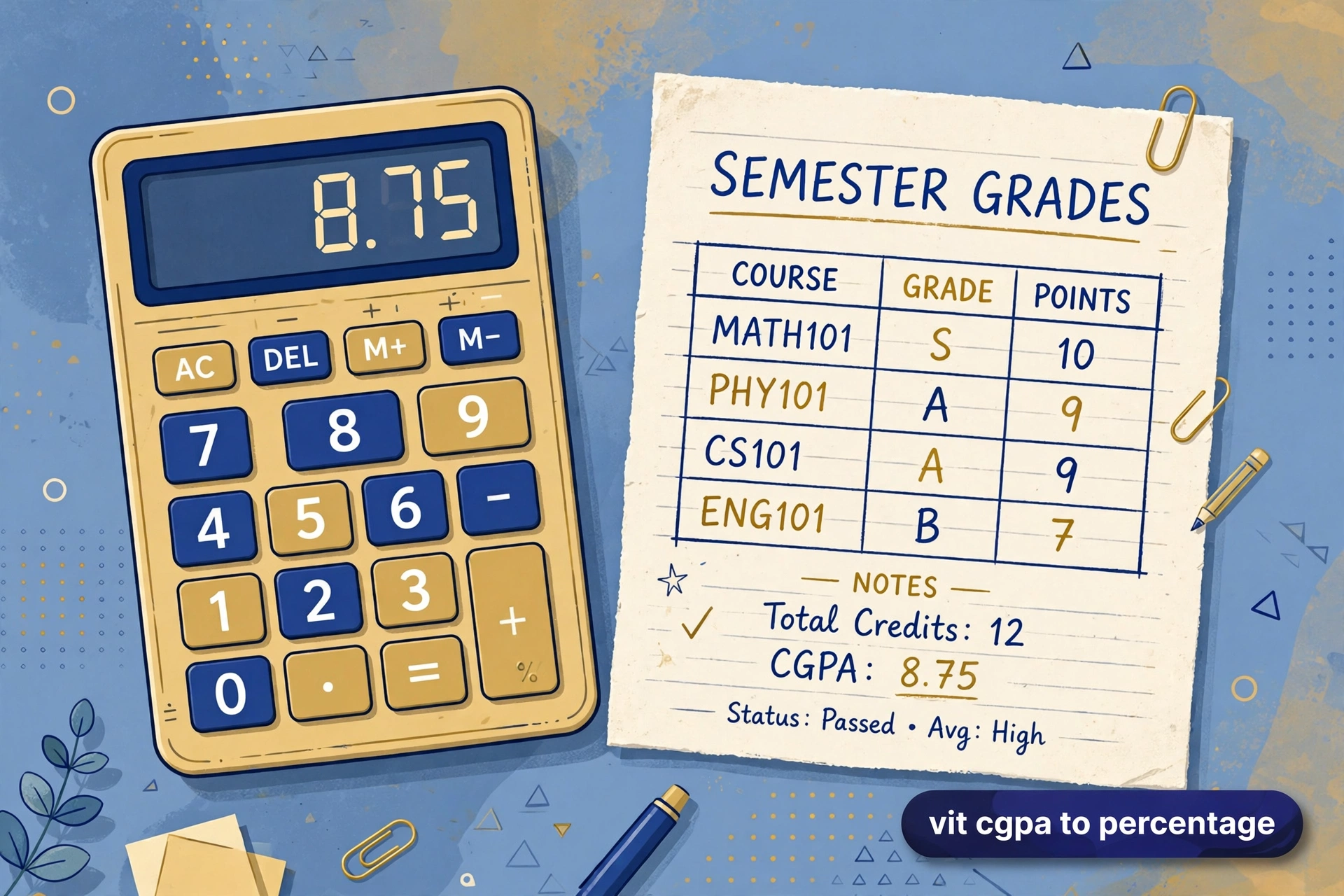
Fully Worked Multi-Semester Example
Let us walk through a realistic two-semester example.
Semester 1: GPA of 8.2 across 21 credits. Weighted points: 8.2 x 21 = 172.2
Semester 2: GPA of 7.6 across 23 credits. Weighted points: 7.6 x 23 = 174.8
CGPA = (172.2 + 174.8) / (21 + 23) = 347 / 44 = 7.89
Now compare with the naive simple average: (8.2 + 7.6) / 2 = 7.9. The difference looks tiny here, but that is only because the credit counts are close. When semesters differ by more, the gap grows.
Let us extend the example with a third semester:
Semester 3: GPA of 8.8 across 20 credits. Weighted points: 8.8 x 20 = 176
CGPA after three semesters = (172.2 + 174.8 + 176) / (21 + 23 + 20) = 523 / 64 = 8.17
Simple average would give (8.2 + 7.6 + 8.8) / 3 = 8.2. Again close, but the correct credit-weighted answer is 8.17, and VIT’s official system uses the credit-weighted method. When placement cutoffs sit at 8.5 or 9.0, even a 0.05 difference can change eligibility.
How to Use a VIT CGPA Calculator Step by Step
A VIT CGPA calculator automates the math above. Here is how to use one correctly:
- Collect semester data. For each completed semester, note the semester GPA and the total credits of that semester. Both numbers appear on the grade sheet.
- Enter each semester. Most calculators accept one row per semester: the GPA and the credits. Enter semesters in any order; the math is commutative.
- Check the grade scale. Confirm the calculator uses VIT’s S-to-F 10-point scale. Generic calculators with A+ to F scales will produce wrong answers.
- Read the result. The output is the CGPA on the 10-point scale, usually to two decimal places.
- Sanity-check the output. The CGPA must always fall between the lowest and highest semester GPA. If the result is outside that range, something was entered wrong.
For students who want to work course by course instead, a per-course calculator is better: enter each course’s grade and credits directly, and the tool computes both the semester GPA and feeds it into the cumulative total. Students planning future semesters can also enter projected grades to see what the CGPA would become, which is the basis for setting realistic targets.
Converting VIT CGPA to Percentage
Many recruiters, universities abroad, and government forms ask for percentage rather than CGPA. VIT’s official conversion is simple:
Percentage = CGPA x 10
So a CGPA of 8.65 becomes 86.5%. A CGPA of 9.2 becomes 92%.
A quick reference table:
| CGPA | Equivalent Percentage |
|---|---|
| 10 | 100 |
| 9.0 – 9.9 | 90 – 99 |
| 8.0 – 8.9 | 80 – 89 |
| 7.0 – 7.9 | 70 – 79 |
| 6.0 – 6.9 | 60 – 69 |
| 5.0 – 5.9 | 50 – 59 |
| Below 5.0 | Below 50 |
Students should always check whether the organization they are applying to accepts the CGPA x 10 conversion or wants to see the original CGPA. Most Indian recruiters are comfortable with the x 10 formula, but it is worth confirming rather than assuming.
Why CGPA Matters So Much at VIT
At VIT, the CGPA is not just an academic statistic. It functions as a gatekeeper:
- Placements: Many companies set a minimum CGPA cutoff for the first screening round. Common cutoffs are around 7.0, while high-paying “dream” and “super dream” roles often require 8.5 or 9.0 and above.
- Higher studies: Universities abroad, especially for MS and MBA programs, look at the cumulative record. A strong final CGPA supports the application.
- Internships and research: Competitive research programs and internships frequently ask for CGPA as a quick filter.
- Semester abroad and exchange programs: These usually have academic eligibility criteria tied to CGPA.
Because early semesters carry real weight, a poor first year cannot simply be erased by a good final year. The CGPA is cumulative by design, which means building it steadily from semester one is the safest strategy.
Common Mistakes When Calculating VIT CGPA
- Averaging semester GPAs without credit weighting. The single most common error. Always weight by credits.
- Using the wrong grade scale. VIT’s scale tops out at S (10), not A+. A generic calculator with a US-style scale produces meaningless results.
- Including P-grade courses. Pass/fail P courses must be excluded from both the numerator and denominator.
- Forgetting N grades. N1 through N4 carry zero points but their credits still count. Leaving them out inflates the result.
- Rounding too early. Round only the final answer, not the intermediate semester products. Early rounding compounds errors.
- Mixing attempted and earned credits. Use the credits of courses taken (attempted), not just passed, in the denominator.
How to Improve Your VIT CGPA
Because the CGPA is credit-weighted, improvement strategy should be too:
- Prioritize high-credit courses. Moving a 4-credit subject from C to B adds (8 – 7) x 4 = 4 weighted points. Moving a 1-credit lab from C to B adds only 1. Effort should follow credits.
- Protect the denominator. Failing and repeating courses, or picking up N grades from attendance issues, hurts far more than a low pass. Showing up and submitting everything is the cheapest CGPA insurance.
- Use grade improvement options. VIT allows students to improve grades in some courses. If a low grade in a high-credit course is dragging the number, an improvement attempt can be worth more than acing an easy elective.
- Project before the semester. Before a semester begins, plug target grades into a VIT CGPA calculator to see what the number would become. Working backward from a target CGPA to the required semester GPA turns a vague wish into a concrete plan.
- Remember the asymmetry. Raising a CGPA gets harder the more semesters are completed, because each new semester is a smaller fraction of the total. A student in semester 2 can move the CGPA far more than a student in semester 7. Early action pays off disproportionately.
For a broader look at semester-level planning, the general grade GPA calculator walks through weighted calculations, and the homepage rounds up every free calculator. Students comparing systems can also check the general CGPA calculator for a non-VIT-specific walkthrough.
Frequently Asked Questions
How is CGPA calculated at VIT?
CGPA at VIT is the sum of (semester GPA x semester credits) for all completed semesters, divided by the total credits. Equivalently, it is the sum of (grade points x course credits) for every course taken, divided by total credits attempted.
What is the difference between VIT GPA and VIT CGPA?
GPA (or SGPA) measures one semester only. CGPA measures all semesters completed so far, credit-weighted. GPA resets every term; CGPA accumulates.
Is CGPA at VIT out of 10?
Yes. VIT uses a 10-point scale where S equals 10 grade points and F equals 0. The maximum possible CGPA is 10.0.
How do I convert my VIT CGPA to percentage?
Multiply the CGPA by 10. A CGPA of 8.4 equals 84%. This is the conversion VIT itself uses.
Do N grades affect my VIT CGPA?
Yes. N1, N2, N3, and N4 all carry 0 grade points, and their credits still count in the denominator. They pull the semester GPA and therefore the CGPA down. P grades for pass/fail courses are excluded entirely.
What is a good CGPA at VIT for placements?
Placement cutoffs vary by company, but many set 7.0 as a baseline, high-paying roles often ask for 8.5 or above, and the most competitive positions can require 9.0 and above. Students should verify the cutoff for each specific recruiter.
Can I improve my CGPA in the final year?
Yes, but the leverage is smaller. Each additional semester is a shrinking fraction of the cumulative total, so late improvements move the number slowly. That said, strong final semesters still help and they appear individually on the transcript.


