 Skip to main content


Calories tell you how much to eat. Macros tell you what those calories should be made of. A macro calculator takes your body stats, activity level, and goal — fat loss, muscle gain, or maintenance — and turns them into daily targets for protein, carbohydrates, and fat. It is the tool behind every “hit your macros” plan, and understanding how it works makes the numbers far more useful than blindly following an app.
This guide explains the full macro calculation chain: what macros are, the formulas calculators use (BMR, activity multipliers, goal adjustments), how protein, carb, and fat targets are derived, complete worked examples for cutting and bulking, the most common macro splits, and the mistakes that stall progress. For background on the calorie side of the equation, the TDEE calculator on this site covers total daily energy expenditure in depth.
What Is a Macro Calculator?
A macro calculator is a tool that estimates your ideal daily intake of the three macronutrients — protein, carbohydrates, and fat — based on your personal stats and goals. You enter your age, height, weight, sex, activity level, and goal, and it returns targets like “2,400 calories: 180g protein, 240g carbs, 80g fat.”
Unlike generic diet advice (“eat 2,000 calories”), macro targets are personalized. Two people with the same calorie target can need very different macro splits — a lifter in a building phase needs far more protein than a sedentary person maintaining weight. The calculator bridges that gap with validated formulas rather than guesswork.
The concept is closely tied to IIFYM — “If It Fits Your Macros” — the flexible-dieting approach where food choices are free as long as daily macro targets are hit. Whether or not someone follows IIFYM strictly, the underlying math is the same, and it is worth understanding even if a coach or app does the arithmetic.
The Three Macros and Their Calorie Values
Every macro calculation rests on three energy densities:
- Protein: 4 calories per gram
- Carbohydrates: 4 calories per gram
- Fat: 9 calories per gram
These numbers are the conversion factors between calories and grams. If a calculator assigns 600 calories to protein, that becomes 600 / 4 = 150 grams. If it assigns 720 calories to fat, that becomes 720 / 9 = 80 grams. Every macro target you have ever seen was produced by dividing a calorie allocation by one of these three numbers.
Each macro also plays a distinct role. Protein builds and repairs tissue — muscle, skin, enzymes, hormones — and has the highest thermic effect, meaning the body burns more energy digesting it. Carbohydrates are the body’s preferred quick fuel, especially for training. Fat supports hormone production, vitamin absorption, and long-term energy. A good macro split respects all three rather than demonizing any of them.
Step 1: Estimating BMR
Most macro calculators start where TDEE calculators start: basal metabolic rate. The Mifflin-St Jeor equation is the standard choice:
Men: BMR = (10 x weight in kg) + (6.25 x height in cm) – (5 x age) + 5 Women: BMR = (10 x weight in kg) + (6.25 x height in cm) – (5 x age) – 161
Example: a 28-year-old man, 70 kg, 175 cm. BMR = (10 x 70) + (6.25 x 175) – (5 x 28) + 5 = 700 + 1093.75 – 140 + 5 = 1658.75, roughly 1659 calories.
Some calculators use the revised Harris-Benedict equation instead, which produces slightly different numbers. The difference is small relative to the activity multiplier that comes next — which is where the real variation between calculators lives.
Step 2: Applying the Activity Multiplier
BMR is multiplied by an activity factor to estimate total daily energy expenditure. The standard tiers are:
- Sedentary (little to no exercise): BMR x 1.2
- Lightly active (1–3 days/week): BMR x 1.375
- Moderately active (3–5 days/week): BMR x 1.55
- Very active (6–7 days/week): BMR x 1.725
- Extra active (very hard exercise or physical job): BMR x 1.9
Continuing the example: our 28-year-old trains four days a week and has a desk job — moderately active. TDEE = 1659 x 1.55 = 2571 calories.
This step deserves honesty. Most people overestimate their activity, which inflates the calorie target and quietly sabotages fat loss. When in doubt, choose one tier lower than instinct suggests and adjust after two to three weeks of tracking. Healthline’s guide to macro calculators, available at healthline.com, walks through these same inputs with additional context on personalizing them.
Step 3: Adjusting for Your Goal
Maintenance calories keep weight stable. Goals shift the target:
- Fat loss: subtract roughly 300–500 calories (a moderate deficit), or 10–20 percent of TDEE
- Muscle gain: add roughly 250–500 calories (a lean surplus), or 10–15 percent
- Maintenance: no adjustment
Our example at 2571 TDEE: for fat loss, 2571 – 500 = 2071 calories. For muscle gain, 2571 + 300 = 2871 calories. Aggressive deficits and surpluses exist, but moderate adjustments preserve muscle during cuts and limit fat gain during bulks — which is why most calculators default to them.
Step 4: Setting Protein — The Anchor Macro
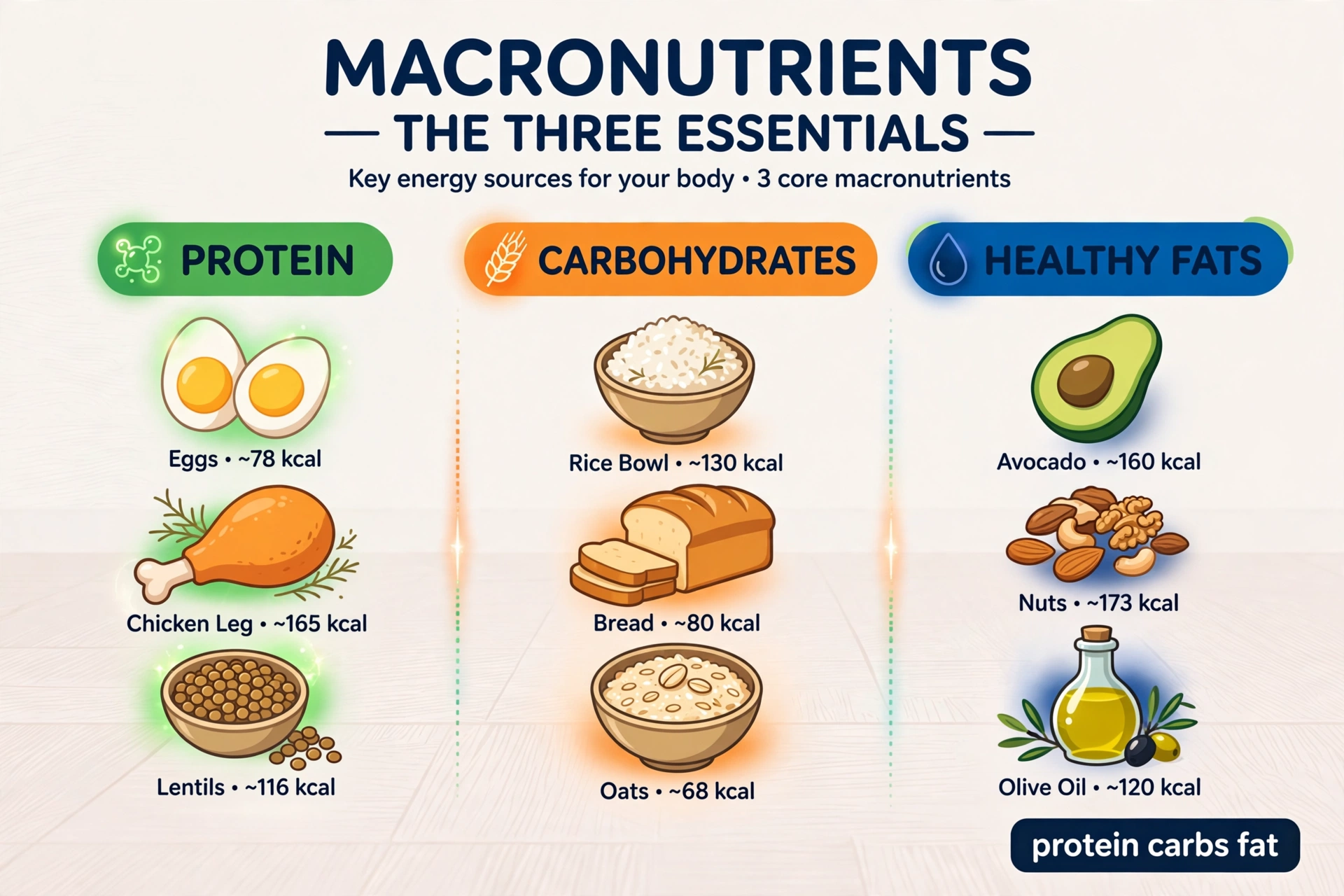
Protein is set first because it has the clearest evidence-based range and the biggest impact on body composition. Common approaches:
- By body weight: 1.6–2.2 grams per kilogram of body weight (0.7–1.0 g per pound). Higher end for dieting or heavy training.
- By lean mass: 2.0–2.4 g per kg of lean body mass, when body fat percentage is known.
- By calorie share: 25–35 percent of total calories.
For our 70 kg example in a fat-loss phase at 2071 calories: 2.0 g/kg x 70 = 140 grams of protein, which is 560 calories. During a diet, err toward the higher end — protein protects muscle when calories are restricted and keeps hunger down better than the other macros.
Step 5: Setting Fat — The Hormone Floor
Fat is set second, usually as a share of calories: 20–35 percent of total intake, with most calculators landing around 25–30 percent. There is also a minimum worth respecting — consistently dropping below about 0.5 g per kg of body weight risks hormonal disruption, low energy, and poor vitamin absorption.
Our example: 25 percent of 2071 calories = 518 calories from fat, which is 518 / 9 = 58 grams. That is 0.83 g/kg — comfortably above the floor and within the standard range.
Step 6: Filling the Rest with Carbs
Carbohydrates get whatever calories remain. The formula:
Carb calories = Total calories – (Protein calories + Fat calories) Carb grams = Carb calories / 4
Our example: 2071 – (560 + 518) = 993 calories for carbs, which is 993 / 4 = 248 grams.
Final macro target for fat loss: 2071 calories — 140g protein, 248g carbs, 58g fat.
Notice the logic: protein and fat are set by body needs, carbs flex with the calorie budget. This is why carb targets swing the most between cutting and bulking phases while protein stays relatively stable.
Complete Worked Example: Muscle Gain
Let us run the full chain for a different goal. A 25-year-old woman, 60 kg, 165 cm, training five days a week, aiming to build muscle.
BMR = (10 x 60) + (6.25 x 165) – (5 x 25) – 161 = 600 + 1031.25 – 125 – 161 = 1345 calories. Activity: very active, 1.725. TDEE = 1345 x 1.725 = 2320 calories. Goal: lean surplus of 300. Target = 2620 calories. Protein: 1.8 g/kg x 60 = 108 g = 432 calories. Fat: 28 percent of 2620 = 734 calories = 82 g (1.37 g/kg — fine). Carbs: 2620 – (432 + 734) = 1454 calories = 364 g.
Final target: 2620 calories — 108g protein, 364g carbs, 82g fat.
Compare the two examples: the bulking target carries over 100 more grams of carbs than the cutting one, while protein barely moved. That pattern — stable protein, flexible carbs — is the signature of sound macro planning.
Popular Macro Splits and When to Use Them
Beyond personalized calculators, several standard splits circulate in fitness culture. The balanced 40/30/30 (carbs/protein/fat by calories) suits general fitness and maintenance. A higher-protein 35/35/30 favors fat loss with muscle retention. Lower-carb approaches like 25/35/40 appeal to people who feel better with fewer carbs, though the evidence for superiority is weak — adherence beats ratios.
Keto-style splits (5–10 percent carbs) are a different animal entirely, aimed at sustained ketosis rather than general macro balance, and they come with their own adaptation demands. For most people, the calculator-derived personalized split outperforms any fixed ratio because it accounts for body size and activity.
The honest truth about splits: total calories determine weight change, protein determines how much of that change is muscle versus fat, and the carb-fat balance is largely personal preference within healthy ranges. Do not agonize over 40/30/30 versus 35/35/30 — pick one, hit protein, and stay consistent.
Common Macro Calculator Mistakes
The biggest mistake is treating the output as a prescription carved in stone. Calculators estimate; your body’s response over two to four weeks is the real answer. If weight is not moving as intended while you are hitting the targets, the targets — not your effort — need adjusting.
Second: changing macros weekly. Constant tweaking prevents you from ever learning what a given target actually does. Give any set of macros at least two to three consistent weeks before judging.
Third: neglecting fiber and micronutrients. Hitting 250g of carbs with candy and 140g of protein with shakes technically “fits your macros” but leaves fiber, vitamins, and minerals behind. IIFYM works best when most food is nutrient-dense and treats fill the remainder.
Fourth: setting protein too low during fat loss. This is the single most costly error — inadequate protein in a deficit means a meaningful share of lost weight comes from muscle, which slows the metabolism and worsens the look of the result.
Fifth: using the wrong activity tier, as discussed earlier. When results stall, the activity multiplier is the first suspect.
How to Track Macros Without Burning Out
Perfection is unnecessary; consistency wins. Weigh or measure food for the first two to three weeks to calibrate your eye — most people are shocked by what a real 100g of rice or 30g of peanut butter looks like. After calibration, estimation plus periodic check-weighing is enough for most goals.
Prioritize hitting protein and total calories daily; let carbs and fat land approximately. A day at 135g protein instead of 140g changes nothing. A week of guessing everything changes a lot. Build 3–5 go-to meals with known macros so most days run on autopilot, and save flexibility for social meals.
Reassess every 4–8 weeks or after every 3–5 kg of weight change, since a smaller or more muscular body has different needs. And remember that macro targets are a tool for a phase of life, not a permanent identity — many people track strictly toward a goal, then maintain with habits alone. Students juggling fitness alongside studies can find more planning tools among the free calculators on the homepage, including the GPA calculator for keeping academics on track.
Frequently Asked Questions
How does a macro calculator work?
It estimates your BMR from age, height, weight, and sex, multiplies by an activity factor to get TDEE, adjusts calories for your goal (deficit, surplus, or maintenance), then splits the calories into protein, fat, and carbs using evidence-based ranges — typically 1.6–2.2 g/kg protein and 20–35 percent of calories from fat, with carbs filling the rest.
How many grams of protein do I need per day?
For active people, 1.6–2.2 grams per kilogram of body weight (0.7–1.0 g per pound). Aim higher when dieting or training hard, since protein protects muscle in a calorie deficit. A 70 kg person would target roughly 112–154 grams daily.
What is a good macro split for fat loss?
A common effective split is around 35 percent protein, 35 percent carbs, 30 percent fat by calories, with protein at the higher end of the 1.6–2.2 g/kg range. The calorie deficit drives the fat loss; the high protein preserves muscle.
What is a good macro split for muscle gain?
Slightly lower protein priority and higher carbs: roughly 25–30 percent protein, 45–55 percent carbs, 20–30 percent fat, on top of a modest 250–500 calorie surplus. Carbs fuel training performance, which drives growth.
Are macro calculators accurate?
They are good starting estimates, typically within about 10 percent of true needs. Individual variation in NEAT (non-exercise activity), digestion, and body composition means real-world adjustment over two to four weeks is always necessary.
Should carbs or fat be higher?
Within healthy ranges it is mostly personal preference and adherence. Keep fat at or above 0.5 g/kg for hormonal health, hit your protein target, and allocate the remaining calories to whichever of carbs or fat you enjoy and perform better on.
Do I need to track macros forever?
No. Many people track strictly for a defined phase — a cut, a bulk, or learning portion awareness — then transition to habit-based eating. The calibration and food awareness gained during tracking tend to persist long after the food scale is put away.


