 Skip to main content


Converting CGPA to percentage looks like a one-line calculation, and that is exactly what makes it dangerous. Millions of students type their CGPA into a converter, multiply by some number they found online, and submit the result on a job or college application — never realizing that the “some number” was wrong for their university. The uncomfortable truth about CGPA to percentage conversion is that there is no single universal formula. Different boards and universities prescribe different multipliers, and using the wrong one can shift the result by four or five percentage points. That gap has decided interviews, admissions, and scholarships.
This guide covers what the conversion means, every major formula in use, which institutions use which, how to find the official rule for any university, and the mistakes that produce wrong percentages. A converter cannot tell you which formula applies to you — this guide can.
What CGPA to Percentage Conversion Actually Means
CGPA (Cumulative Grade Point Average) summarizes academic performance as a single number on a grade-point scale — usually 10 in India, 4 in the United States. A percentage expresses the same performance on a 0–100 scale. Converting CGPA to percentage maps the grade-point number onto the percentage scale so that employers, universities, and scholarship boards that think in percentages can evaluate the record.
CGPA is a weighted average of grade points across subjects and semesters; a percentage historically reflects raw marks. Because the mapping from letter grades to marks differs between institutions, the conversion factor legitimately differs too. The multiple formulas are not competing opinions — they are different institutions’ official mappings.
The One Rule That Matters: Use Your Institution’s Official Formula
Before touching any formula, internalize this rule: the correct conversion is the one your board or university prescribes. Your marksheet, transcript, university examination regulations, or controller of examinations portal may state it outright. Some universities issue a conversion certificate alongside the transcript — when that document exists, it is the only conversion with institutional authority, and it is the one that will hold up under scrutiny.
A calculator can do the arithmetic, but it cannot decide which institutional rule applies to a record. Every formula below is officially used somewhere. The skill is picking the right one.
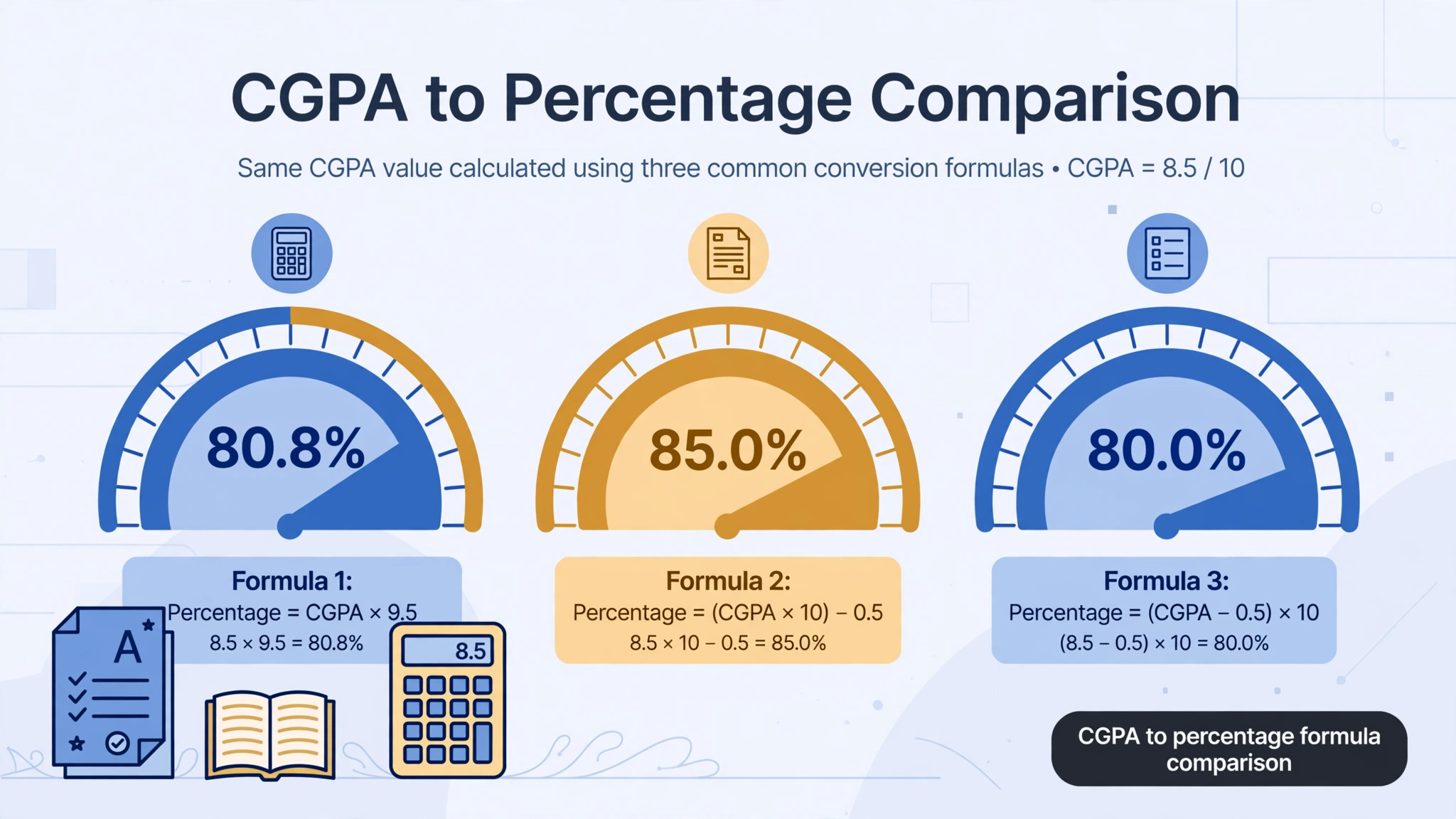
Formula 1: CGPA x 9.5 (The CBSE Standard)
The most widely recognized formula in India is:
Percentage = CGPA x 9.5
This is the official method of the Central Board of Secondary Education (CBSE), used for Class 10 results on the 10-point CGPA scale. A CGPA of 8.0 becomes 76%, a CGPA of 9.0 becomes 85.5%, and a CGPA of 7.5 becomes 71.25%.
The 9.5 multiplier is not arbitrary. It was derived from the average marks of students who earned each grade point, mapping the grade-point scale back to the percentage scale it replaced. Because CBSE is the largest school board in the country, this formula became the default that most generic converters apply — which is precisely why students from universities that use other formulas get wrong results from generic tools.
Use this formula when: the board or university explicitly prescribes 9.5, or the record is a CBSE Class 10 CGPA.
Formula 2: (CGPA – 0.75) x 10 (The UGC-Recommended Method)
Several major Indian universities use a different official conversion:
Percentage = (CGPA – 0.75) x 10
Visvesvaraya Technological University (VTU) and Anna University are the best-known examples. Under this formula, a CGPA of 8.0 converts to 72.5%, not 76% — a 3.5-point difference from the CBSE formula that can easily cross a cutoff.
This formula traces back to the University Grants Commission’s recommended conversion under the Choice Based Credit System. Students and institutions looking for the authoritative framing of this method can consult the UGC’s official guidelines at ugc.gov.in, which describe the CBCS grading framework that Indian universities build their conversion rules on. The subtraction of 0.75 before multiplying adjusts for how grade points cluster on the 10-point scale, producing a more conservative percentage than a straight multiplication.
Use this formula when: the university follows UGC CBCS norms with this prescribed conversion — always confirm in the university’s own academic regulations.
Formula 3: CGPA x 10 (The Direct Scale)
The simplest formula is a straight multiplication:
Percentage = CGPA x 10
Delhi University, the University of Mumbai, the University of Pune, and APJ Abdul Kalam Technological University (KTU) are commonly cited users of this direct 10x mapping. A CGPA of 8.5 becomes 85%, and a CGPA of 9.2 becomes 92%.
This formula applies where the grading system is designed so that the 10-point scale maps linearly onto the percentage scale. It is the most generous of the three common formulas for the same CGPA — which is exactly why students should not “shop” for formulas. Using x10 when the university prescribes x9.5 inflates the percentage by up to 4-5 points, and a verifier who checks the official rule will catch the discrepancy.
Use this formula when: the university’s regulations state a direct 10x conversion.
Same CGPA, Different Percentage: The Comparison That Matters
The table below shows what one CGPA becomes under each of the three formulas. This is the single most important table in CGPA conversion, because it makes the cost of choosing wrong concrete.
| CGPA | x 9.5 (CBSE) | (CGPA – 0.75) x 10 (UGC/VTU) | x 10 (Direct) |
|---|---|---|---|
| 6.0 | 57.0% | 52.5% | 60.0% |
| 7.0 | 66.5% | 62.5% | 70.0% |
| 7.5 | 71.25% | 67.5% | 75.0% |
| 8.0 | 76.0% | 72.5% | 80.0% |
| 8.5 | 80.75% | 77.5% | 85.0% |
| 9.0 | 85.5% | 82.5% | 90.0% |
| 9.5 | 90.25% | 87.5% | 95.0% |
An 8.0 CGPA can legitimately be reported as 76%, 72.5%, or 80% depending on the institution. None of these is “wrong” in the abstract — each is right for the institution that prescribes it and wrong everywhere else.
Master Conversion Table (CBSE x 9.5)
For quick reference, here is the full table under the CBSE 9.5 formula, the version most students need most often:
| CGPA | Percentage | CGPA | Percentage |
|---|---|---|---|
| 10.0 | 95.0% | 7.0 | 66.5% |
| 9.5 | 90.25% | 6.5 | 61.75% |
| 9.0 | 85.5% | 6.0 | 57.0% |
| 8.5 | 80.75% | 5.5 | 52.25% |
| 8.0 | 76.0% | 5.0 | 47.5% |
| 7.5 | 71.25% | 4.5 | 42.75% |
Remember: this table is only valid where the 9.5 multiplier is the official rule. A VTU student reading 76% for an 8.0 CGPA here would be reading the wrong row of the wrong table.
Worked Examples: Converting Real CGPAs
Example 1 — CBSE student, CGPA 8.6: 8.6 x 9.5 = 81.7%. Straightforward multiplication, two steps, done.
Example 2 — VTU student, CGPA 8.6: (8.6 – 0.75) x 10 = 7.85 x 10 = 78.5%. Same CGPA, 3.2 points lower — the formula matters more than the arithmetic.
Example 3 — KTU student, CGPA 8.6: 8.6 x 10 = 86%. Same CGPA again, now 4.3 points above the VTU result.
Example 4 — a student who does not know their university’s rule: stop and do not convert. Guessing produces a number that is confidently wrong. Find the official rule first (next section), then convert.
How to Find Your University’s Official Conversion Formula
Follow this checklist in order, and stop at the first source that gives a definitive answer:
- Check the back of the marksheet or the transcript — many institutions print the conversion formula there.
- Search the university website for the academic regulations, examination manual, or CBCS handbook.
- Check the controller of examinations portal or the student login dashboard for a conversion notice.
- Ask the examination section for a conversion certificate — some universities issue one on request, and it carries official weight with employers.
- If the university is silent, check whether it follows UGC CBCS norms, in which case the (CGPA – 0.75) x 10 method is the documented recommendation — but treat this as a fallback, not a default.
Never rely on a converter site’s “university-wise formula” list as the final authority — regulations change, and the university’s own current document always wins.
Converting Percentage Back to CGPA
The reverse conversion comes up when a form asks for CGPA but the record is in percentage. Invert whichever formula the institution uses:
- CBSE-style: CGPA = Percentage / 9.5 (76% becomes 8.0)
- UGC-style: CGPA = (Percentage / 10) + 0.75 (72.5% becomes 8.0)
- Direct: CGPA = Percentage / 10 (80% becomes 8.0)
The same institution-consistency rule applies in reverse. Mixing a forward conversion from one formula with a reverse conversion from another produces nonsense numbers that will not survive verification.
When You Will Need the Conversion
Job applications are the most common trigger. Many Indian employers — especially in campus placements and government-adjacent roles — set eligibility cutoffs in percentage terms (60%, 65%, 70%), and candidates must translate their CGPA into the employer’s frame. Use the university’s official formula and keep any conversion certificate issued; recruiters do verify.
Higher education applications come next. Universities abroad and Indian postgraduate programs often ask for percentage equivalents, and some ask for both the CGPA and the conversion formula used. Stating the formula alongside the number (“8.0 CGPA, 76% per CBSE x9.5”) signals diligence and preempts questions.
Scholarship applications frequently carry minimum percentage requirements, where the stakes of choosing wrong are highest: an inflated percentage that clears a cutoff on paper but fails document verification can cost the scholarship and damage credibility. When in doubt, convert conservatively and document the source.
Students who want to track the underlying number before converting can compute their cumulative score with a CGPA calculator and then apply the right formula to the result.
Common Mistakes Students Make
The most common mistake is not using the wrong formula — it is not knowing which formula the institution expects and applying a popular one without checking. The second is confusing CGPA with SGPA: the C in CGPA means cumulative, covering the entire program, while SGPA covers a single semester. Converting a semester figure and labeling it as the cumulative percentage misrepresents the record.
A third mistake is rounding too early. Converting 8.55 to 8.6 before multiplying shifts the percentage by nearly half a point under the x9.5 formula. Keep two decimals through the multiplication; round only the final percentage.
A fourth is assuming the 4-point US GPA scale converts the same way. It does not — a 4-point GPA of 3.7 is commonly approximated as 92.5% (x25), a completely different mapping. Cross-scale conversions deserve their own method — a grade GPA calculator set to the right scale keeps the two systems from contaminating each other.
Finally, some students convert every semester separately and average the percentages. That is mathematically wrong: percentages must be derived from the cumulative CGPA, not averaged from semester conversions, because credit weighting differs across semesters.
The Bigger Picture: Grades Are Only Half the Record
A converted percentage tells an employer or admissions officer what the grades say, but academic records are judged on consistency too — and consistency shows up in attendance. Students with strong attendance records tend to produce the steady semester-over-semester performance that high CGPAs require. Understanding what attendance percentage means and why it matters rounds out the picture: grades measure outcomes, attendance measures the habits behind them.
Frequently Asked Questions
What is the formula for converting CGPA to percentage?
There is no single formula. The three official methods are: Percentage = CGPA x 9.5 (CBSE), Percentage = (CGPA – 0.75) x 10 (UGC/VTU/Anna University), and Percentage = CGPA x 10 (KTU, Delhi University, Mumbai University, Pune University). Use the one your institution prescribes.
Is 8 CGPA equal to 76%?
Only where the x9.5 formula is official (for example, CBSE). At VTU an 8.0 CGPA is 72.5%, and at KTU it is 80%. The same CGPA means different percentages under different official rules.
How do I convert a 10-point CGPA to percentage if my university has no stated formula?
Check the marksheet, the university’s academic regulations, and the controller of examinations portal first. If the university follows UGC CBCS norms, the (CGPA – 0.75) x 10 method is the documented recommendation — but confirm with the examination section before submitting the number anywhere official.
Can I convert SGPA to percentage the same way?
The arithmetic is the same, but label it correctly as a semester percentage, not a cumulative one. Employers and universities asking for “percentage” almost always mean the cumulative figure derived from CGPA.
What is 7.5 CGPA in percentage?
Under x9.5 it is 71.25%, under (CGPA – 0.75) x 10 it is 67.5%, and under x10 it is 75%. The institution’s rule decides which answer is correct.
Do US universities accept CGPA-to-percentage conversions?
Most US universities evaluate the transcript directly or through a credential evaluation service, using their own course-by-course conversion. A self-computed percentage is rarely the deciding document — the official transcript and the stated conversion formula matter more.
Should I round my CGPA before converting?
No. Convert with the full precision of the CGPA (usually two decimals) and round only the final percentage. Rounding first introduces errors of up to half a percentage point.


