 Skip to main content


An MIT GPA calculator is a specialized grade calculator built around one unusual fact: the Massachusetts Institute of Technology does not use the 4.0 scale that most American colleges use. MIT grades on a 5.0 scale, rounds its official GPA to a single decimal place, and runs a first-year grading system unlike almost any other university in the world. Anyone who plugs MIT grades into a standard 4.0 GPA calculator will get a wrong answer, which is exactly why a dedicated MIT GPA calculator exists.
This guide explains how MIT calculates GPA step by step, walks through the official formula with a worked example, decodes the Pass/No Record system for first-year students, and shows how to convert an MIT GPA to the 4.0 scale used by graduate schools and employers. By the end, calculating an MIT GPA by hand or with a calculator will feel straightforward.
What Is an MIT GPA Calculator?
An MIT GPA calculator is a tool that computes a Grade Point Average using MIT’s own rules instead of the generic 4.0 system. A standard GPA calculator assumes an A is worth 4.0 points. At MIT, an A is worth 5.0 points, a B is worth 4.0, and so on down the scale. Because the grade values are different, the final GPA numbers are different too — a straight-A record at MIT produces a 5.0, not a 4.0.
A proper MIT GPA calculator also handles two quirks that generic calculators ignore. First, MIT reports its official GPA rounded to one decimal place, with its own rounding convention. Second, many MIT subjects carry grades that do not count toward the GPA at all, such as Pass/No Record marks from the first year. A good calculator separates GPA-bearing subjects from non-GPA subjects before doing the math, so the result matches what MIT itself would report.
How MIT Calculates GPA: The Official Method
MIT’s official method is refreshingly simple once the scale is understood. Every letter grade maps to a grade-point value on the 5.0 scale. Each subject’s grade points equal its grade-point value multiplied by its units. Add up all the grade points, divide by the total number of GPA-bearing units, and the result is the GPA.
The MIT GPA Formula
The formula MIT uses is:
MIT GPA = Total grade points / Total GPA-bearing MIT units
Grade points for one subject = Grade-point value x Subject units. So a 12-unit subject with an A contributes 12 x 5.0 = 60 grade points, while a 12-unit subject with a B contributes 12 x 4.0 = 48 grade points. Subjects with larger unit counts move the GPA more than smaller ones, exactly like credit weighting at other universities.
The MIT 5.0 Grade Scale
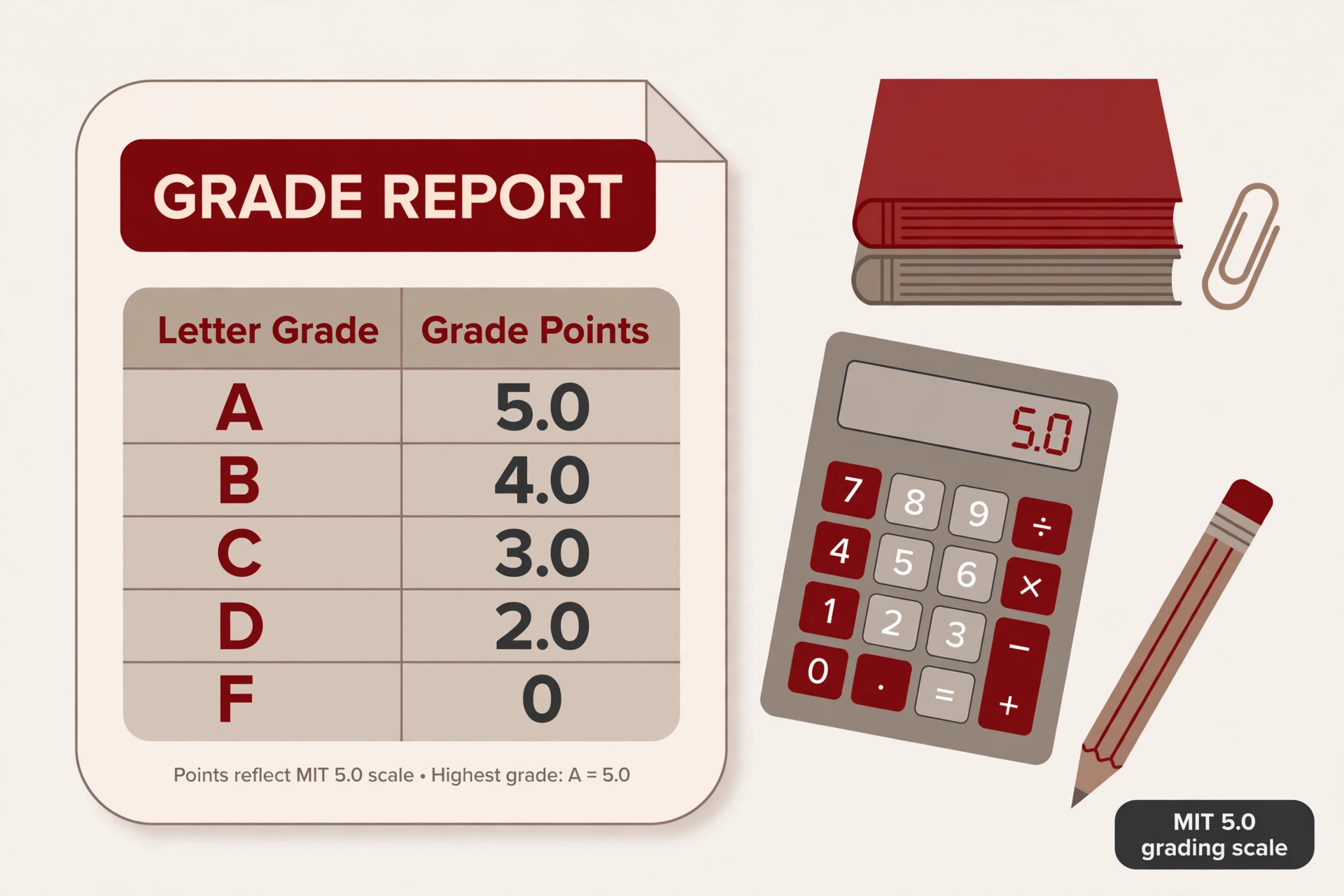
MIT grades on a 5.0 scale with no plus or minus modifiers. The mapping is:
| Letter Grade | Grade-Point Value |
|---|---|
| A | 5.0 |
| B | 4.0 |
| C | 3.0 |
| D | 2.0 |
| F | 0.0 |
There is no A+ worth extra points and no B- worth fewer. An A is 5.0, period. This is one of the most common sources of error when students estimate their MIT GPA with generic tools: the generic tool silently converts every A to 4.0 and understates the real result by a full point.
MIT GPA Rounding Rules
MIT reports the official GPA to one decimal place, and the rounding rule is worth knowing because a single hundredth can move the reported number. If the digit in the hundredth place is 5 or above, the tenth place rounds up. If it is 4 or below, the tenth place stays.
In practice: a computed GPA of 4.75 is reported as 4.8, while 4.74 is reported as 4.7. A 4.449 becomes 4.4 and a 4.451 becomes 4.5. Because the official record shows only one decimal, small changes in one subject can shift the reported GPA by a full tenth — or change nothing at all, if the movement stays inside the same tenth. An MIT GPA calculator that rounds the same way MIT does avoids unpleasant surprises on the transcript.
Worked Example: Calculating an MIT GPA Step by Step
Suppose a student completes a term with four subjects:
- 12-unit subject, grade A
- 12-unit subject, grade B
- 9-unit subject, grade A
- 6-unit subject, grade C
Step 1: Convert each grade to grade points.
- A in a 12-unit subject: 5.0 x 12 = 60
- B in a 12-unit subject: 4.0 x 12 = 48
- A in a 9-unit subject: 5.0 x 9 = 45
- C in a 6-unit subject: 3.0 x 6 = 18
Step 2: Add the grade points. 60 + 48 + 45 + 18 = 171 total grade points.
Step 3: Add the GPA-bearing units. 12 + 12 + 9 + 6 = 39 units.
Step 4: Divide. 171 / 39 = 4.3846…, which MIT reports as 4.4 after rounding to one decimal.
Notice how the 12-unit subjects dominate the result. The C in the small 6-unit subject costs far less than a C in a 12-unit subject would. This weighting is why students planning their effort around GPA always check unit counts first.
MIT First-Year Grading: Pass/No Record Explained
MIT’s first-year grading system confuses almost everyone at first, and it matters for GPA calculation because most first-year grades never touch the GPA at all.
Fall Term and IAP: Pass/No Record
In the fall term of the first year and during IAP (the Independent Activities Period in January), MIT uses Pass/No Record grading. Subjects are graded P for pass or NR for no record. Neither mark contributes grade points or GPA units, so fall and IAP grades do not affect the GPA in any direction. A first-year student simply does not have an official GPA after the fall term.
Spring Term: ABC/No Record
In the spring of the first year, MIT uses ABC/No Record grading. Students receive A, B, or C grades that do count toward the GPA, while anything below a C becomes No Record and vanishes from the GPA calculation. The first official GPA is therefore calculated after the spring term, based only on spring subjects. This design gives first-year students room to adjust to MIT’s pace without early stumbles permanently scarring their record.
Flexible P/NR in Later Years
After the first year, eligible undergraduates may use Flexible P/NR grading for a limited number of subjects, choosing to take a subject on a Pass/No Record basis under official rules. A Flexible P result, like any P, contributes neither grade points nor GPA units. Students use this option strategically — typically for demanding electives outside their comfort zone — and an MIT GPA calculator should let those subjects be excluded from the GPA-bearing total.
What Counts Toward Your MIT GPA (and What Does Not)
Only letter-graded subjects with A through F grades contribute to the GPA. Pass (P), No Record (NR), and other non-letter marks contribute neither grade points nor GPA units — they are simply left out of both the numerator and the denominator. This is an important subtlety: excluding a subject does not drag the GPA down the way a zero would. It just shrinks the pool of units the average is computed over.
Transfer credit, advanced standing credit, and most subjects taken at other institutions also sit outside the MIT GPA. The GPA reflects performance in MIT subjects graded on the MIT scale, nothing else.
For students tracking cumulative performance across terms, the same formula applies: add up every grade point earned in every GPA-bearing subject across all terms, divide by every GPA-bearing unit across all terms. A running cumulative GPA can be maintained with a general CGPA calculator as long as the 5.0 grade values are entered instead of 4.0 values.
Converting an MIT GPA to a 4.0 Scale
Sooner or later, most MIT students need their GPA expressed on the standard 4.0 scale — for graduate school applications, scholarships, or employers whose forms only accept 4.0-scale numbers. There is no single official conversion, because MIT’s scale is not linear in the way a simple ratio would suggest. The most widely used approach is the proportional conversion:
4.0-scale GPA = (MIT GPA / 5.0) x 4.0
Under this method, a 4.5 MIT GPA converts to 3.6, a 4.0 converts to 3.2, and a perfect 5.0 converts to 4.0. Many students use exactly this proportional mapping when a form demands a 4.0 number. Credential evaluation services sometimes apply their own course-by-course conversions instead, so students applying abroad should check what the receiving institution or evaluator expects.
Indian students face the mirror-image version of this problem: they arrive with a CGPA on the 10-point scale and need to understand where they stand against MIT’s 5.0 expectations. The UGC’s CBCS grading guidelines at ugc.gov.in describe the official Indian 10-point framework, which is the right starting point before attempting any cross-scale comparison. A general grade GPA calculator can handle the 4.0-scale side of these conversions once the grade values are set correctly.
Using an MIT GPA Calculator: Step by Step
Whether the tool is a web calculator or a spreadsheet, the workflow is the same:
- List every subject for the term, with its unit count and letter grade.
- Remove any subject graded P, NR, or another non-letter mark — these contribute nothing to either side of the fraction.
- Convert each remaining grade using the 5.0 scale: A = 5.0, B = 4.0, C = 3.0, D = 2.0, F = 0.
- Multiply each grade-point value by its subject’s units to get grade points.
- Add all grade points and all GPA-bearing units separately.
- Divide total grade points by total units, then round to one decimal place using MIT’s rounding rule.
Double-check two things before trusting the result: that first-year P/NR subjects were excluded rather than counted as zeros, and that no plus/minus adjustments crept in. Those two mistakes account for nearly every wrong MIT GPA students compute on their own.
Tips to Keep Your MIT GPA Strong
Unit weighting is the single biggest lever. A 12-unit subject moves the GPA roughly twice as much as a 6-unit subject, so effort should follow units. Students who distribute study time in proportion to unit counts usually outperform those who split it evenly.
The Flexible P/NR option exists for a reason: taking one genuinely exploratory subject per term on a P/NR basis protects the GPA while keeping the schedule adventurous. Used sparingly and within the official rules, it is a feature of the system, not a loophole.
Finally, the unglamorous truth: showing up drives grades. Consistent class attendance correlates with stronger performance in demanding technical subjects, and students who want a number on it can track their own record with an attendance percentage calculator. A term with strong attendance rarely produces a weak GPA.
Frequently Asked Questions
Is the MIT GPA on a 5.0 scale?
Yes. MIT uses a 5.0 scale where A = 5.0, B = 4.0, C = 3.0, D = 2.0, and F = 0. There are no plus or minus grades. A perfect record at MIT is a 5.0, not a 4.0.
How does MIT round GPA?
MIT reports the official GPA to one decimal place. If the hundredth digit is 5 or higher, the tenth rounds up (4.75 becomes 4.8). If it is 4 or lower, the tenth stays (4.74 becomes 4.7).
Do Pass/No Record grades affect the MIT GPA?
No. P, NR, and other non-letter marks contribute neither grade points nor GPA-bearing units. They are excluded from the calculation entirely, which means they neither help nor hurt the GPA.
When does an MIT student get their first official GPA?
After the spring term of the first year. Fall and IAP are graded Pass/No Record, which does not generate a GPA. Spring uses ABC/No Record, and those letter grades form the first official GPA.
What is a good GPA at MIT?
MIT does not publish official GPA thresholds for “good,” and grading culture varies by department. As a rough frame of reference, a GPA above 4.5 represents mostly A grades, the low 4s represent a mix of A and B grades, and anything above 4.0 is generally considered strong given MIT’s rigor.
How do I convert my MIT GPA to a 4.0 scale?
The common proportional method is (MIT GPA / 5.0) x 4.0. A 4.5 MIT GPA converts to roughly 3.6 on the 4.0 scale. Graduate schools and credential evaluators may use their own course-by-course methods, so confirm before submitting.
Does MIT count A+ grades?
No. MIT’s grading system has no plus or minus modifiers. The top grade is a plain A worth 5.0 grade points.


