 Skip to main content


TDEE — Total Daily Energy Expenditure — is the total number of calories the human body burns in a full 24-hour day. Every diet plan, every “eat this many calories” recommendation, and every explanation of why two people can eat the same food and get different results traces back to this one number. Yet most people have never heard of it, and many who have confuse it with BMR or with the calories printed on food labels. This guide explains what TDEE actually is, what it is made of, why it matters more than any fixed calorie rule, and how the number behaves in real life.
TDEE in One Paragraph
TDEE is the sum of every calorie the body spends in a day: the energy to keep the heart beating and lungs breathing at rest, the energy to digest food, the energy of walking to the kitchen and fidgeting at a desk, and the energy of a workout. Add all of it together and the total is the body’s daily energy budget. Eat exactly that many calories and weight stays roughly stable; eat more and the surplus is stored; eat less and the body draws on its reserves. Everything else in nutrition — deficits, surpluses, maintenance — is arithmetic built on top of TDEE.
The Four Components of TDEE
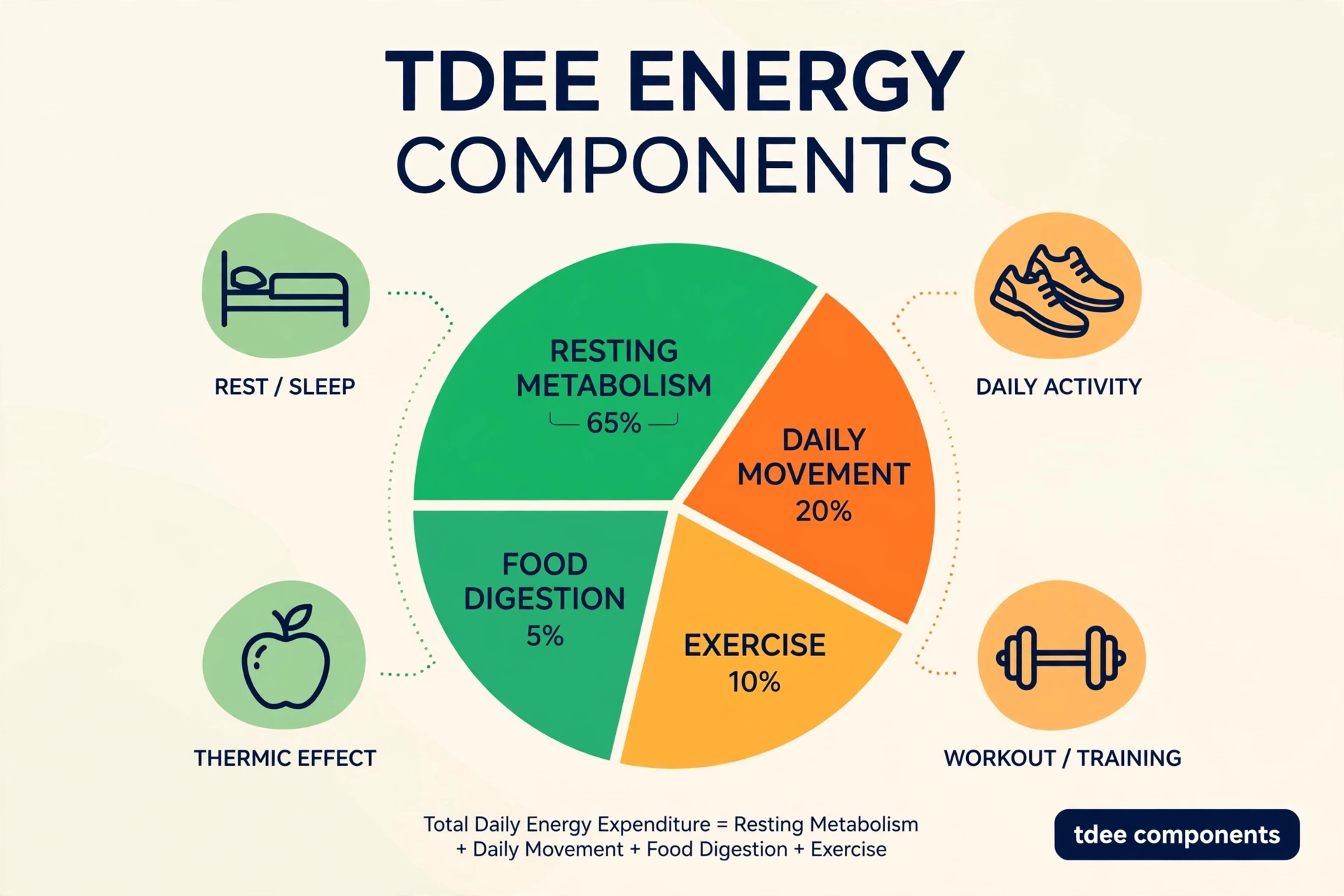
TDEE is not one thing but four, and understanding the split is what makes the concept useful. The proportions below describe a typical non-athlete adult; athletes shift more toward exercise, and older adults shift more toward the resting component.
1. Basal Metabolic Rate (BMR): 60–70%
BMR is the energy the body needs for its vital functions at complete rest — breathing, circulation, brain activity, body temperature, cell repair. It is by far the largest slice of TDEE, which surprises people who assume exercise dominates. BMR is set mainly by body size, muscle mass, age, and sex: bigger bodies and more muscular bodies burn more at rest, and BMR drifts down with age as muscle tends to decline. Healthline’s overview of metabolic age shows how this same resting burn is used to compare metabolic health across age groups.
2. Non-Exercise Activity Thermogenesis (NEAT): 15–30%
NEAT is the energy of everything active that is not deliberate exercise: walking between rooms, standing, fidgeting, typing, shopping, cleaning, taking the stairs. It is the most underrated component and the one that varies most between individuals. A nurse on shift can burn several hundred more calories a day through NEAT than a desk worker of identical size — which explains a large part of why some people “eat whatever they want” without gaining. Small NEAT upgrades, like a daily walk or a standing desk, quietly raise TDEE without any gym time.
3. Thermic Effect of Food (TEF): 8–15%
Digestion itself costs energy. The body spends calories breaking food down, absorbing nutrients, and storing or using the result — roughly a tenth of daily intake on average. Protein has the highest thermic effect by far, costing far more to process than fat or carbohydrate, which is one reason higher-protein diets are slightly more “expensive” for the body to run on.
4. Exercise Activity Thermogenesis (EAT): 5–10%
EAT is the planned workout — the run, the lifting session, the swim. For most non-athletes it is the smallest slice, typically just 5–10% of TDEE. That is not an argument against exercise; training builds the muscle that raises BMR and improves every health marker. It is simply a correction to the common belief that the workout is where most calories go. The 80–90% the body burns without thinking about it is where energy balance is actually decided.
TDEE vs BMR vs “Calories In”: Clearing Up the Confusion
Three numbers get tangled constantly, so here is the clean separation. BMR is the resting baseline — what the body burns doing nothing, roughly two-thirds of TDEE. TDEE is BMR plus everything else: the full 24-hour spend, and the number calorie targets are built from. “Calories in” is food energy eaten, the other side of the ledger. Weight change is the gap between calories in and TDEE, not between calories in and BMR — a distinction that matters because BMR alone ignores 30–40% of daily burn.
Why TDEE Matters More Than Any Fixed Calorie Number
Generic advice like “eat 2,000 calories a day” fails because TDEE varies enormously between people. A tall, active young man might have a TDEE near 3,000; a small, sedentary older woman might sit near 1,600. The same 2,000-calorie diet is a comfortable deficit for one and a surplus for the other. TDEE personalizes the target: it replaces the chart with the individual’s own math. That is also why the number is the starting point of every serious fat-loss, muscle-gain, or maintenance plan — without it, calorie targets are guesses.
Anyone who wants their own figure can estimate it in a minute with a free TDEE calculator, which combines a BMR equation with an activity multiplier.
What Makes One Person’s TDEE Higher Than Another’s
Body size. Larger bodies cost more energy to run and move — height and weight are the two biggest inputs in every TDEE equation.
Muscle mass. Muscle is metabolically expensive tissue. Two people at the same weight can have TDEEs hundreds of calories apart if one carries significantly more muscle, because the muscular person’s BMR runs higher around the clock.
Age. TDEE drifts down with age, roughly 100 calories per decade after the twenties, mostly tracking the gradual loss of muscle. Strength training is the direct countermeasure.
Sex. Men average higher TDEEs than women of the same age and height, largely because of greater average muscle mass — the equations account for this with separate constants.
Daily movement habits. NEAT differences between a physical job and a desk job can exceed the calories of a full workout. Occupation and lifestyle often matter more than the gym.
Hormones, illness, and medication. Thyroid function, for example, directly sets the pace of resting metabolism. Anyone with a medical condition affecting weight should treat TDEE as a discussion point with their doctor, not a self-service number.
A Day in the Life of Your TDEE
Numbers feel abstract until they wear a schedule. Take a 70 kg office worker with a TDEE of roughly 2,300 calories:
- Sleep, 8 hours: the body still runs the vital systems — about 550 calories of BMR, the night shift of TDEE.
- Morning routine and commute, 2 hours: showering, dressing, walking to transit — around 200 calories of NEAT.
- Desk work, 8 hours: typing, meetings, fidgeting — roughly 700 calories, mostly BMR with a NEAT topping.
- Lunch and digestion: the meal itself costs about 10% of its calories to process — TEF quietly at work.
- Evening gym session, 1 hour: 300–400 calories of EAT, the visible but modest slice.
- Evening at home, 5 hours: cooking, tidying, television — another 350 calories split between BMR and NEAT.
Two observations jump out. First, the workout — the part people obsess over — is one line among six. Second, NEAT appears in almost every line; it is the background hum of the whole day. Anyone hunting for a higher TDEE usually finds it faster in the ordinary hours than in an extra gym session.
How People Use Their TDEE
Once the number is known, it becomes a reference point for three goals. Maintenance means eating at TDEE — the right target during diet breaks or when holding a reached weight. Fat loss means eating moderately below TDEE, typically 300–500 calories under, which produces steady loss while preserving muscle when paired with protein and resistance training. Muscle gain means eating modestly above TDEE, roughly 200–300 calories over, supplying the surplus new tissue is built from. This article stays at the concept level by design; the step-by-step calculation method belongs to dedicated how-to guides.
Why TDEE Changes Over Time
TDEE is not a fixed trait — it is a moving number, and misunderstanding that causes most diet frustration. Lose 10 kg and the smaller body burns fewer calories at rest and in motion, so TDEE falls; the same calorie intake that produced loss at the start becomes maintenance a few months later. This is the famous plateau, and it is not a broken metabolism — it is the equation updating its inputs. The practical fix is to recompute TDEE every few weeks during active weight change and adjust targets to the new number. Activity changes move it too: a new desk job, an injury, or a marathon training block can shift TDEE by hundreds of calories in either direction.
Common Myths About TDEE
“My TDEE is slow because of my metabolism.” For most people, a low TDEE reflects low muscle mass and low daily movement, not a defective metabolism. Both are changeable.
“Exercise is the main driver.” As the component split shows, planned exercise is usually the smallest slice. NEAT and BMR do the heavy lifting.
“Eating too little destroys TDEE permanently.” Severe, prolonged dieting can suppress energy expenditure beyond what weight loss alone predicts — the body adapts — but the effect reverses with refeeding and retraining. It is real but not permanent.
“TDEE calculators are exact.” They are estimates built on population equations, typically within 10–15% of the true value. They are excellent starting points and poor finishing lines.
TDEE Is an Estimate, Not a Lab Result
The only way to measure true energy expenditure is doubly labeled water or a metabolic chamber — precise, expensive, and impractical. Everything else, from online calculators to fitness watches, is an estimate layered on equations and assumptions. The honest way to use TDEE is as a starting hypothesis: estimate it, eat to the target for two to three weeks, watch the scale and the mirror, and adjust. The body’s response is the final authority, and it outranks any calculator output. Treat TDEE as the map, not the territory.
What TDEE Cannot Tell You
TDEE is powerful but bounded, and knowing its edges prevents misuse. It says nothing about food quality — 2,300 calories of whole foods and 2,300 of sweets share a TDEE but not a health outcome. It says nothing about body composition change — the scale can hold steady at maintenance calories while muscle replaces fat, a recomposition TDEE alone cannot see. It does not diagnose metabolic conditions; thyroid disorders and medications move the real number away from every equation. And it cannot account for adaptation — after long dieting, actual expenditure can run below the formula’s prediction for a while. TDEE answers one question brilliantly (how much energy did today cost?) and should not be asked to answer the rest of nutrition.
FAQs
What is TDEE in simple words? The total calories your body burns in one full day — resting, digesting, moving, and exercising combined.
What is a normal TDEE? It varies widely: roughly 1,600–2,000 for small sedentary adults and 2,500–3,200+ for large active ones. “Normal” is personal.
Is TDEE the same as BMR? No. BMR is the resting portion only (60–70% of TDEE). TDEE adds digestion, daily movement, and exercise on top.
Does TDEE include exercise? Yes — exercise activity thermogenesis (EAT) is one of the four components, though usually the smallest for non-athletes.
How often should I recalculate my TDEE? Every 4–8 weeks during active weight change, or whenever activity level, weight, or routine shifts meaningfully.
Can TDEE be increased? Yes: build muscle (raises BMR), move more through the day (raises NEAT), and train regularly (raises EAT). Age-related decline is slowed, not stopped, by the same habits.
Why do two calculators give different TDEE values? They may use different BMR equations (Mifflin-St Jeor vs Harris-Benedict) or interpret activity levels differently. Pick one method and track trends with it.
Students visiting for academics can also try the site’s grade GPA calculator or start from the homepage.


