 Skip to main content


Every calorie calculator on the internet starts from the same foundation: the energy the body burns just by being alive. That foundation has a name — Basal Energy Expenditure, or BEE — and a BEE calculator estimates it from four simple inputs: sex, age, height, and weight. The number it produces is the starting point for weight-loss plans, sports nutrition, and clinical feeding decisions alike.
Yet most people who use a BEE calculator cannot say what the number means, which equation produced it, or how far to trust it. This guide fixes that. It explains what basal energy expenditure is, how the century-old Harris-Benedict equation computes it, how to calculate BEE by hand with worked examples, how BEE becomes total daily energy expenditure, and where the estimates break down. It is written to go deeper than the formula-and-tool pages that currently rank for this topic.
Quick Answer
What does a BEE calculator measure? A BEE calculator estimates Basal Energy Expenditure, the number of calories the body needs over 24 hours to sustain its fundamental functions while completely at rest, from four inputs: sex, age, height, and weight. BEE typically represents the largest single share of daily calorie burn, often 60 to 70 percent of the total, and it is the foundation on which activity multipliers build total daily energy expenditure.
What Is Basal Energy Expenditure?
Basal Energy Expenditure is the number of calories the body needs over 24 hours to sustain its fundamental functions while completely at rest — awake but lying still, in a thermally neutral environment, roughly 12 hours after the last meal. Breathing, blood circulation, body temperature regulation, brain activity, cell repair, and hormone production all draw energy continuously, and BEE is the accounting total.
BEE typically represents the largest single share of daily calorie burn — often 60 to 70 percent of the total for a sedentary person — which is why every serious calorie plan starts here rather than with exercise estimates. Exercise calories are the variable garnish; BEE is the main course. Anyone who has wondered why two people of the same weight can eat very differently without gaining is usually looking at differences in the components that BEE summarizes: body size, body composition, age, and sex.
BEE vs BMR vs TDEE: Clearing Up the Confusion
Three terms orbit this topic and are constantly mixed up. Here is the clean distinction:
- BEE (Basal Energy Expenditure) and BMR (Basal Metabolic Rate) measure the same thing: resting energy needs over 24 hours. The difference is mostly contextual — BEE is the preferred term in clinical nutrition and medical settings, while BMR appears more often in fitness and sports science. A BEE calculator and a BMR calculator using the Harris-Benedict equation will give the same answer.
- TDEE (Total Daily Energy Expenditure) is the bigger number: BEE plus everything else — daily activity, exercise, and the energy cost of digesting food. TDEE is what weight-management plans actually target.
Think of it as layers: BEE is the foundation, activity multipliers build TDEE on top of it, and food choices are planned against the TDEE total. This article owns the BEE layer — the foundation and its equation. For the full daily total, the site’s TDEE calculator applies the activity multipliers covered later in this guide.
The Harris-Benedict Equation: The Formula Behind Every BEE Calculator
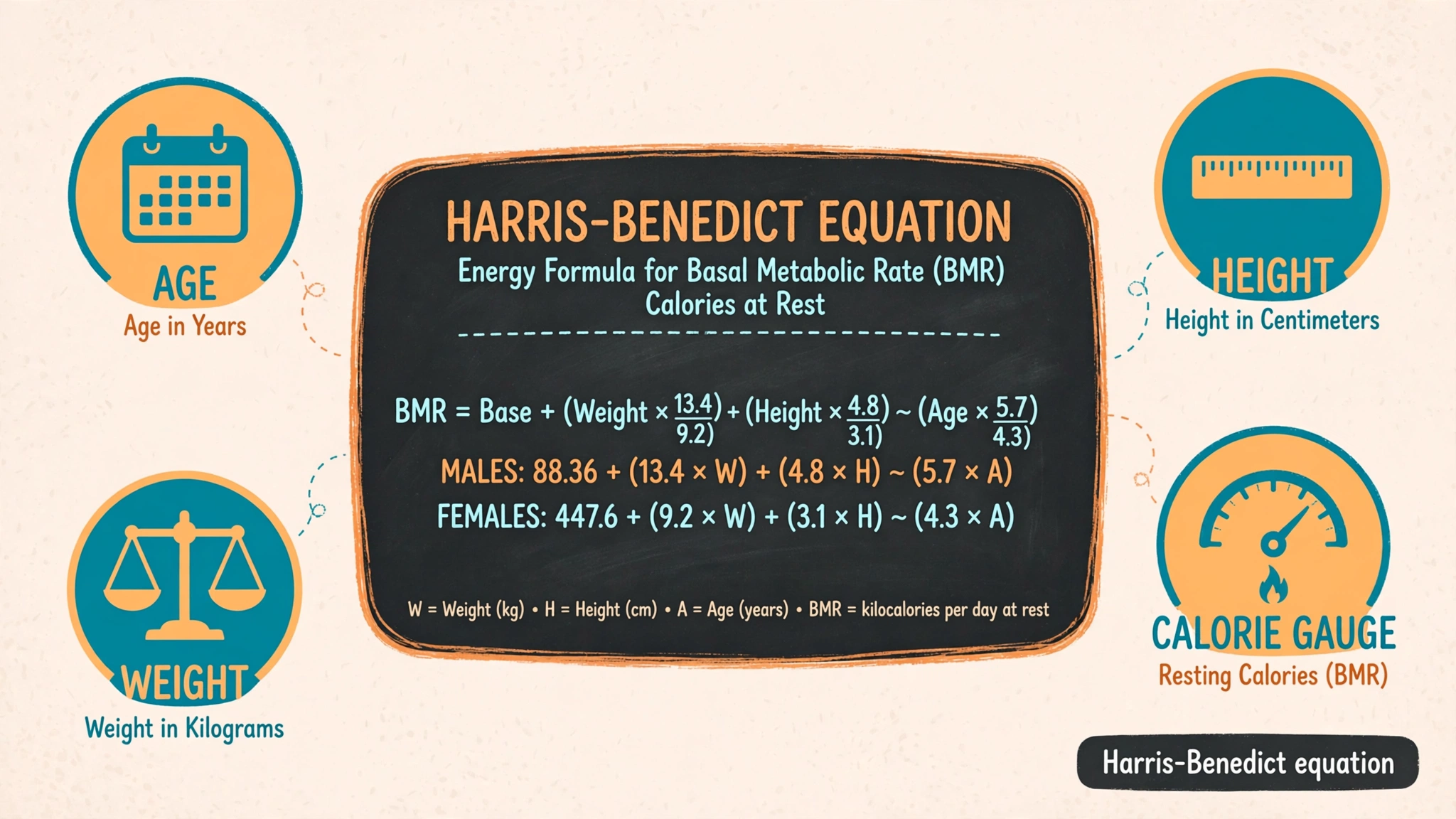
Nearly every BEE calculator uses the original Harris-Benedict equation, published in 1919 by J. Arthur Harris and Francis G. Benedict after their biometric study of basal metabolism at the Carnegie Institute. A century of newer equations exists, but Harris-Benedict remains the default because it needs only four easily measured inputs and performs reasonably across typical adult bodies.
The equations differ by sex because lean body mass is a major determinant of resting energy burn, and women on average carry more body fat and less lean muscle than men of the same weight — so female BEE runs lower.
Metric Formulas
Using weight in kilograms and height in centimeters:
- Men: BEE = 66.5 + (13.75 x weight in kg) + (5.003 x height in cm) – (6.775 x age in years)
- Women: BEE = 655.1 + (9.563 x weight in kg) + (1.850 x height in cm) – (4.676 x age in years)
The result is in kilocalories per day (kcal/day).
Imperial Formulas
Using weight in pounds and height in inches:
- Men: BEE = 66.5 + (6.23 x weight in lb) + (12.7 x height in inches) – (6.76 x age in years)
- Women: BEE = 655.1 + (4.35 x weight in lb) + (4.7 x height in inches) – (4.7 x age in years)
Most online calculators accept either system and convert imperial inputs to metric internally before applying the equation. When calculating by hand, pick one system and stay in it — mixing kilograms with inches is the classic arithmetic error.
The Four Inputs a BEE Calculator Needs
A BEE calculator asks for exactly four things, and each one earns its place:
- Sex — the equation is sex-specific because of average differences in lean mass. Calculators use biological sex here, not gender identity, because the variable that matters is body composition.
- Age — BEE declines with age as muscle mass decreases and metabolic rate slows. The equation subtracts an age term, so older inputs produce lower BEE.
- Height — taller bodies have more tissue to maintain. Height enters positively: more centimeters mean more calories.
- Weight — heavier bodies cost more energy to run. Weight is the strongest positive driver in the equation.
Notice what is missing: body fat percentage. The original Harris-Benedict equation does not use it, which is both its convenience (no special measurement needed) and its main weakness (two people of identical height, weight, age, and sex can have very different muscle mass). Newer equations like Katch-McArdle incorporate lean mass for this reason, but they require a body-fat measurement most people do not have.
Worked Example 1: Calculating BEE for a Man
Take a 35-year-old man weighing 75 kg at 175 cm tall, using the metric formula:
BEE = 66.5 + (13.75 x 75) + (5.003 x 175) – (6.775 x 35)
Step by step:
- 13.75 x 75 = 1031.25
- 5.003 x 175 = 875.525
- 6.775 x 35 = 237.125
- BEE = 66.5 + 1031.25 + 875.525 – 237.125 = 1736.15
His basal energy expenditure is approximately 1,736 kcal per day. That is what his body burns before he gets out of bed, walks anywhere, or digests a single meal. Per hour, it is about 72 kcal — the body is never truly “off.”
Worked Example 2: Calculating BEE for a Woman
Take a 30-year-old woman weighing 60 kg at 165 cm tall:
BEE = 655.1 + (9.563 x 60) + (1.850 x 165) – (4.676 x 30)
Step by step:
- 9.563 x 60 = 573.78
- 1.850 x 165 = 305.25
- 4.676 x 30 = 140.28
- BEE = 655.1 + 573.78 + 305.25 – 140.28 = 1393.85
Her BEE is approximately 1,394 kcal per day. The gap between the two examples — roughly 340 kcal — comes mostly from the sex-specific constants and the weight difference, which is exactly why the equation keeps the two formulas separate.
From BEE to TDEE: The Activity Multipliers
BEE describes a person lying still all day, which describes nobody. To estimate real daily needs, BEE is multiplied by an activity factor:
- Sedentary (little to no exercise): BEE x 1.2
- Lightly active (light exercise 1-3 days/week): BEE x 1.375
- Moderately active (moderate exercise 3-5 days/week): BEE x 1.55
- Very active (hard exercise 6-7 days/week): BEE x 1.725
- Extremely active (very hard exercise, physical job, or training twice daily): BEE x 1.9
The man from Example 1 with a moderately active lifestyle: 1,736 x 1.55 = 2,691 kcal/day TDEE. That 2,691 is the maintenance number — eat at it to hold weight, below it to lose, above it to gain. Choosing the activity level honestly is where most self-calculations go wrong; desk workers who walk the dog routinely select “moderately active” and overshoot by 300+ calories. When in doubt, pick the lower level for two weeks and adjust based on what the scale does. Sedentary office workers are the classic 1.2x case, and employers tackling low energy and absenteeism often address nutrition and movement together with structured attendance improvement tactics.
Stress and Temperature Factors: The Clinical Side of BEE
In hospitals, BEE is only the starting point of a longer chain. Total Energy Expenditure for a patient is estimated as:
TEE = BEE x Activity factor x Stress factor x Temperature factor
Stress factors account for the metabolic cost of illness, injury, surgery, or trauma — severe stress can raise energy needs substantially, with clinical practice commonly using factors around 1.5 to 2.0 for severe cases. Fever raises expenditure too, roughly 7-13% per degree Celsius above normal depending on the reference used. This is the “clinical nutrition” context where the term BEE (rather than BMR) dominates, and it is why dietitians in critical care start from Harris-Benedict rather than fitness-industry variants.
None of this applies to healthy people planning meals — but it explains why BEE calculators built for clinical use ask about stress and fever while fitness ones do not.
How to Use Your BEE Number for Weight Goals
The practical pipeline is: BEE -> TDEE -> target calories -> food plan.
- Calculate BEE from the four inputs.
- Multiply by the honest activity factor to get TDEE (maintenance calories).
- Set the target: roughly 500 kcal below TDEE per day for steady fat loss of about 0.5 kg per week; roughly 300-500 above for lean muscle gain.
- Never set the target below BEE for extended periods without professional guidance — eating below basal needs means under-fueling the organs the BEE number exists to protect.
The NIH’s National Institute of Diabetes and Digestive and Kidney Diseases explains the broader factors affecting weight and energy balance — sleep, medications, health conditions, and environment all modulate the simple calories-in-versus-calories-out picture that starts with BEE.
Energy management is also a performance issue beyond fitness. Students and professionals who eat in line with their real energy needs sustain focus better through long days — one more reason that people tracking body metrics often end up tracking habits like attendance with the same discipline.
Limitations: When BEE Estimates Miss
Harris-Benedict is an estimate, not a measurement, and honest guides say where it wobbles:
- Muscular builds: the equation underestimates BEE for very muscular people, because it cannot see that a kilogram of muscle burns more at rest than a kilogram of fat.
- Very lean or underweight bodies: accuracy drops at low BMI, where the equation can overestimate needs.
- Older adults: the age term is a population average; individual variation in muscle loss means some older adults burn meaningfully more or less than predicted.
- Children and teenagers: the equation was built for adults and should not be applied to growing bodies.
A BEE result is a starting estimate to be validated against reality — track intake and weight for two to three weeks, then adjust. The equation points the compass; the scale calibrates it.
Frequently Asked Questions
What is a BEE calculator?
A BEE calculator estimates Basal Energy Expenditure — the calories the body burns at complete rest over 24 hours — from sex, age, height, and weight, almost always using the Harris-Benedict equation.
Are BEE and BMR the same thing?
Functionally, yes. Both measure resting 24-hour energy needs. BEE is the term used in clinical nutrition; BMR is more common in fitness contexts. Calculators using the same equation give the same number under either name.
What is the Harris-Benedict equation?
The 1919 formula estimating BEE from sex, age, height, and weight. For men (metric): 66.5 + (13.75 x weight kg) + (5.003 x height cm) – (6.775 x age). For women: 655.1 + (9.563 x weight kg) + (1.850 x height cm) – (4.676 x age).
How do I go from BEE to TDEE?
Multiply BEE by an activity factor: 1.2 (sedentary), 1.375 (light), 1.55 (moderate), 1.725 (very active), or 1.9 (extremely active). The result is estimated total daily energy expenditure.
Is a BEE calculator accurate?
It is a reasonable estimate for typical adult bodies — usually within 10-15% of measured values — but less accurate for very muscular, very lean, elderly, or young users. Treat the result as a starting point and adjust based on real-world weight trends.
Can I use BEE to lose weight?
Yes, indirectly: BEE x activity factor gives TDEE (maintenance calories), and eating moderately below TDEE produces fat loss. Avoid sustained intake below BEE itself without professional guidance.
Why do men and women have different BEE formulas?
Because lean body mass drives resting energy burn, and women on average carry less lean mass than men of equal weight. The separate constants capture that average difference.


