 Skip to main content


Every semester, millions of students look at their report card and see a number like 8.2 or 7.6 printed where their marks used to be. That number is the CGPA, and while most students learn to calculate it, far fewer understand what it actually represents, why the education system switched to it, and what it says about their academic journey. This guide explains the meaning of CGPA from the ground up: its full form, the idea behind it, how grade points work, how it differs from SGPA and percentage, and why it matters for higher studies, jobs, and scholarships.
What Is CGPA? The Full Form Explained
CGPA stands for Cumulative Grade Point Average. Each word carries meaning:
- Cumulative — it accumulates performance across subjects and semesters, not just one exam.
- Grade Point — instead of raw marks, performance is expressed as grade points on a scale (usually 0 to 10 in India).
- Average — the grade points are averaged (with credits as weights at the college level) into a single number.
In plain language, CGPA is a single number that summarizes how well a student performed across an entire course or academic session. A CGPA of 8.5 does not tell you the student’s exact marks in Physics or English, but it tells you, at a glance, that the student performed at a strong level overall.
The system is used across Indian schools following the CBSE pattern, most state boards that adopted grading, and the vast majority of Indian universities running semester-based programs. It also exists internationally: American and Canadian universities use a 4.0-scale GPA, which is the same idea on a different scale.
Why Does the CGPA System Exist? A Brief History
To understand what CGPA means, it helps to understand the problem it was built to solve.
The problem with raw marks
For decades, Indian students were judged purely on marks out of 100. A student scoring 92% was declared better than one scoring 91%, even though a one-mark difference often comes down to examiner mood, handwriting, or a single careless error. Marks created unhealthy cutthroat competition, tiny differences were treated as meaningful, and students were ranked to decimal places on what was essentially noisy measurement.
Marks also made comparison difficult. A 75 in one university’s tough paper was not the same achievement as a 75 in another university’s easier paper, yet the numbers looked identical.
How grading entered Indian education
The shift began in earnest when the CBSE introduced the Continuous and Comprehensive Evaluation (CCE) system in 2009, replacing marks with a 9-point grading scale and CGPA for Class X board results. The message was deliberate: stop obsessing over single marks and look at performance in bands.
At the higher-education level, the University Grants Commission (UGC) recommended that Indian universities move toward a uniform 10-point grading system under the Choice Based Credit System. Over the following decade, most Indian universities adopted semester systems with letter grades, grade points, and credit weighting, making CGPA the standard summary figure on transcripts nationwide. For readers who want to see the official grading framework, the UGC publishes its regulations and guidelines at ugc.gov.in.
The philosophy behind the change is simple: education is better served by grouping performance into meaningful levels than by pretending a one-mark difference reflects a real difference in learning.
What Does CGPA Actually Measure?
CGPA measures overall academic performance across a defined period, expressed on a standardized scale. A few things it captures:
- Consistency — Because it averages many subjects and semesters, a high CGPA means the student performed well repeatedly, not just once.
- Breadth — It covers every subject in the curriculum, so it reflects the whole program rather than a favorite subject.
- Relative standing — Grade points are defined against fixed performance bands, so a CGPA has roughly the same meaning across different subjects and semesters within the same institution.
What CGPA does not measure is equally important. It does not measure intelligence, creativity, practical skill, or effort directly. Two students with the same CGPA may have very different strengths. CGPA is a summary statistic, and like all summaries, it hides detail. That is the trade-off the system accepts in exchange for simplicity.
How Grade Points Work
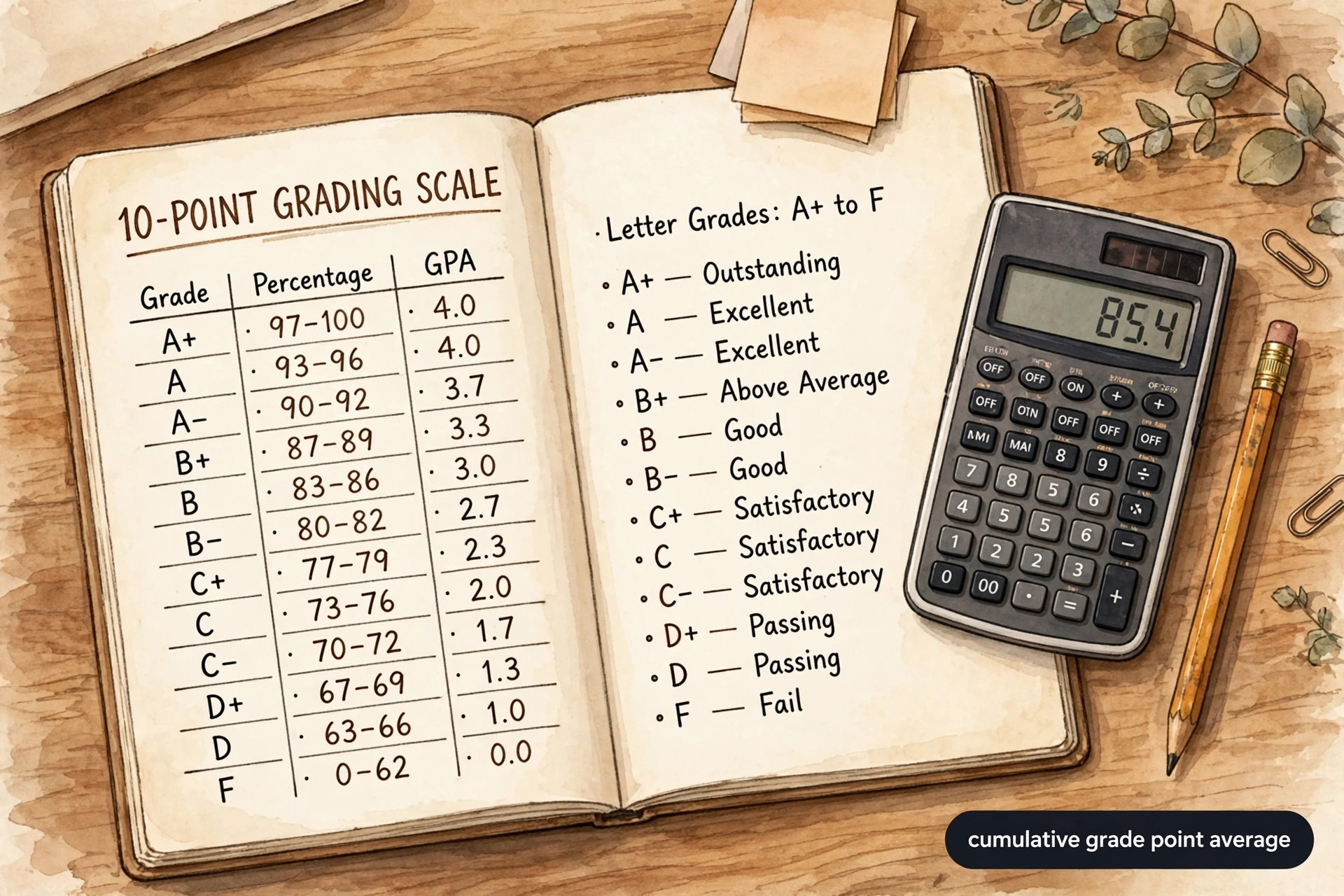
The building block of CGPA is the grade point: a number assigned to a letter grade. Most Indian institutions use a 10-point scale recommended in UGC-aligned frameworks:
| Letter Grade | Meaning | Grade Point | Typical Marks Range |
|---|---|---|---|
| O | Outstanding | 10 | 90–100 |
| A+ | Excellent | 9 | 80–89 |
| A | Very Good | 8 | 70–79 |
| B+ | Good | 7 | 60–69 |
| B | Above Average | 6 | 50–59 |
| C | Average | 5 | 40–49 |
| F | Fail | 0 | Below 40 |
Each subject’s marks are converted to a grade, the grade becomes a grade point, and the grade points are averaged. At the school level (CBSE Class X pattern), the average is usually a simple average of subject grade points. At the college level, credits weight the average: a 4-credit core subject influences the result more than a 1-credit lab.
The exact grade boundaries can vary slightly between universities — one institution may award an A+ at 80 while another starts it at 85 — which is why students should always check their own university’s grading table rather than assuming a universal chart.
Where You Will Find Your CGPA
CGPA appears in several official documents throughout a student’s academic life:
- School report cards — CBSE and many state-board report cards print the CGPA prominently, sometimes alongside subject-wise grades.
- Semester marksheets — Universities print the SGPA (semester figure) and the running CGPA on each semester’s marksheet.
- Degree transcripts — The final consolidated transcript or degree certificate carries the overall CGPA, which is the number employers and foreign universities ask for.
- Online student portals — Most universities now show live SGPA/CGPA figures in their student information systems after each semester’s results.
Because the CGPA on the final transcript is the official record, students applying for jobs or higher studies should always quote the figure exactly as it appears there, not a self-calculated approximation.
CGPA vs SGPA vs GPA vs Percentage
These four terms are constantly mixed up. Here is how they differ:
| Term | Full Form | What It Covers | Scale (India) |
|---|---|---|---|
| SGPA | Semester Grade Point Average | One semester only | 0–10 |
| CGPA | Cumulative Grade Point Average | All semesters so far (cumulative) | 0–10 |
| GPA | Grade Point Average | One term; the American equivalent of SGPA | 0–4.0 |
| Percentage | — | Marks-based; raw scores out of 100 | 0–100 |
Think of it this way: SGPA is a chapter, CGPA is the whole book. GPA is the same book in a different language (the American 4.0 scale). Percentage is a different measuring instrument altogether — it counts marks, while the others count grade points.
A common point of confusion: some universities compute CGPA as the simple average of semester SGPAs, while others recompute it from all subjects and credits across semesters. The two methods can give slightly different results when semesters carry different credit loads. The transcript figure is always the official one.
Students who want to see how the semester-level figure feeds into the cumulative one can read a detailed walkthrough of the SGPA calculation and then watch how each semester’s SGPA becomes a building block of the final CGPA. When it is time to run the numbers, a dedicated CGPA calculator handles the credit-weighted math, and students working on the American scale can use a GPA calculator built for the 4.0 system.
Why CGPA Matters: 6 Real-World Uses
CGPA is not just a report-card decoration. It functions as a gatekeeper in at least six important situations:
1. Higher education admissions
Indian postgraduate programs routinely set CGPA cutoffs, and foreign universities convert CGPA to their local scale during application review. A consistently strong CGPA signals academic readiness better than a single good semester.
2. Campus placements
Many companies set minimum CGPA eligibility criteria for placement drives — commonly 6.0, 6.5, 7.0, or 7.5 depending on the recruiter. Students below the cutoff are filtered out before interviews begin, which makes every semester count from the first year onward.
3. Scholarships
Merit scholarships, both government and private, frequently require applicants to maintain a minimum CGPA. Some renew annually only if the CGPA stays above the threshold.
4. Study-abroad applications
Credential evaluation agencies convert a 10-point CGPA into the 4.0 GPA scale used by American universities. Admissions committees look at the CGPA trend across semesters, not just the final number — an upward trajectory can strengthen an application.
5. Government jobs and competitive exams
Several public-sector recruitments and fellowship programs ask for CGPA or its percentage equivalent on the application form, and shortlisting may depend on it.
6. Academic progression
Universities set minimum CGPA requirements for promotion to the next year, for honors classifications, and for degree award. Falling below the minimum can mean repeating courses or losing a year.
What Is a Good CGPA?
There is no universal answer, because “good” depends on context. Still, students find it useful to have rough benchmarks on the 10-point scale:
- 9.0 and above — Exceptional. Opens nearly every door: top recruiters, premier institutes, competitive scholarships.
- 8.0 to 8.9 — Strong. Meets the eligibility bar for most placements and good postgraduate programs.
- 7.0 to 7.9 — Respectable. Clears many (though not all) placement cutoffs; usually classified as First Class.
- 6.0 to 6.9 — Average to below-average for competitive purposes. May miss premium placement cutoffs but suffices for the degree and many opportunities.
- Below 6.0 — The degree is still earned (subject to passing rules), but competitive options narrow significantly.
These bands describe general perception, not official classifications — universities define their own division and distinction rules. A 7.5 at one university might earn “First Class with Distinction” while another reserves that title for 8.0 and above.
It is also worth remembering that CGPA is only one factor in a student’s profile. Recruiters weigh internships, projects, and communication skills alongside it, and universities consider test scores, essays, and recommendations. A strong CGPA opens doors, but it rarely walks through them alone.
Consistent daily habits matter as much as exam-week effort: students who protect their class attendance tend to absorb material steadily instead of cramming, and that steadiness shows up in grade points. Readers can explore why attendance percentage matters for academic performance to see the connection.
Common Misconceptions About CGPA
“CGPA and percentage are the same thing.” They are not. Percentage counts marks; CGPA counts grade points. They are related through conversion formulas, but they are different measurement systems, and converting between them requires knowing the institution’s official rule.
“A 10 CGPA means 100%.” Under the common ×9.5 conversion, a 10 CGPA converts to 95%, not 100. Grade bands top out below perfect marks by design.
“CGPA only counts the final year.” The word “cumulative” is doing real work here — every semester contributes. First-year subjects count just as much per credit as final-year ones.
“Improving CGPA later is impossible.” Because CGPA is an average, later semesters can pull it up, though the mathematics gets harder as more semesters accumulate. Strong final semesters still move the needle.
“All universities calculate CGPA the same way.” They do not. Credit systems, grade tables, and averaging methods vary. Always follow your own university’s regulations.
Frequently Asked Questions
What is the full form of CGPA?
CGPA stands for Cumulative Grade Point Average. It is a standardized score, usually on a 10-point scale in India, that summarizes a student’s overall academic performance across subjects and semesters.
What is the difference between CGPA and SGPA?
SGPA (Semester Grade Point Average) covers a single semester, while CGPA (Cumulative Grade Point Average) accumulates performance across all completed semesters. Each semester’s SGPA feeds into the running CGPA.
Is CGPA the same as percentage?
No. CGPA is based on grade points (typically 0–10), while percentage is based on marks out of 100. They can be converted into each other using the institution’s official formula — commonly CGPA × 9.5 in CBSE-pattern schools — but they are different systems.
What is a good CGPA in India?
On the 10-point scale, 8.0 and above is generally considered strong, 7.0–7.9 is respectable and clears many placement cutoffs, and 9.0+ is exceptional. Context matters: cutoffs vary by recruiter, program, and university.
Where is CGPA used?
CGPA is used for higher-education admissions, campus placement eligibility, scholarships, study-abroad applications, some government job applications, and academic progression decisions like promotion and degree classification.
Can CGPA be improved after a bad semester?
Yes. Because CGPA is cumulative, strong performance in later semesters raises the average. The more semesters already completed, the more high grades are needed to move the number significantly — but improvement is always mathematically possible.
Does every country use CGPA?
The concept exists worldwide, but the scale differs. India commonly uses a 10-point scale, while the United States and Canada use a 4.0 GPA scale, and some European systems use other scales entirely. Conversion between scales follows standard equivalency tables.


