 Skip to main content



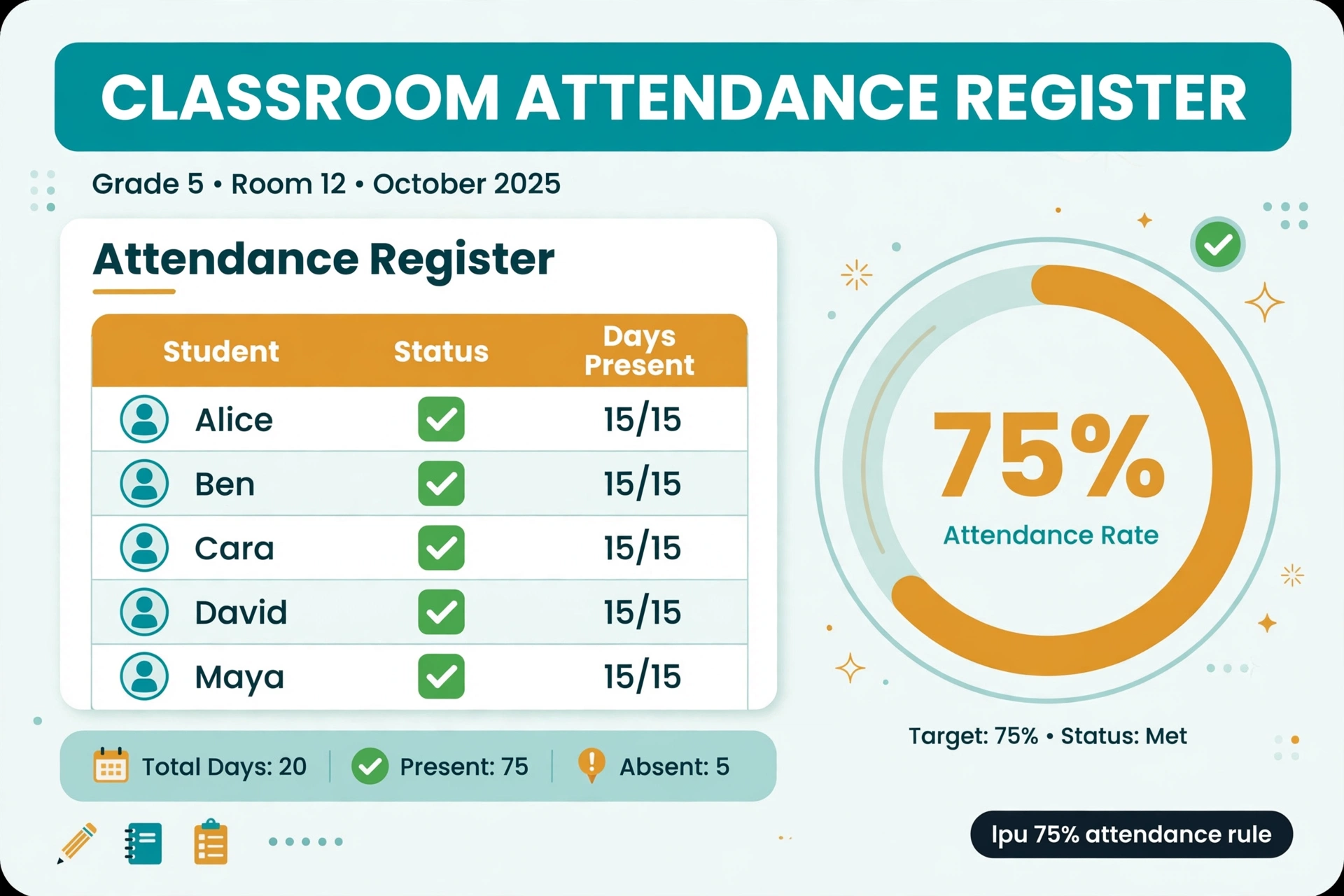
Students at Lovely Professional University, popularly known as LPU, live with one number hanging over every semester: 75. That is the minimum attendance percentage every student must maintain to stay eligible for end-term examinations. Fall below it, and the consequences are real — students can be debarred from sitting in exams, no matter how strong their marks are.
Because the rule is strict and the math can get confusing across subjects, sections, and mid-semester breaks, an LPU attendance calculator has become one of the most-searched tools among students on the Phagwara campus. This guide explains exactly how attendance works at LPU, how to use an LPU attendance calculator step by step, and how students can plan their leaves without ever slipping into the danger zone.
Why Attendance Matters So Much at LPU
At many universities, attendance is a soft guideline. At LPU, it is a hard academic gate. The university’s academic regulations require students to maintain at least 75% attendance in each subject to be eligible for the end-term examination of that subject. This is not an average across all subjects — it applies course by course.
That distinction matters more than most first-year students realize. A student could have 90% attendance in four subjects and 60% in a fifth, and still face trouble in that fifth subject. Attendance is tracked per course, which means every subject needs its own calculation.
The rule also affects more than exam eligibility. Consistent attendance influences internal assessment, helps students keep up with continuous assessments and mid-term tests, and keeps them in good academic standing. Students who treat attendance as a number to manage — rather than a habit to hope for — almost always find the semester less stressful.
Research on student attendance consistently shows that regular class presence is one of the strongest predictors of academic performance. Organizations like Attendance Works have documented how chronic absence erodes learning outcomes, and the same principle applies at the university level: missing lectures creates gaps that are hard to close before exams.
What Is the 75% Attendance Rule at LPU?
The 75% attendance rule is simple to state: a student must be present for at least three out of every four classes held in a subject. In percentage terms, the formula is:
Attendance % = (Classes Attended ÷ Total Classes Held) × 100
If a subject has held 40 classes and a student attended 30 of them, the attendance is (30 ÷ 40) × 100 = 75%. That student is exactly at the threshold — safe, but with zero margin.
The rule applies to undergraduate programs like B.Tech, BBA, and B.Com, postgraduate programs like MBA and M.Tech, and doctoral coursework as well. While the exact implementation can vary slightly by program and term, the 75% benchmark is the number every LPU student plans around. Readers who want the broader context of this requirement across Indian colleges can read more about what the 75 percent attendance rule means for colleges.
How LPU Tracks Attendance for Each Student
LPU maintains attendance records through its University Management System, commonly called UMS. Every student can log in to UMS and see subject-wise attendance: total classes held, classes attended, and the resulting percentage for each course.
This per-subject view is the most important input for any attendance calculation. Students should check UMS regularly — ideally every week — because attendance sometimes takes a day or two to update, and catching an error early is far easier than fixing one at the end of the semester.
A few things students notice when they study their UMS attendance page:
- Attendance is course-specific. Each subject has its own row with its own percentage.
- Theory and practical components may be tracked separately. Missing a lab session can hurt differently than missing a lecture.
- The denominator keeps growing. Total classes held increases every week, which means the same number of absences hurts less early in the semester and more near the end.
That last point is worth understanding deeply, because it is the reason an LPU attendance calculator is more useful than a single manual calculation. Early in the semester, a student can afford to miss a few classes; late in the semester, each missed class carries more weight.
How to Use an LPU Attendance Calculator: Step by Step
An LPU attendance calculator takes three inputs and returns a complete picture: the current percentage, whether the student is safe, how many more classes can be missed, and how many must be attended to recover. Here is how students use it.
Step 1: Gather the Numbers From UMS
Before touching the calculator, students should open UMS and note two numbers for the subject they want to check: total classes held so far and total classes attended. Writing both down avoids the common mistake of calculating from memory.
Step 2: Enter Total Classes Held
This is the denominator — every class the faculty has conducted in that subject, whether the student was present or not. It includes classes held on days the student was sick, on leave, or simply absent.
Step 3: Enter Classes Attended
This is the numerator — only the classes where the student was actually marked present. Students should count carefully and not include classes where attendance was marked as absent, on duty, or pending unless the university counts those categories as present.
Step 4: Read the Result and the Safe-Bunk Count
A good LPU attendance calculator shows more than a percentage. It typically shows:
- Current attendance percentage — the headline number.
- Status — safe, borderline, or below required.
- Classes that can be missed — the “safe bunk” count: how many future classes can be skipped while staying at or above 75%.
- Classes that must be attended — if the student is below 75%, how many consecutive classes must be attended to climb back above the line.
That fourth output is the one students check most anxiously before planning a trip home or a weekend outing.
The Safe-Bunk Formula, Explained
The safe-bunk number is not magic — it comes from straightforward algebra, and understanding it helps students trust the calculator’s output. The idea is simple: find the maximum number of additional absences, call it x, such that attendance stays at or above 75%.
If a student has attended A classes out of T total classes, and plans to miss x more classes (with no new attendances), the future attendance would be:
A ÷ (T + x) ≥ 0.75
Solving for x gives the number of classes that can be missed. For example, with 40 classes attended out of 50 held:
- Current: 40 ÷ 50 = 80%
- Solve 40 ÷ (50 + x) = 0.75 → 50 + x = 53.33 → x = 3.33
So the student can miss 3 more classes and stay above 75%. A calculator performs this instantly, but knowing the logic behind it helps students sanity-check results.
There is a mirror formula for recovery. If attendance is below 75%, the number of consecutive classes that must be attended to reach 75% is found by solving (A + y) ÷ (T + y) = 0.75 for y. Students who are at 60% with 30 attended out of 50 held would need to solve (30 + y) ÷ (50 + y) = 0.75, which gives y = 30 — thirty straight classes with zero absences. That steep climb is exactly why catching a slide early matters.
Worked Examples for Common Student Situations
Real situations make the numbers concrete. Here are three scenarios LPU students commonly face.
Scenario 1: Planning a Trip Home
A B.Tech student has attended 64 out of 80 classes (80%). She wants to visit home for a week, which would mean missing 6 classes. Is it safe?
- After the trip: 64 attended out of 86 total → 64 ÷ 86 = 74.4%
- Verdict: Not safe. The trip would drag her just below 75%.
With the calculator, she can see this in seconds and decide to shorten the trip to 4 missed classes: 64 ÷ 84 = 76.2%, which keeps her above the line.
Scenario 2: Recovering After an Illness
An MBA student missed two weeks with the flu. He has attended 42 out of 62 classes (67.7%) — below the threshold. How many consecutive classes must he attend to recover?
- Solve (42 + y) ÷ (62 + y) = 0.75 → 42 + y = 46.5 + 0.75y → 0.25y = 4.5 → y = 18
- Verdict: He must attend 18 consecutive classes without a single absence to climb back to 75%.
That is a sobering number, and it shows why the recovery math feels punishing: every missed class early in the semester echoes through the whole term.
Scenario 3: The Borderline Student
A BBA student sits at exactly 75% — 45 attended out of 60 held. Every future absence must be matched by future attendance to stay level. The calculator shows zero safe bunks, which is the signal to attend everything until a buffer rebuilds.
Students facing these situations often also wonder how many classes they can afford to miss in general terms — the same math applies, just with different numbers plugged in.
What Counts Toward Attendance at LPU
Not every absence is treated identically, and this is where students sometimes miscalculate. Categories that commonly appear in attendance records include:
- Present — counted in the numerator, as expected.
- Absent — counted in the denominator but not the numerator; this is what drags the percentage down.
- Duty leave (DL) — granted for representing the university in sports, cultural events, or official activities. At many institutions, approved duty leave is treated more leniently, but students should confirm with their department how DL reflects in UMS before assuming it is neutral.
- Medical leave — supported by a medical certificate. Whether it excuses the absence from the percentage or simply documents it depends on university policy for that term.
- On-duty or official assignments — similar to duty leave; the treatment varies.
The safest approach is to check UMS after any leave is approved and verify how the classes were marked. If a duty leave still shows as absent in the percentage, the student needs to plan around it rather than assume it will be adjusted later.
What Happens If Attendance Falls Below 75%
The consequence students fear most is being debarred from the end-term examination in the affected subject. A debarred student typically cannot sit for that subject’s final exam in the regular term, which can delay the course, affect the semester grade point average, and in some cases extend the time needed to complete the program.
Beyond the formal penalty, there are softer costs: falling behind in continuous assessments, losing internal marks tied to class participation, and the stress of a recovery schedule that allows zero further absences. None of these are worth a few casual bunks early in the semester.
The good news is that the system is entirely predictable. Unlike an exam, where the questions are unknown, attendance is pure arithmetic. A student who checks the numbers weekly and uses a calculator before planning any absence will never be surprised.
5 Practical Ways LPU Students Keep Attendance Above 75%
Staying above the line is mostly about habits, not heroics. These five practices work reliably:
- Check UMS every Sunday evening. Ten minutes a week keeps the numbers fresh and catches data errors while they are easy to fix.
- Build a buffer early. Attending everything in the first month creates a cushion that absorbs an illness or emergency later. Students can verify their buffer anytime with a 75% attendance criteria checker.
- Calculate before every planned absence. Trips, events, and outings should all pass through the calculator first. If the safe-bunk count is zero, the answer is no.
- Treat each subject separately. A comfortable overall average can hide one subject in the danger zone. Check the weakest subject first.
- Document every leave immediately. Medical certificates and duty-leave approvals should be submitted promptly so the record reflects reality.
Frequently Asked Questions
What is the minimum attendance required at LPU?
LPU requires students to maintain at least 75% attendance in each subject to remain eligible for end-term examinations. The rule applies per course, not as an average across subjects.
How is attendance percentage calculated at LPU?
The formula is (Classes Attended ÷ Total Classes Held) × 100, calculated separately for each subject. Both numbers are visible on the student’s UMS dashboard.
Can LPU students check attendance online?
Yes. Students log in to the University Management System (UMS), where subject-wise attendance — total classes held, classes attended, and percentage — is displayed and updated regularly.
What happens if attendance drops below 75% at LPU?
A student falling below 75% in a subject risks being debarred from that subject’s end-term examination, which can delay the course and affect the semester’s academic standing.
Does duty leave count as attendance at LPU?
Duty leave granted for official university representation is handled under university policy, and its treatment in the attendance percentage can vary. Students should verify in UMS how approved leaves were actually marked rather than assuming they are neutral.
How many classes can an LPU student miss and stay above 75%?
It depends entirely on the current numbers. With 40 attended out of 50 held (80%), a student can miss about 3 more classes. An LPU attendance calculator computes the exact safe-bunk count from the student’s UMS figures in seconds.


