 Skip to main content


Polytechnic students in India often find themselves doing the same anxious math every semester: turning a mark sheet full of grades into one clean number that sums up their performance. A polytechnic GPA calculator makes that job easy, but understanding what it does — and how the numbers actually work behind it — gives students far more control over their academic future.
This guide covers everything a diploma student needs to know: what GPA means in a polytechnic context, how the 10-point grading scale works, the exact formula, a full worked example, how backlogs affect the result, and how to use an online polytechnic GPA calculator properly.
What a Polytechnic GPA Means
A polytechnic GPA, or Grade Point Average, is a number that summarizes a student’s academic performance for one semester of a diploma program. Indian polytechnics offer three-year diploma courses (six semesters) in fields like mechanical, civil, electrical, electronics, and computer engineering, and most of them now run on a credit-based grading system.
Each subject in a semester carries a certain number of credits, which reflect how heavy that subject is. Each subject also earns a grade — such as O, A+, A, or B — based on the marks scored. The GPA blends these two pieces of information into one figure, usually expressed on a 10-point scale.
Why does this matter? The GPA is what appears on the semester result. It feeds into the cumulative GPA that summarizes the whole diploma. And it is often the first number a recruiter looks at during campus placements.
The 10-Point Grading Scale Used by Indian Polytechnics
Most Indian polytechnics follow a 10-point grading system introduced under the credit-based evaluation framework. Marks in each subject are first converted into a letter grade, and each letter grade maps to a grade point.
The Standard Grade-Point Table
The exact labels can vary slightly between state boards and autonomous institutes, but the widely used table looks like this:
| Marks Range | Letter Grade | Grade Point |
|---|---|---|
| 91–100 | O (Outstanding) | 10 |
| 81–90 | A+ (Excellent) | 9 |
| 71–80 | A (Very Good) | 8 |
| 61–70 | B+ (Good) | 7 |
| 51–60 | B (Above Average) | 6 |
| 41–50 | C (Average) | 5 |
| 36–40 | P (Pass) | 4 |
| Below 36 | F (Fail) | 0 |
A few things to note here. First, some institutes use slightly different marks bands or grade letters — the state technical education board’s rulebook is always the final authority. Second, the fail grade carries zero grade points, which is why backlogs pull a semester GPA down so sharply. Third, students should confirm whether their institute rounds marks up at grade boundaries, because a single mark can shift a grade point.
How Marks Become Grades in Each Subject
The conversion happens subject by subject. A student who scores 78 in Applied Mathematics gets an A and 8 grade points for that subject. A student who scores 88 in Engineering Drawing gets an A+ and 9 grade points. These grade points are not the final answer yet — they still need to be combined with each subject’s credit weight, which is where the GPA formula comes in.
The Polytechnic GPA Formula, Step by Step
The GPA for one semester is the credit-weighted average of the grade points earned in all subjects of that semester. Here is the formula:
Semester GPA = Sum of (Grade Point × Credits) for each subject ÷ Total credits of the semester
In plain language, the steps are:
- Convert each subject’s marks into a grade point using the institute’s grade table.
- Multiply each subject’s grade point by that subject’s credit value to get the subject’s credit points.
- Add up all the credit points across subjects.
- Add up all the credits across subjects.
- Divide the total credit points by the total credits.
The result is the semester GPA, usually reported to two decimal places.
This weighted approach matters because not all subjects are equal. A 4-credit core subject like Engineering Mechanics influences the GPA twice as much as a 2-credit lab. Students sometimes forget this when estimating their GPA mentally — but any good polytechnic GPA calculator handles the weighting automatically.
Worked Example: A Diploma Student’s Semester GPA
Let us work through a realistic third-semester mechanical engineering example so the formula feels concrete.
| Subject | Marks | Grade | Grade Point | Credits | Grade Point × Credits |
|---|---|---|---|---|---|
| Thermal Engineering | 84 | A+ | 9 | 4 | 36 |
| Manufacturing Processes | 76 | A | 8 | 4 | 32 |
| Fluid Mechanics | 68 | B+ | 7 | 3 | 21 |
| Engineering Materials | 79 | A | 8 | 3 | 24 |
| Workshop Practice (Lab) | 92 | O | 10 | 2 | 20 |
| Technical Communication | 58 | B | 6 | 2 | 12 |
| Total | — | — | — | 18 | 145 |
Step 1: The credit points add up to 36 + 32 + 21 + 24 + 20 + 12 = 145. Step 2: The total credits add up to 4 + 4 + 3 + 3 + 2 + 2 = 18. Step 3: GPA = 145 ÷ 18 = 8.06.
The student’s semester GPA is 8.06. Notice how the two 4-credit subjects contributed 68 of the 145 total credit points — almost half the GPA’s weight came from just two subjects. That is the weighting doing its job.
Semester GPA Versus CGPA in Polytechnic Programs
One semester’s GPA is a snapshot. The CGPA — Cumulative Grade Point Average — is the full picture. It combines every completed semester of the diploma into a single number using the same weighted logic:
CGPA = Sum of (Semester GPA × Semester Credits) ÷ Total credits across all semesters
Students sometimes make the mistake of simply averaging their semester GPAs. That only works if every semester has identical total credits, which is rarely true — some semesters carry heavy labs or project work. The credit-weighted method is always correct. For an instant, error-free calculation, the CGPA calculator on this site handles multi-semester results in one go.
How to Use a Polytechnic GPA Calculator Tool
An online polytechnic GPA calculator replaces the hand arithmetic above with a few clicks. Here is how to get an accurate result from one.
What to Enter
A good calculator asks for each subject’s name (optional), the credits, and either the grade letter or the grade point. Students should enter the official credit values from their syllabus — not guessed numbers — because wrong credits produce a wrong GPA. If the tool accepts grade letters directly, it applies the standard grade-point table; if it only accepts grade points, convert marks to points first using the institute’s table.
Reading the Result
The tool returns the semester GPA along with the total credits and total credit points. Students should sanity-check the result: the GPA must always fall between the lowest and highest grade points earned that semester. If it does not, an input was entered wrong. Many tools also project what the CGPA will look like once the new semester is included — useful for setting targets before results are out.
For a single-semester result computed from scratch, this site’s free GPA calculator lets students enter subjects one by one and see the weighted math instantly.
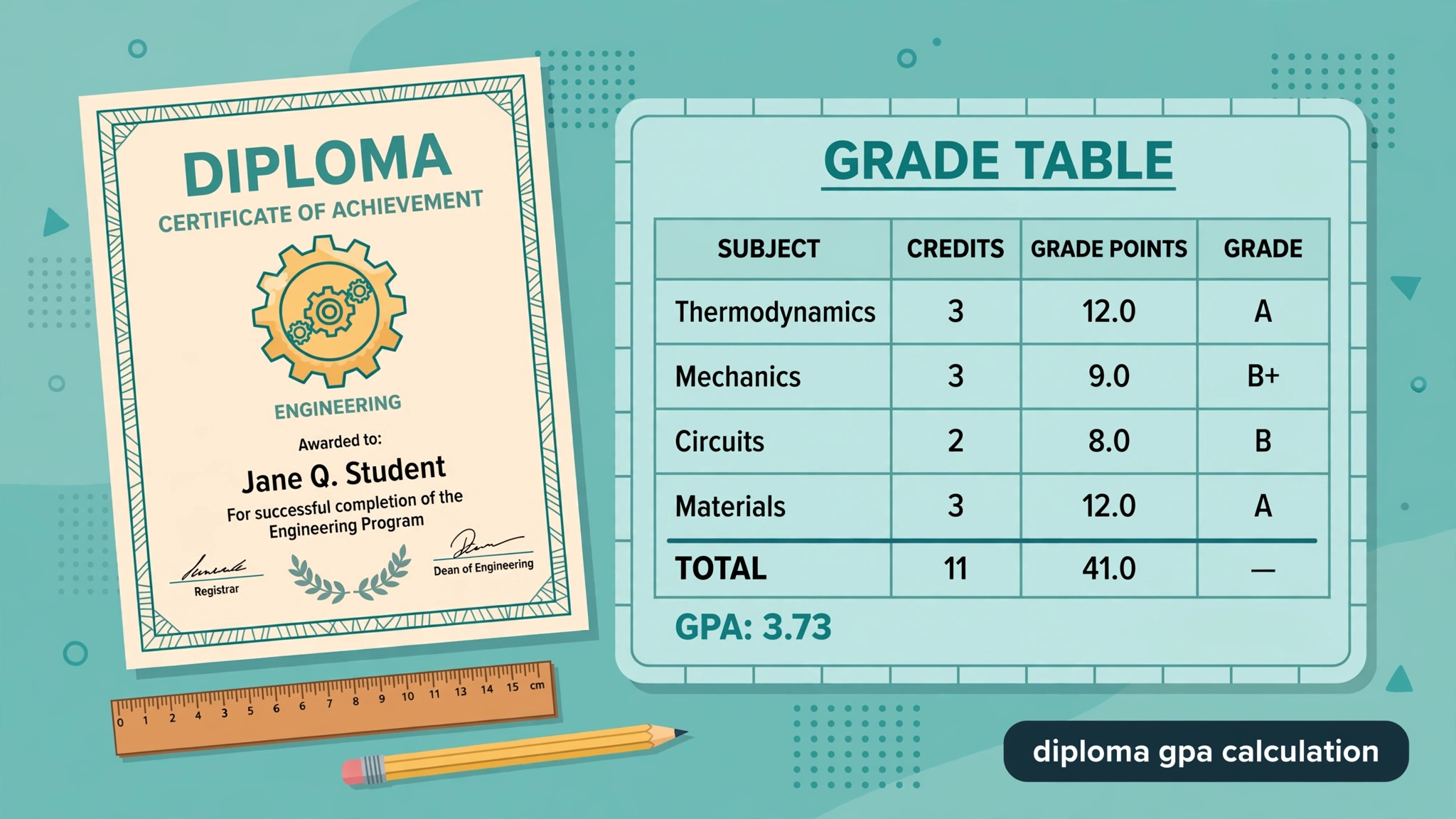
The University Grants Commission oversees higher-education standards in India, including the credit-based grading frameworks that many technical boards adapted for diploma programs. Individual polytechnics still publish their own exact rules, so students should always cross-check the grading bands and rounding policies in their institute’s handbook.
Backlogs, Repeats, and Failed Subjects
Backlogs are the elephant in the room for many polytechnic students, so here is how they interact with GPA honestly.
A failed subject contributes zero grade points but its credits still count in the denominator — that combination drags the semester GPA down hard. When the subject is cleared in a later attempt, most boards replace the fail with the new grade for that subject, and the GPA can be recalculated for the affected semester. Some boards cap the grade for repeated subjects (for example, limiting a repeat to a B grade regardless of marks). This varies, so the institute’s examination rules are the only reliable source.
Practical advice: students with backlogs should prioritize clearing them before chasing distinctions in new subjects, because a zero-grade-point subject is the single heaviest anchor on a GPA.
How to Raise a Polytechnic GPA
GPA improvement is a strategy game, and the math points the way:
- Target high-credit subjects first. An extra grade point in a 4-credit subject moves the GPA twice as far as the same improvement in a 2-credit one.
- Protect the easy wins. Labs and practicals often carry fewer credits but are scored generously — banking high grades there lifts the whole average.
- Understand grade boundaries. If a subject sits at 79 marks, one more mark can flip a B+ to an A. Knowing where the boundaries fall tells students exactly where effort pays off most.
- Use what-if planning. Before the exams, enter expected grades into a GPA calculator with different scenarios to see which subjects deserve the most study time.
- Guard attendance as well. A strong GPA means nothing if an attendance shortage blocks exam entry. The attendance percentage guide shows exactly how to track it.
Converting Polytechnic GPA to Percentage
Employers and application forms sometimes ask for a percentage instead of a GPA. The conversion formula is set by the institute or board — there is no single universal rule. The most common conventions are:
- GPA × 9.5 — used by many boards as a standard approximation.
- GPA × 10 — used by others as a direct conversion.
An 8.06 GPA becomes roughly 76.6% under the 9.5 multiplier or 80.6% under the 10 multiplier. Students should never invent a conversion for official forms; the board’s certificate or website states the sanctioned formula.
Polytechnic GPA in Placements and Higher Studies
During campus placements, recruiters for core engineering roles and PSUs often set a CGPA cutoff — commonly 6.5 to 7.5 — and only students above it get shortlisted for written tests. A strong, steady CGPA signals consistency, which is exactly what recruiters screening hundreds of diploma candidates are looking for.
For higher studies, lateral-entry admissions into B.Tech second year typically consider diploma percentage or CGPA alongside entrance exam performance. Some institutions also weigh the final-year project and the last two semesters more heavily, so a rising GPA trend can help even if the early semesters were average.
Students who track their GPA every semester — not just at the end — almost always end up with better numbers, because they can course-correct while there is still time.
Frequently Asked Questions
What is a good GPA in an Indian polytechnic?
On the 10-point scale, anything above 7.5 is generally considered good, above 8.5 is very good, and above 9.0 is excellent. Cutoffs for placements usually sit between 6.5 and 7.5 CGPA.
Is polytechnic GPA calculated on a 10-point or 4-point scale?
Indian polytechnics overwhelmingly use the 10-point scale. The 4-point scale appears mainly on some autonomous institutes and in conversions for foreign applications.
Can I calculate my polytechnic GPA without a calculator?
Yes — the manual method above works with basic arithmetic. An online polytechnic GPA calculator just automates it and removes the risk of mistakes in the weighting.
Do lab and practical marks count toward GPA?
Yes. Labs carry credits like any other subject, so their grade points feed into the same weighted formula. They are often high-scoring, which makes them valuable GPA boosters.
How do I find my subjects’ credit values?
The institute’s syllabus or curriculum document lists credits per subject. If it is not online, the department office or class coordinator can provide it.
What happens to my GPA if I fail one subject?
The failed subject adds zero grade points while its credits stay in the total, pulling the semester GPA down. Clearing it in a re-attempt usually lets the new grade replace the fail.
Is GPA the same as percentage?
No. GPA is a grade-point average on a scale (usually 10); percentage is marks out of 100. They convert through the board’s official formula, which is an approximation, not an exact translation.


