 Skip to main content


Every semester at KL University, students ask the same question once results are out: “What is my CGPA now, and how do I calculate it?” Whether you are a first-year student trying to understand how grades work or a final-year student estimating your CGPA for placements, knowing how to calculate CGPA correctly is one of the most useful academic skills you can pick up. This guide explains the KLU CGPA calculator concept in simple terms, walks through the standard 10-point CGPA system used across Indian universities, and shows you exactly how to work out your own Cumulative Grade Point Average step by step.
What Is the KLU CGPA Calculator?
A KLU CGPA calculator is simply a tool or method that helps KL University students convert their semester grades into a single number — the Cumulative Grade Point Average. Instead of manually multiplying each subject’s grade points by its credits and dividing by the total credits, a calculator does the math for you in seconds. Students use it to check their academic standing, track progress across semesters, and estimate what grades they need in upcoming exams to reach a target CGPA.
CGPA is the single most quoted number on a student’s academic record. Companies ask for it during placements, universities ask for it during postgraduate admissions, and many scholarship schemes set minimum CGPA cut-offs. So understanding how the number is produced — not just what the number is — gives students real control over their academic planning.
How CGPA Works at KL University
KL University follows the credit-based grading structure that is standard across most Indian universities. Each subject you study carries a certain number of credits, and at the end of the semester you receive a letter grade in each subject. Those letter grades are converted into grade points, and your performance is then summarized as SGPA (Semester Grade Point Average) for that semester and CGPA across all semesters completed so far.
It is worth noting that academic regulations can vary between institutions and are updated from time to time. Students should always cross-check the exact grade-to-point mapping and credit structure with KL University’s official academic regulations for their programme and batch, since those are the rules that apply to their own marksheet.
The 10-Point Grading System Explained
Most Indian universities, including KL University, use a 10-point grading scale. Under this system, the best possible grade carries 10 grade points and the scale steps down from there. The most common mapping looks like this:
| Letter Grade | Grade Points | Performance Level |
|---|---|---|
| O (Outstanding) | 10 | Exceptional |
| A+ | 9 | Excellent |
| A | 8 | Very Good |
| B+ | 7 | Good |
| B | 6 | Above Average |
| C | 5 | Average |
| P (Pass) | 4 | Pass |
| F (Fail) | 0 | Fail |
Because the exact letter-grade labels and their point values can differ slightly between institutions and programmes, the table above reflects the standard 10-point pattern rather than a claim about KLU’s specific policy. For anything official — transcripts, placements, or applications — the grade sheet issued by the university is the final authority.
Grade Points, Credits, and Weightage
Here is the idea that confuses many students: not all subjects count equally. A subject with 4 credits influences your CGPA twice as much as a subject with 2 credits. That is why a “calculator” approach multiplies each grade point by the subject’s credits before averaging. A high grade in a high-credit core subject moves the needle far more than the same grade in a low-credit elective, so smart students plan their effort accordingly.
How to Calculate CGPA: The Standard Formula
Learning how to calculate CGPA by hand takes only a few minutes, and it is worth doing at least once so you understand what the calculator is doing for you. The core idea is simple: every subject contributes “grade points × credits,” and the CGPA is the weighted average of all those contributions.
SGPA vs CGPA: What Is the Difference?
SGPA measures performance in a single semester. CGPA measures performance across every semester completed so far. When students say “my CGPA,” they usually mean the cumulative figure that appears on their consolidated marksheet. Employers and universities care about the CGPA; the SGPA is mainly useful for spotting which semesters were strong and which ones pulled the average down.
The Step-by-Step CGPA Calculation Method
To calculate CGPA manually, follow these steps:
- List every subject you completed in the period you are measuring, along with its credits.
- Convert each letter grade to grade points using your university’s official mapping.
- Multiply each subject’s grade points by its credits to get that subject’s credit points.
- Add up all the credit points.
- Add up all the credits.
- Divide total credit points by total credits. The result is the CGPA, usually rounded to two decimal places.
The formula looks like this:
CGPA = (Sum of Grade Points × Credits for all subjects) ÷ (Total Credits)
Students often find that keeping a small spreadsheet of their semester results makes this process painless. Attendance records matter here too, since most universities set minimum attendance requirements for appearing in exams — and missing an exam because of short attendance directly affects the grades that feed into your CGPA. This free attendance percentage calculator can help you keep track of your attendance through the semester so that shortfall never becomes a problem.
Worked Example: Calculating a KL University CGPA
A worked example makes the method concrete. Suppose a student completes one semester with five subjects:
| Subject | Credits | Grade | Grade Points | Credit Points |
|---|---|---|---|---|
| Mathematics | 4 | A+ | 9 | 36 |
| Physics | 4 | A | 8 | 32 |
| Programming | 3 | O | 10 | 30 |
| English | 2 | B+ | 7 | 14 |
| Workshop Lab | 2 | A | 8 | 16 |
Total credit points = 36 + 32 + 30 + 14 + 16 = 128 Total credits = 4 + 4 + 3 + 2 + 2 = 15 SGPA = 128 ÷ 15 = 8.53
To extend this to CGPA across two semesters, you would combine both semesters’ totals. If semester one gave 128 credit points over 15 credits and semester two gave 140 credit points over 16 credits, the CGPA would be (128 + 140) ÷ (15 + 16) = 268 ÷ 31 = 8.65. Notice that the CGPA is not simply the average of the two SGPAs — it is weighted by credits, which is the detail most students get wrong.
For official information about KL University’s programmes, regulations, and academic policies, students can visit the university’s website at klu.edu.in.
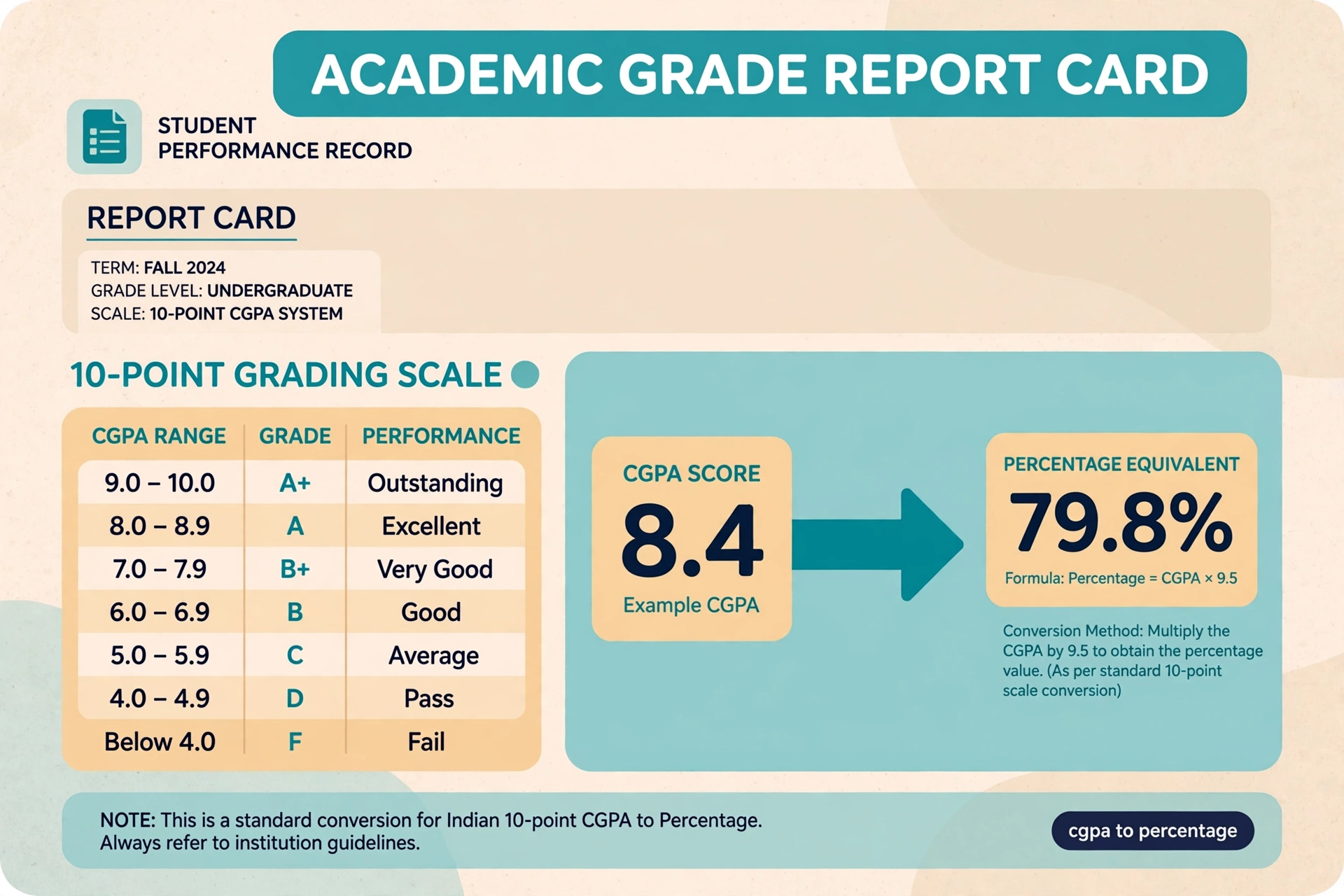
CGPA to Percentage Conversion
Many placement forms and application portals ask for percentage even when the university awards CGPA. The most widely used conversion in India is the simple formula:
Percentage = CGPA × 9.5
So a CGPA of 8.53 converts to roughly 81.04%. Some universities specify their own conversion factor in their academic regulations, and a few multiply by 10 instead. Because this varies, students should check which conversion their university officially recognizes before filling in any application. For a deeper look at percentage-based calculations in general, this guide on how to calculate attendance percentage shows how percentages are worked out step by step in an academic context.
Why Your KLU CGPA Matters
A strong CGPA opens doors that grades in individual subjects cannot. Here is where it actually counts:
- Placements: Many recruiters set a minimum CGPA cut-off (often around 6.5 or 7.0) before a student can even sit for the first round. A higher CGPA widens the pool of companies you are eligible for.
- Higher studies: Universities in India and abroad ask for CGPA on applications, and it is one of the first academic filters they apply.
- Scholarships: Merit-based scholarships and fee waivers frequently require students to maintain a minimum CGPA every semester.
- Internships: Competitive internships, especially in engineering and technology, often screen applicants by CGPA.
- Confidence and momentum: A steadily rising CGPA is a reliable signal that study habits are working — and a falling one is an early warning to adjust.
How to Improve Your CGPA at KL University
CGPA is cumulative, which means early semesters carry weight throughout the degree — but it also means every new semester is a chance to pull the average up. Practical strategies that work:
- Prioritize high-credit subjects. Since CGPA is credit-weighted, the 4-credit core subjects deserve more preparation time than 1- or 2-credit courses.
- Fix weak subjects first. One failing or low grade drags the average more than most students expect. Clearing backlogs early stops the damage from compounding.
- Use continuous assessment marks. Internal marks, lab records, assignments, and attendance weightage (where applicable) are the easiest points to secure — collect them all.
- Maintain attendance. Beyond exam eligibility, regular attendance keeps you in sync with the syllabus so revision is a review, not a first read. Understanding why student attendance percentage matters helps connect the habit to the outcome.
- Set a target CGPA and work backwards. Decide the CGPA you want at graduation, calculate what SGPA you need each remaining semester, and plan your effort around those numbers. A KLU CGPA calculator makes these “what-if” checks quick.
Using an Online CGPA Calculator Effectively
An online CGPA calculator saves time, but only if it is used correctly. A few tips:
- Enter credits exactly as your marksheet shows. The most common error is guessing credit values or mixing up theory and lab credits.
- Use the correct grade-point mapping. If the calculator lets you customize the scale, match it to your university’s official mapping.
- Double-check failed subjects. An “F” carries zero grade points but its credits still count in the denominator, which is why failures hurt CGPA so much. Some calculators handle this correctly only if the subject is entered rather than skipped.
- Verify against your marksheet. After calculating, compare the result with the SGPA/CGPA printed on your official grade sheet. If they differ, recheck your inputs before assuming the university made an error.
Manual calculation and calculator calculation should agree. When they do not, the input data is almost always the problem, not the arithmetic.
Common Mistakes Students Make When Calculating CGPA
Even careful students slip up. Watch out for these:
- Averaging the SGPAs directly. CGPA is credit-weighted, so a simple average of semester SGPAs is wrong whenever semesters have different total credits.
- Leaving out failed subjects. Failed subjects with zero grade points still add their credits to the denominator.
- Using the wrong grade-point table. Different programmes and batches can use different mappings — always confirm against your own regulations.
- Confusing percentage with CGPA. A CGPA of 8.0 is not the same as 80% unless your university’s conversion says so.
- Rounding too early. Round only the final result. Rounding intermediate credit points can shift the final CGPA by a few hundredths — which occasionally matters at cut-off boundaries.
Frequently Asked Questions
How do I calculate my KLU CGPA manually?
List every subject with its credits, convert each letter grade to grade points using the official 10-point mapping, multiply grade points by credits for each subject, add all the products together, and divide by the total credits. That gives the credit-weighted average, which is the CGPA.
What is a good CGPA at KL University?
There is no official “good” threshold, but in practical terms a CGPA of 7.5 and above keeps most placement and higher-study options open, while 8.5 and above is generally considered strong. Cut-offs vary by company and programme, so treat these as rough benchmarks rather than rules.
How is SGPA different from CGPA?
SGPA covers one semester only. CGPA covers all semesters completed so far, weighted by credits. The CGPA is the number that appears on the consolidated marksheet and the one employers ask for.
Can I convert my KLU CGPA to percentage?
Yes. The commonly used formula is Percentage = CGPA × 9.5. However, some universities define their own conversion factor, so check KL University’s academic regulations to see which conversion is officially recognized for your batch.
Does attendance affect my CGPA?
Indirectly, yes. Most universities require minimum attendance to be eligible for semester exams, and missing exams or scoring poorly because of gaps in learning lowers the grades that feed into CGPA. Keeping attendance healthy protects the grades behind the number.
What happens to my CGPA if I fail a subject?
A failed subject contributes zero grade points while its credits still count in the denominator, which pulls the CGPA down. Clearing the backlog in the next attempt replaces the damage, but the failed semester’s record remains part of the cumulative history.
Where can I find KL University’s official grading policy?
The official academic regulations for your programme and batch are published by the university. Check KL University’s official website and your department’s notice board for the grade-point mapping and credit structure that apply to you.


