 Skip to main content


Families searching for how many absences are allowed in a school year in NC usually expect a simple answer in days. North Carolina never sets a fixed number. Instead, the law builds a step-by-step response around unexcused absences: parent notification at three absences, a school conference at six, and a truancy referral at ten.
The key idea: North Carolina cares less about total days missed and more about how many lacked a legitimate excuse. Excused absences still cost learning time, but the legal process moves on unexcused ones. This guide walks through the rules, the thresholds, and exactly what happens at each stage.
There Is No Fixed Number of Allowed Absences
Unlike some states that publish a maximum number of missed days, North Carolina does not give families a set allowance. A student could miss many days for documented illness without triggering the truancy process, while a handful of unexplained absences can set the machinery in motion. The law focuses on the reason behind the absence rather than the raw count.
The state wants schools to intervene early when students disengage, not punish every sick day. The trade-off: parents must learn the notification stages and respond to each one, because ignoring them is what turns a manageable situation into a legal one.
The Three-Unexcused-Absence Notification
The process starts quietly. When a student accumulates three unexcused absences in a school year, the school must notify the parent or guardian in writing. This notice is not a punishment. It is an early warning that the school has noticed a pattern and wants the family involved before the situation grows.
Take this letter seriously even though nothing bad has happened yet. The notice creates a paper trail showing the school reached out. Responding promptly and documenting valid excuses keeps the record clean and shows good faith from the start.
The Six-Unexcused-Absence Conference
At six unexcused absences, the school sends another written notice and arranges a conference with the parent and the principal or a designee. The purpose is collaborative: figure out what is driving the absences and build a plan to fix them. Transportation problems, health issues, bullying, and family schedules often surface at this stage.
This meeting is the family’s best chance to steer the outcome. Parents who attend, bring documentation, and agree to concrete steps almost always keep the matter inside the school. Skipping the conference signals that outreach is not working, which pushes the process to its next stage.
The Ten-Day Rule and Truancy Referral
Ten unexcused absences is the line most people mean by the ten-day rule. After the tenth, the school must determine whether the parent made a good-faith effort to comply with the attendance law. If the parent cooperated, the school may keep working with the family. If not, the school can refer the matter to the juvenile court system.
This is where an attendance counselor or school social worker typically enters the picture. The counselor reviews the file, meets the family, and tries one more round of intervention before any court filing. Families who engage honestly and follow the plan rarely see a courtroom.
What the Attendance Counselor Does
Attendance counselors are the bridge between schools and families. They investigate barriers to attendance, connect families with community resources, and document every step the school takes. Understanding what a truancy officer does day to day helps parents see these staff members as helpers rather than enforcers, which makes cooperation far easier.
Excused vs. Unexcused: Why the Difference Matters
Only absences without a legitimate excuse move the truancy process forward. That makes the excused-unexcused distinction the most important detail in North Carolina attendance law. Excused absences do not advance the three, six, and ten thresholds, though they still cost students instructional time.
The catch: schools cannot excuse what they do not know about. An absence becomes unexcused by default when no valid reason is provided. Families who assume the school understands, without sending a note, often discover too late that the days were coded unexcused. Learning the difference between excused and unexcused absences protects families here.
Reasons North Carolina Schools Commonly Excuse
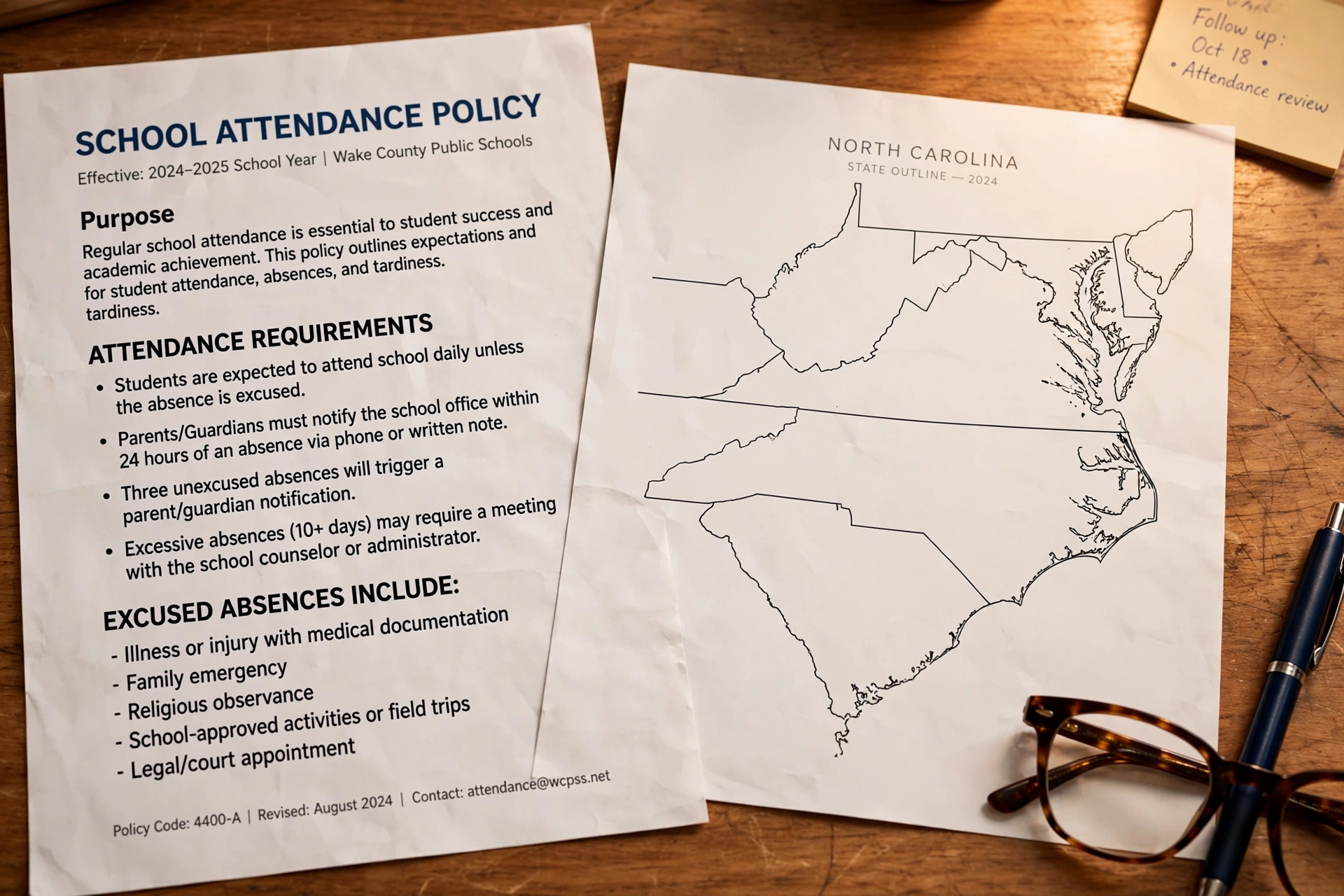
Local school boards define the specific list, but illness, medical appointments, death in the family, religious observances, and school-approved educational activities are excused nearly everywhere. Districts also typically excuse court appearances and certain family emergencies. Parents should read their own district’s attendance policy, since it controls exactly what documentation is required and how quickly it must arrive.
Chronic Absenteeism: A Separate Federal Metric
Beyond the state’s truancy process, schools track chronic absenteeism, defined as missing ten percent or more of the school year for any reason. In a standard 180-day year, that is about eighteen days, excused or not. This metric carries no legal penalties, but it appears on school report cards and flags students for academic support.
A student can be chronically absent without ever being truant. Truancy law polices disengagement; chronic absenteeism measures lost learning. Families watching only the unexcused count may miss the learning gap behind a stack of excused absences. The North Carolina Department of Public Instruction publishes attendance data and guidance on both measures.
What Parents Are Legally Required to Do
North Carolina’s compulsory attendance law requires parents and guardians to cause children between the ages of seven and sixteen to attend school continuously. Parents must also notify the school of the reason for any absence and cooperate with the school’s efforts to improve attendance. These duties are the legal backbone behind the notification stages.
The state views attendance as a shared responsibility: schools must reach out and offer help; parents must respond and participate. When both sides do their part, the process almost always resolves inside the school building.
What “Good Faith Effort” Means for Schools
Before any court referral, the school must document its good-faith effort: the written notices, the conference, counselor involvement, and offered services. This protects parents who genuinely try. Schools keep careful records, so families should keep their own copies of every note, call, and meeting.
What Happens If the Case Reaches Juvenile Court
Court is the last resort, not the default. If intervention fails, the district may file a petition alleging truancy. A judge can then order measures designed to get the student back in school, which may include counseling, community service, or supervision. The goal remains attendance, not punishment.
Take a court referral seriously but do not panic. Judges see these cases regularly and respond best to families who show up prepared, acknowledge the problem, and present a concrete plan. For context on the process, read about how truancy court handles attendance cases.
How Families Stay on the Right Side of the Rules
Staying compliant is mostly about communication. Send a written excuse for every absence as soon as possible, using the district’s preferred method. Keep copies of doctor’s notes and appointment slips. Answer every school notice in writing, and attend every conference offered.
Name barriers early. Schools have counselors, social workers, and community partnerships for transportation, health, and family problems. Parents who raise the issue at the three-absence stage get help; those who wait until ten get a process. The difference is entirely about timing.
So how many absences are allowed in a school year in NC? North Carolina never sets a single number. Instead, it draws lines at three, six, and ten unexcused absences, each raising the level of school involvement. Families who document excuses, answer every notice, and engage early almost always resolve attendance issues long before a courtroom enters the picture.
Frequently Asked Questions
Is there a maximum number of absences allowed in North Carolina? No. North Carolina does not set a fixed cap on absences. The legal process is driven by unexcused absences: a written notification at three, a parent conference at six, and a possible truancy referral at ten.
Do excused absences count toward the ten-day rule? No. Only unexcused absences advance the truancy thresholds. Excused absences do count toward the separate chronic absenteeism metric, which flags students missing ten percent or more of the school year.
What happens after ten unexcused absences in NC? The school reviews whether the parent made a good-faith effort to comply with the attendance law. An attendance counselor typically intervenes, and if cooperation fails, the school may refer the case to the juvenile court system.
Can parents be punished for a child’s truancy in North Carolina? The process focuses first on intervention, but persistent non-cooperation can lead to court action where a judge may order counseling, services, or supervision aimed at restoring attendance.
How do I excuse an absence in North Carolina? Follow your district’s attendance policy: submit a written note or the district’s form, usually within a few days, stating the reason for the absence. Keep copies of everything you send.


