 Skip to main content


Students of Dr. A.P.J. Abdul Kalam Technical University (AKTU), Lucknow — formerly UPTU — check their results on the AKTU ERP portal and immediately face the same question: what does this semester’s performance do to the overall CGPA? An AKTU CGPA calculator answers it in seconds, but only if it uses AKTU’s own grading scale and AKTU’s own credit-weighted formulas. This guide explains the university’s system exactly as it works, with fully worked examples for both SGPA and CGPA, the percentage conversion, and how backlogs change the final number.
What Makes AKTU’s System Different
AKTU follows the Choice Based Credit System (CBCS) with a 10-point grading scale, and it applies to B.Tech, MBA, B.Pharm, MCA, and other programs across its hundreds of affiliated colleges. Three things distinguish it from a generic CGPA calculator.
First, the grade letters are O, A+, A, B+, B, C, P, and F — a different set from most other Indian universities, with its own grade-point mapping. Second, AKTU computes CGPA as a credit-weighted average across semesters, not a simple average of SGPAs, so a heavy semester counts more than a light one. Third, in several programs AKTU also reports YGPA (Yearly Grade Point Average), an intermediate figure between the semester and cumulative levels. A calculator built for another university’s scale will silently produce the wrong number, which is why AKTU students need AKTU-specific math.
The AKTU Grade Table
Every AKTU grade carries a fixed grade point. Marks map to grades per the university’s published bands, and the grade fixes the points used in every calculation.
- O (Outstanding) → 10 grade points
- A+ → 9 grade points
- A → 8 grade points
- B+ → 7 grade points
- B → 6 grade points
- C → 5 grade points
- P (Pass) → 4 grade points
- F (Fail) → 0 grade points
The P grade is the minimum pass. An F contributes zero grade points while its credits stay in the denominator — the single most damaging entry on a marksheet, and the reason clearing backlogs matters so much for the final CGPA.
How the AKTU CGPA Calculator Works: SGPA First
An AKTU CGPA calculator runs a two-stage process. Stage one computes the SGPA (Semester Grade Point Average) for each semester. Stage two combines the semester SGPAs into the CGPA. Skipping stage one and averaging SGPAs directly is the most common student error, and it produces the wrong answer whenever semesters carry different credit totals.
Step 1: Calculate SGPA for One Semester
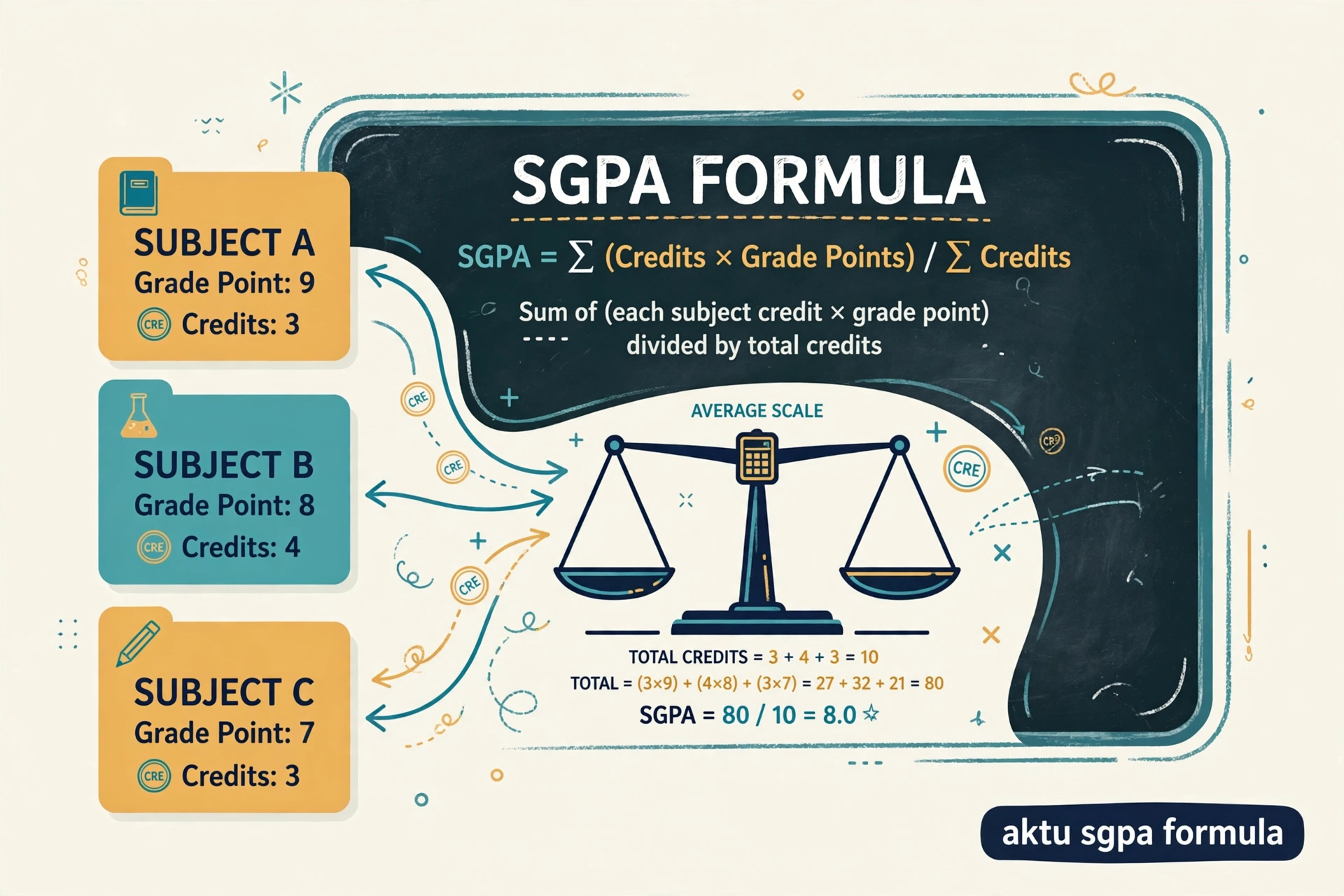
The official formula is:
SGPA = total of (course credits × grade points earned) ÷ total credits of the semester
Worked example. A second-semester B.Tech student has these results:
- Engineering Mathematics: 4 credits, grade A (8 points) → 4 × 8 = 32
- Physics: 4 credits, grade A+ (9 points) → 4 × 9 = 36
- Basic Electrical Engineering: 3 credits, grade B+ (7 points) → 3 × 7 = 21
- Programming Lab: 2 credits, grade O (10 points) → 2 × 10 = 20
- Workshop Practice: 1 credit, grade A (8 points) → 1 × 8 = 8
Total weighted points = 32 + 36 + 21 + 20 + 8 = 117. Total credits = 4 + 4 + 3 + 2 + 1 = 14. SGPA = 117 ÷ 14 ≈ 8.36 (rounded to two decimals, as AKTU does).
Step 2: Combine SGPAs into CGPA
The CGPA is the weighted average of semester SGPAs, with each semester weighted by its total credits:
CGPA = total of (semester SGPA × semester credits) ÷ total credits across all semesters
Worked example. After four semesters:
- Semester 1: SGPA 7.64, 22 credits → 7.64 × 22 = 168.08
- Semester 2: SGPA 8.36, 23 credits → 8.36 × 23 = 192.28
- Semester 3: SGPA 7.90, 24 credits → 7.90 × 24 = 189.60
- Semester 4: SGPA 8.20, 22 credits → 8.20 × 22 = 180.40
Weighted total = 168.08 + 192.28 + 189.60 + 180.40 = 730.36. Total credits = 22 + 23 + 24 + 22 = 91. CGPA = 730.36 ÷ 91 ≈ 8.03. A simple average of the four SGPAs would give 8.025 — close here, but the gap widens whenever credit loads differ more, which is exactly why the weighted formula is the official one. Students who want the same calculation for a non-AKTU scale can use the general CGPA calculator on this site.
YGPA: AKTU’s Yearly Average, Explained Briefly
Some AKTU programs report YGPA — the Yearly Grade Point Average — computed over the two semesters of an academic year using the same credit-weighted method. YGPA sits between SGPA and CGPA in the hierarchy: two semester SGPAs combine into one YGPA, and the YGPAs combine into the final CGPA. Not every program or college displays it prominently, so students should check their ERP marksheet to see whether YGPA appears for their course. Where it does appear, it is useful for year-on-year comparison: a rising YGPA trend is the clearest evidence of academic improvement.
SGPA, YGPA, and CGPA: The Full Hierarchy
It helps to see the three figures as nested levels, each built from the one below:
- SGPA covers one semester: every course’s grade points weighted by course credits.
- YGPA covers one academic year: the two semester SGPAs weighted by semester credits.
- CGPA covers the whole program: all semester SGPAs (or all YGPAs) weighted by their credits.
A useful consequence: improving any single semester’s SGPA lifts the YGPA for that year and the CGPA for the degree, with the lift proportional to that semester’s share of total credits. Early semesters in B.Tech often carry slightly fewer credits than middle ones, which means a slow start is recoverable — but only if the heavier later semesters genuinely improve. Students sometimes assume the final year “counts double”; it does not, but it usually counts more, because project and elective credits pile up there.
Planning Backward from a Target CGPA
The calculator becomes a planning tool when run in reverse. Suppose a student has completed 4 semesters with a CGPA of 7.60 across 91 credits, and the placement cutoff needs 8.0 after 8 semesters totaling roughly 180 credits.
- Needed total weighted points = 8.0 × 180 = 1,440.
- Points already banked = 7.60 × 91 = 691.6.
- Points still needed = 1,440 − 691.6 = 748.4.
- Credits remaining = 180 − 91 = 89.
- Required average SGPA = 748.4 ÷ 89 ≈ 8.41 per remaining semester.
The number is demanding but concrete — and it tells the student exactly which grade letters that means per course, using the grade table above. Running this projection at the start of each semester turns a vague “I need to do better” into a per-course grade plan. If the required average exceeds 10, the target is mathematically impossible and needs resetting early, not discovered in the final semester.
Converting AKTU CGPA to Percentage
Placements, government job forms, and higher-education applications usually ask for a percentage, not a CGPA. The conversion formula widely used across AKTU-affiliated colleges is:
Percentage = (CGPA − 0.75) × 10
For the worked example above: (8.03 − 0.75) × 10 = 7.28 × 10 = 72.8%. An 8.0 CGPA converts to 72.5%, and a 9.0 to 82.5%. Students should note that this formula is the common college-level convention rather than a single gazetted rule, so it is worth confirming with the college examination cell before writing it on an official form. The University Grants Commission’s national framework for grading practices is published at ugc.gov.in for reference.
Backlogs and Improvement Exams: How They Change the Number
Backlogs interact with the CGPA formula in a specific way. While a backlog is active, the F grade contributes 0 grade points with full credits in the denominator, dragging both the semester SGPA and the CGPA down. Once the backlog is cleared, the new passing grade replaces the F in the calculation, and the affected semester’s SGPA is recomputed — which then flows through to the CGPA. For improvement examinations, the higher of the two grades is taken.
This is why clearing backlogs early has a compounding benefit: it not only removes the zero but lets the replacement grade lift every average built on top of it. Students can model the effect before the supplementary exam by running the calculator twice — once with the F, once with the expected replacement grade — to see exactly how many CGPA points the clearance is worth.
Common Mistakes AKTU Students Make
Averaging SGPAs instead of weighting them. CGPA = (SGPA1 + SGPA2) ÷ 2 is wrong whenever the semesters have different credits. Always multiply each SGPA by its semester’s credits first.
Using another university’s grade table. Plugging AKTU grades into a generic calculator that maps A+ to 10 or uses a 4.0 scale silently corrupts every result. The O/A+/A/B+/B/C/P/F mapping above is the only one that belongs in an AKTU calculation.
Forgetting lab and practical credits. Labs carry 1–2 credits each and are easy to omit, but five labs at 2 credits equal a full theory subject in the denominator.
Rounding too early. AKTU works to two decimals. Rounding each semester’s SGPA to one decimal before combining can shift the final CGPA by a few hundredths — enough to matter at placement cutoffs.
Writing percentage with the wrong formula. Using CGPA × 10 instead of (CGPA − 0.75) × 10 overstates the percentage by 7.5 points, a discrepancy an employer’s verification can easily catch.
Where to Check Your Official Numbers
The authoritative source is always the AKTU ERP portal and the OneView result system, where SGPAs and the CGPA appear on official marksheets. OneView typically shows the semester result first, with the updated CGPA reflecting on the consolidated marksheet once the semester’s data is finalized — so a student who just cleared a backlog may see the new grade before the recalculated CGPA lands, and a day or two of patience beats a panicked recalculation. Third-party calculators — including this guide’s method — are for planning, verification, and what-if scenarios. If a hand calculation and the portal disagree, trust the portal and recheck the inputs: a misremembered credit value is the culprit in the large majority of cases.
FAQs
What is a good CGPA at AKTU? 8.0 and above is generally considered strong and clears most placement cutoffs; 7.5+ keeps most options open, while below 6.5 narrows them significantly.
How is AKTU CGPA different from a simple average? AKTU weights each semester by its total credits, so a 24-credit semester influences the CGPA more than an 18-credit one. A simple average ignores this.
Does AKTU use YGPA for all courses? No. YGPA appears in several programs but not universally — check the ERP marksheet for the specific course.
What happens to CGPA if I have an active backlog? The F grade adds zero points with full credits, lowering both SGPA and CGPA until the backlog is cleared and the grade is replaced.
Which percentage formula should I use on job applications? (CGPA − 0.75) × 10 is the widely used convention in AKTU colleges, but confirm with the college examination cell for official forms.
Can I calculate my final CGPA before the 8th semester ends? Yes — run the formula with completed semesters to get the current CGPA, then model remaining semesters with expected SGPAs to project the final figure. Revisit the projection each semester, because even a half-point swing in one heavy semester can move the final CGPA by a tenth or more, which is often the difference between two placement cutoff bands.
Where does the grade-to-point mapping come from? From AKTU’s CBCS grading scheme: O=10, A+=9, A=8, B+=7, B=6, C=5, P=4, F=0, as published in the university’s ordinances.
Students can cross-check semester-level math with the site’s grade GPA calculator, or return to the homepage for all free tools.


