 Skip to main content


The attendance percentage formula is one of the simplest equations students will ever meet — and one of the most misunderstood. On paper it is a single division and a multiplication. In real life, students get tripped up by partial attendance, excused absences, rounding rules, and the difference between what they attended and what they were supposed to attend.
This guide owns the formula itself. It breaks the attendance percentage formula into its parts, works through multiple examples step by step, covers the variations schools actually use, and shows how to reverse the formula to plan absences. Every example shows the full arithmetic so nothing is hidden.
The Core Attendance Percentage Formula
Here is the formula in its standard form:
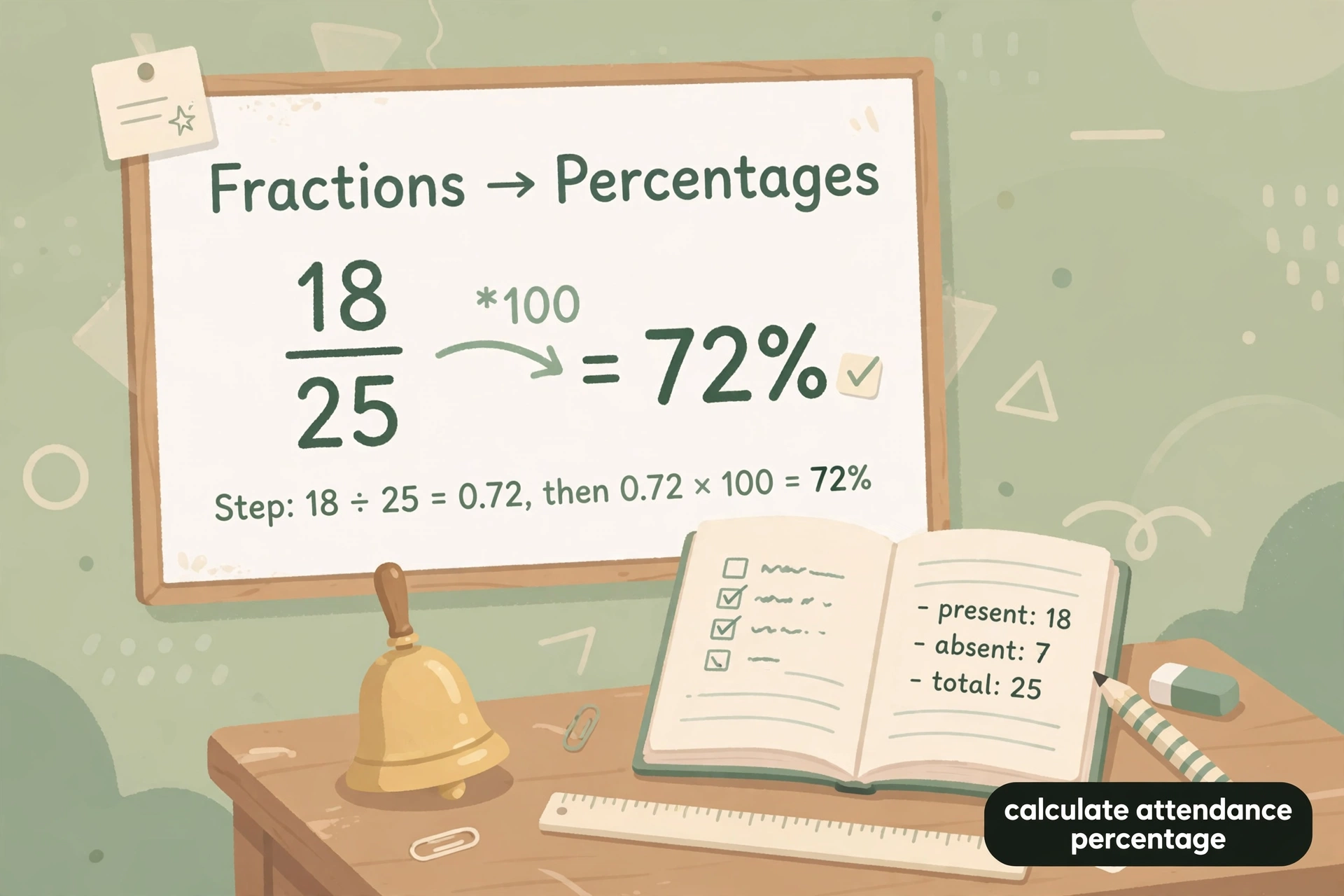
Attendance Percentage = (Classes Attended ÷ Total Classes Held) × 100
Two definitions make or break the result:
- Classes Attended means the number of sessions the student was actually present for — days in a school setting, or lectures, labs, and tutorials in a college setting.
- Total Classes Held means the number of sessions that have actually taken place so far — not the number scheduled for the whole term, and not the number the student feels they should have attended.
That second point is where most errors begin. If a semester plans 90 classes but only 60 have been held, the denominator is 60. Using 90 gives a falsely low percentage and unnecessary panic.
Worked Example 1: The Simple Case
A student has attended 45 out of 50 classes held so far.
Step 1: Divide attended by held: 45 ÷ 50 = 0.9. Step 2: Multiply by 100: 0.9 × 100 = 90.
Attendance percentage = 90%.
This is the clean case. The rest of this guide handles everything that makes real attendance messier than this.
Worked Example 2: Mid-Semester With an Odd Denominator
A student has attended 68 out of 90 classes.
Step 1: 68 ÷ 90 = 0.7556 (rounded). Step 2: 0.7556 × 100 = 75.56.
Attendance percentage = 75.56%, which most institutions report as 75.6% or 76% depending on their rounding rule. Students hovering near a cutoff like 75% should find out whether their institution rounds up, rounds down, or truncates — because 74.6% truncated is 74%, while rounded it is 75%, and that single point can decide exam eligibility.
Worked Example 3: A Full School Year
A school year has 180 working days. A student was present for 162 of them.
Step 1: 162 ÷ 180 = 0.9. Step 2: 0.9 × 100 = 90.
Attendance percentage = 90%, meaning 18 days missed. As a rule of thumb, in a 180-day year each percentage point equals 1.8 days — so 95% means about 9 absences and 85% means about 27.
The Reverse Formula: How Many Classes Must You Attend?
The forward formula tells students where they stand. The reverse formula tells them what to do. To find the minimum attendance needed for a target percentage:
Required Attendance = Total Classes × (Target Percentage ÷ 100)
Worked example: A semester has 120 total classes and the student wants at least 75%.
Required = 120 × 0.75 = 90 classes.
So the student must attend at least 90 of the 120. Flipping it around, the maximum they can miss is 120 − 90 = 30 classes. This reverse calculation is the basis of every “how many classes can I skip” table — it is just the formula solved for a different unknown.
The Reverse Formula, Part Two: How Many More to Reach a Target?
A harder and more useful question: with some classes already missed, how many of the remaining classes must be attended to hit the target?
The formula: Let A = attended so far, T = total classes held so far, R = remaining classes, and P = target percentage (as a decimal). The student needs final attendance ≥ P, so:
Needed from remaining = ceil(P × (T + R) − A)
Worked example: A student has attended 48 of 60 classes (80%), with 20 classes remaining, and wants to finish at 85%.
- Total classes by end = 60 + 20 = 80.
- Total needed attended = 0.85 × 80 = 68.
- Already attended = 48.
- Must attend of remaining = 68 − 48 = 20.
The student must attend all 20 remaining classes — no skips left. If the target were 75% instead: needed = 0.75 × 80 − 48 = 60 − 48 = 12 of the remaining 20, so 8 skips are affordable.
For students who want this math done instantly for the common 75% college rule, the 75% attendance calculator runs these exact projections.
How Excused Absences Change the Formula
This is the most contested part of attendance math, because institutions handle it differently. There are two main approaches:
Approach A — Excused absences stay in the denominator. The absence counts as not attended, period. Formula unchanged: attended ÷ total held × 100.
Approach B — Excused absences are removed from the denominator. The student is not penalized for approved leave. The adjusted formula becomes:
Adjusted Attendance = Attended ÷ (Total Held − Excused Absences) × 100
Worked example: 60 classes held, 48 attended, 12 absent, of which 4 were excused (medical leave approved).
- Approach A: 48 ÷ 60 × 100 = 80%.
- Approach B: 48 ÷ (60 − 4) × 100 = 48 ÷ 56 × 100 = 85.71%.
That is a meaningful gap. Students should check their institution’s policy rather than assuming — applying the wrong approach here is the single biggest source of “my percentage doesn’t match the portal” confusion.
Partial Attendance: Half Days and Late Arrivals
Some institutions count a half-day or a late arrival as a fraction rather than a binary present/absent:
- A half-day present might count as 0.5 attended.
- Some schools convert three late arrivals into one absence.
Worked example: Out of 40 school days, a student was fully present 34 days, half-present 4 days, and absent 2 days, with half-days counting as 0.5.
Effective attended = 34 + (4 × 0.5) = 36. Attendance = 36 ÷ 40 × 100 = 90%.
If the school instead counted half-days as full absences, the same student would show 34 ÷ 40 = 85%. Same student, same days — different rule, different number. This is why the formula is only as reliable as the counting rules behind it.
Percentage Points Versus Percent Change
Students and even teachers sometimes confuse these two, and it matters when discussing improvement:
- Percentage points measure the plain difference between two percentages. Going from 70% to 80% attendance is a 10-percentage-point rise.
- Percent change measures the relative difference. Going from 70% to 80% is a (10 ÷ 70) × 100 = 14.3% increase.
When a teacher says “raise your attendance by 5%,” they almost always mean 5 percentage points. But a student at 60% hearing “increase by 10%” might wonder whether the target is 70% or 66%. Clarifying avoids miscommunication.
Education researchers track attendance closely because the link between presence and outcomes is one of the most consistent findings in school data. Organizations like Attendance Works publish extensive research on chronic absenteeism and its effects, which is worth reading for anyone who wants to understand why schools guard these percentages so carefully.
The Formula Over Custom Periods: Weekly and Monthly Attendance
The same formula works for any time window — the only change is what goes into the denominator. For a weekly check, use classes held that week. For a monthly check, use classes held that month.
Worked example (weekly): A college student had 18 lectures scheduled this week but 2 were cancelled by the professor, so 16 were held. The student attended 14.
Attendance = 14 ÷ 16 × 100 = 87.5%. The 2 cancelled lectures are excluded entirely — they were never held, so they belong in neither the numerator nor the denominator.
Worked example (monthly): In a month with 22 working days, a student was present 19 days, absent 2, and 1 day was a declared holiday.
Attendance = 19 ÷ 21 × 100 = 90.48%. The holiday is excluded because no class was held. A common mistake is dividing by 22, which would give 86.4% — wrong, because the student was never expected to be present on the holiday.
Monthly tracking is how many schools spot trends early. Two consecutive months below 90% is often the trigger for a counselor check-in, long before any official cutoff is breached.
The Formula at Class Level: Average Attendance for Teachers
Teachers use the same formula in aggregate form to measure whole-class attendance:
Class Attendance Percentage = (Total Present-Marks Across All Students ÷ (Number of Students × Classes Held)) × 100
Worked example: A class of 30 students meets 20 times in a month. The register shows 540 present-marks in total.
Denominator = 30 × 20 = 600 possible present-marks. Attendance = 540 ÷ 600 × 100 = 90%.
Equivalently, a teacher can compute each student’s percentage and average them — the result is identical when every student faced the same number of held classes. This class-level figure is what feeds into school reports, funding formulas in some systems, and intervention planning.
Common Formula Mistakes to Avoid
Most wrong answers come from a short list of errors:
- Using scheduled classes instead of held classes in the denominator.
- Counting future classes that have not happened yet.
- Mixing up attended and absent — the formula needs attended; if only absences are known, subtract from the total first.
- Forgetting to multiply by 100, which leaves a decimal like 0.75 instead of 75%.
- Applying the wrong excused-absence rule for the institution.
- Rounding too early, which compounds errors in multi-step projections.
A student who wants a guided walkthrough of checking their own numbers can follow the step-by-step method in this site’s how to calculate attendance percentage guide. And anyone who has slipped under the line should read what happens when attendance falls below 75 percent so the consequences are clear before exam season.
Quick Reference: Every Formula in One Place
- Basic: Attendance % = (Attended ÷ Held) × 100
- From absences: Attendance % = ((Held − Absent) ÷ Held) × 100
- Excused removed: Attendance % = (Attended ÷ (Held − Excused)) × 100
- Required to reach target: Needed = Total × Target ÷ 100
- Catch-up needed: Must attend = (Target × Total final classes) − Already attended
- Class average: Class % = Total present-marks ÷ (Students × Classes held) × 100
Frequently Asked Questions
What is the formula for attendance percentage?
Attendance Percentage = (Classes Attended ÷ Total Classes Held) × 100. Divide what was attended by what has taken place, then multiply by 100.
Do excused absences count in the formula?
It depends on the institution. Some count them as absences; others remove them from the total. Check the school or college policy — the two approaches give different answers.
How do I calculate attendance if I only know my absences?
Subtract absences from the total held to get attended, then apply the formula. Example: 12 absences out of 60 held means 48 attended, so (48 ÷ 60) × 100 = 80%.
Should future classes be included in the total?
No. Only classes that have actually been held go in the denominator. Including future classes artificially lowers the percentage.
What is the difference between 75% and 75 percentage points?
Nothing in this context — both mean the same number. The distinction matters only when comparing two percentages, like describing a rise from 70% to 75% as 5 percentage points.
How do I find how many classes I can still miss?
Use the reverse formula: maximum skips = total classes − (total classes × target percentage ÷ 100). For 120 classes at a 75% target, that is 120 − 90 = 30 skips.
Why does my percentage not match the school portal?
The usual causes are different excused-absence rules, half-day counting policies, rounding methods, or the portal using a different date range. Compare the inputs, not just the formula.


