 Skip to main content


If you have ever used an online TDEE calculator, you have met the basal factor — the activity-level setting most people glance past. That one choice can swing the result by several hundred calories a day, and it is why two people with the same height, weight, and age can get very different calorie targets from the same tool.
This guide explains the basal factor from the ground up: what it is, where it comes from, the five standard activity levels and what each one really means, how to pick the right one honestly, and how it turns your basal metabolic rate into your total daily energy expenditure. It pairs well with the free health and study calculators on the homepage, which include tools for students tracking attendance, GPA, and daily calorie needs. There are also worked examples, the most common mistakes people make, and answers to the questions readers ask most.
What Is a Basal Factor in TDEE Calculations?
In the world of TDEE calculators, the basal factor is the multiplier applied to your basal metabolic rate (BMR) to estimate your total daily energy expenditure (TDEE). Think of it as a dial between roughly 1.2 and 1.9 that accounts for everything you do beyond simply staying alive — walking, working, exercising, fidgeting, cooking, and all the small movements of the day.
The math is simple on the surface:
TDEE = BMR x basal factor (activity multiplier)
Your BMR covers the energy your body burns at complete rest — breathing, circulation, cell repair, keeping your organs running. The basal factor scales that number up to reflect your real life. A desk worker who barely moves might use a factor near 1.2, meaning their daily burn is only about 20 percent above their resting rate. A construction worker or an athlete training twice a day might use 1.9, nearly doubling their BMR.
One clarification: in genetics, “basal factor” means something entirely different — proteins involved in gene transcription. In fitness and nutrition, it almost always means this activity multiplier inside calorie calculators, used interchangeably with “activity factor.”
BMR: The Number Your Basal Factor Multiplies
You cannot understand the basal factor without a quick look at what it multiplies. Your basal metabolic rate is the number of calories your body would burn in 24 hours if you did absolutely nothing — no moving, no digesting food, no thinking hard — while lying still in a comfortable room. It typically accounts for around 60 to 75 percent of your total daily calorie burn, which makes it the single biggest piece of the puzzle.
Most modern calculators estimate BMR with the Mifflin-St Jeor equation, widely considered the most accurate formula for the general public. For men: BMR = (10 x weight in kilograms) + (6.25 x height in centimeters) – (5 x age in years) + 5. For women, the same formula ends with -161 instead of +5. The equation needs only four objective inputs — which is exactly why the basal factor, the subjective part, deserves the attention. For the clinical background on metabolic measurement, the National Institutes of Health publishes research resources on human energy expenditure.
If you want to run the numbers yourself, try a TDEE calculator and watch how much the result changes when you switch activity levels while keeping everything else the same. That change is the basal factor doing its work.
The Five Standard Activity Factor Levels
Almost every TDEE calculator uses the same five activity tiers, which trace back to the original Harris-Benedict research from the early twentieth century. The names sound plain, but the exact definitions matter more than most people realize. Here is what each level means in practice.
Sedentary: Basal Factor 1.2
This is the baseline. A factor of 1.2 applies to someone with a desk job or mostly seated lifestyle and little to no planned exercise. Daily life includes basic activities — getting around the house, light errands, office work — but nothing that raises the heart rate on purpose. If you work from a chair, drive everywhere, and your workouts are rare or nonexistent, 1.2 is the honest choice.
Lightly Active: Basal Factor 1.375
Light exercise or sports one to three days a week, or a job that keeps you on your feet without heavy effort — teaching, retail work, or light service jobs can fit here even without a gym habit. If you go for a gentle jog a couple of evenings a week and otherwise live a low-key routine, 1.375 is usually the right tier.
Moderately Active: Basal Factor 1.55
Moderate exercise or sports three to five days a week. This is where many people place themselves, but genuinely belonging here means consistent, real workouts — think 45 to 60 minutes of moderate-to-vigorous training most weekdays, plus a reasonably active daily routine. A three-times-a-week gym habit combined with a desk job sits on the borderline between lightly active and moderately active, and honest people often belong one tier lower than they first guess.
Very Active: Basal Factor 1.725
Hard exercise or sports six to seven days a week, or a physically demanding job plus regular training. This tier describes people like daily runners, committed lifters training most days, manual laborers with an active lifestyle, or athletes in season. If you take rest days, that does not automatically disqualify you — but the overall volume needs to be genuinely high.
Extra Active: Basal Factor 1.9
Very hard exercise or sports, a physical job, or training twice a day. This top tier is reserved for elite athletes, military personnel in training, farm or construction laborers doing long physical days, and people combining a physical job with serious training. Very few recreational exercisers honestly belong here.
How the Basal Factor Turns BMR Into TDEE
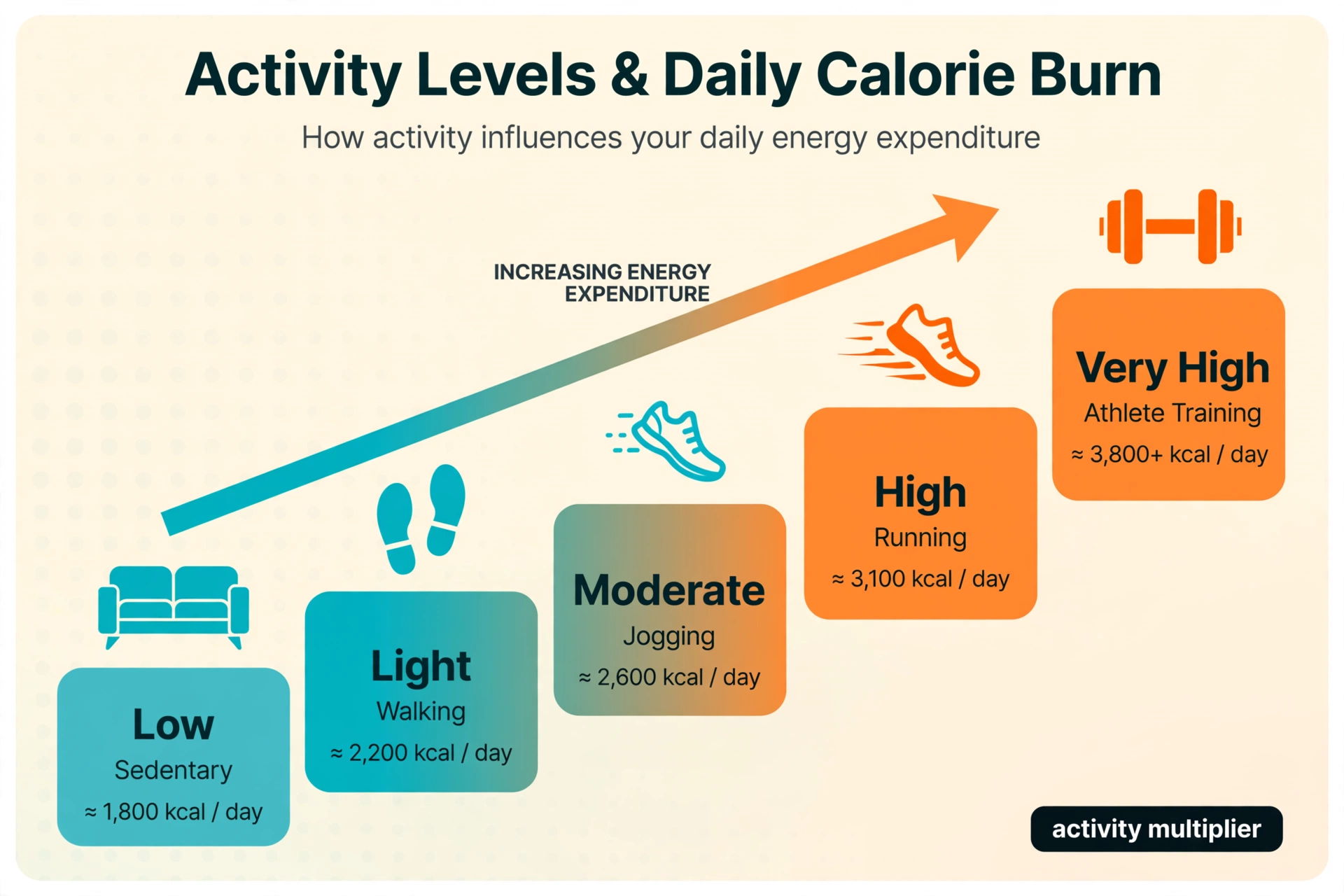
The calculation itself takes seconds. Suppose a 30-year-old man weighs 75 kilograms and stands 178 centimeters tall. First, his BMR:
BMR = (10 x 75) + (6.25 x 178) – (5 x 30) + 5 BMR = 750 + 1112.5 – 150 + 5 = 1717.5 calories per day
Now the basal factor does its job. If he is sedentary (1.2), his TDEE is 1717.5 x 1.2 = 2061 calories. If he is moderately active (1.55), it becomes 1717.5 x 1.55 = 2662 calories. If he is very active (1.725), it is 1717.5 x 1.725 = 2963 calories.
Look at the spread: the same man, the same body, three different basal factors, and the daily calorie estimate ranges from about 2,060 to about 2,960. That 900-calorie gap is the difference between a diet that works and one that stalls — which is why choosing the factor carefully matters more than the exact BMR formula.
Why Most People Pick the Wrong Activity Factor
Studies on self-reported activity consistently find the same pattern: people overestimate how active they are. A 45-minute gym session three times a week feels like a lot of effort — and it is effort — but mathematically it is a small fraction of the week’s total hours. Three hours of training out of 168 weekly hours does not make someone moderately active if the other 165 are spent sitting.
The honest test: outside of planned workouts, how much do you move? Many coaches suggest dropping one tier from your first instinct — try lightly active for a few weeks and watch your weight trend. The basal factor is an estimate, not a verdict; two to three weeks of tracking against a consistent intake is the real calibration tool.
There is another subtle trap. People sometimes count their workout and their job twice — for example, choosing “very active” because they train hard five days a week while also having a desk job. The tiers already assume a normal daily routine; the training is what moves you between them. A hard-training office worker is usually moderately active, not very active.
Basal Factor vs. Related Terms
Fitness calculators throw around several overlapping terms, and it helps to keep them straight. Your BMR is your resting burn, as described above. Your RMR, or resting metabolic rate, is nearly the same thing measured under slightly less strict conditions — in practice, calculators use them interchangeably, and the difference of a few dozen calories does not change the outcome.
Two more terms describe the activity side. NEAT (non-exercise activity thermogenesis) covers all non-workout movement: walking, cleaning, fidgeting, stairs. It is the hidden variable that makes the basal factor imprecise — two people with identical workouts can have very different NEAT. TEF, the thermic effect of food, is the energy spent digesting meals — roughly 10 percent of intake, highest for protein.
The basal factor bundles NEAT, workouts, and everything else into one number. It will never be perfect — it only needs to be close enough to start, with real-world results doing the rest of the tuning.
How to Choose the Right Basal Factor: A Self-Assessment
Rather than guessing, walk through these questions honestly. First, what does a typical weekday look like outside of exercise? Count your daily steps if you can — under 5,000 is sedentary territory, 5,000 to 7,500 leans light, and 7,500 to 10,000 supports a moderate rating even before workouts.
Second, how many real training sessions do you do per week, and how hard are they? A slow 20-minute walk is not the same as a 60-minute lifting session, and the factor cares about intensity and duration, not just attendance. Third, is your job physical? Standing all day is worth something, but it is not the same as lifting and carrying for eight hours.
Fourth — the one people skip — are you rating your average month or your best week? Calculators cannot tell a plan from a habit; your results can.
Worked Example: Same BMR, Two Different Lives
Consider two women, both 28 years old, 165 centimeters, 62 kilograms. Their BMR is identical: (10 x 62) + (6.25 x 165) – (5 x 28) – 161 = 620 + 1031.25 – 140 – 161 = 1350 calories.
The first works as a software developer, drives to work, and does yoga twice a week. She chooses lightly active: 1350 x 1.375 = 1856 calories of TDEE. The second is a nurse on her feet for 12-hour shifts who also runs four times a week. She chooses very active: 1350 x 1.725 = 2329 calories.
Same body, same resting burn — but a 470-calorie daily difference in maintenance intake. Swap their factors and one slowly loses weight while the other gains, neither understanding why. The basal factor is personal, not just physical.
When to Reassess Your Basal Factor
Your activity level is not a permanent label. It changes with seasons, jobs, injuries, and motivation. A student who trained five days a week during summer and then started a desk internship in autumn is no longer very active, even if the habit feels recent. Someone recovering from an injury should drop a tier or two temporarily rather than eating for a lifestyle they cannot currently live.
Revisit the choice whenever your routine changes for more than a couple of weeks, and sanity-check it against results monthly. If you are eating at calculated maintenance and steadily gaining or losing, the basal factor — not the BMR formula — is almost always what was wrong. For a broader look at how the pieces fit together, the site’s TDEE calculator page walks through the full calculation chain, and students juggling coursework can also use the grade and GPA calculator to keep academic progress on track.
Common Basal Factor Mistakes to Avoid
The most frequent error is picking based on identity rather than behavior — “I am an active person” instead of “I moved this much this week.” Next comes double-counting workouts while ignoring 23 sedentary hours, and the aspirational pick: the factor for the routine starting next Monday.
Another quiet mistake is double-counting: calculating TDEE with a moderate factor, then adding “exercise calories” from a fitness tracker on top. Pick one method — the tier system or BMR-plus-tracked-exercise — not both.
Finally, people treat the result as exact. It carries an error band of 10 percent or more — the factor gets you into the right neighborhood, and consistency gets you to the right address.
Frequently Asked Questions
What is a basal factor in simple terms?
It is the multiplier — usually between 1.2 and 1.9 — that a TDEE calculator applies to your basal metabolic rate to estimate your total daily calorie burn. It represents your activity level, from sedentary to extra active.
Is the basal factor the same as the activity factor?
Yes. The two terms describe the same thing: the number multiplied by your BMR to get your TDEE.
What basal factor should I choose if I exercise three times a week?
If the sessions are genuine moderate-to-vigorous workouts of 45 minutes or more and your job is sedentary, lightly active (1.375) is the honest starting point. If you are also on your feet most of the day, moderately active (1.55) may fit.
Why do two calculators give me different TDEE results?
They may use different BMR formulas or different basal factor values for the same activity label. Some calculators also adjust the multipliers or add separate inputs for exercise. The basal factor tier is usually the biggest source of disagreement.
Can my basal factor change over time?
Absolutely. Job changes, seasons, injuries, travel, and new training routines all shift your activity level. Revisit your choice whenever your lifestyle changes for more than a few weeks, and recalibrate against your actual weight trend monthly.
Is a higher basal factor always better?
No. A higher factor is not a badge of honor — it is just a bigger calorie budget. Choosing one you have not earned leads to overeating and stalled fat loss. The right factor is the honest one, and honesty here is what makes the whole calculation work.


