 Skip to main content


Every semester at SRM Institute of Science and Technology ends the same way: students hunched over mark sheets, phones out, trying to work out what their grades actually mean for their GPA. SRM follows its own grading system under its university regulations, and because it uses absolute grading with credit-weighted grade points, the math is not quite the simple average many newcomers expect.
This guide walks through the complete SRM GPA calculation process — the official grade scale, the credit system, the exact formula, multiple worked examples, the difference between GPA (SGPA) and CGPA, how to convert your CGPA to a percentage, and the mistakes that cost students points they should have earned. If you want to skip the manual math, the GPA calculator on this site handles the weighted calculation for you.
How the SRM Grading System Works
SRM uses absolute grading, which means your letter grade depends only on the marks you score, not on how the rest of the class performed. There is no relative grading curve moving the cutoffs around. Score in a given band, earn the corresponding grade — it is that straightforward, and it means your GPA is entirely within your control.
Each letter grade maps to a grade point on a 10-point scale. This is the core lookup table every SRM student should memorize:
| Marks Range | Letter Grade | Grade Point |
|---|---|---|
| 91 – 100 | O (Outstanding) | 10 |
| 81 – 90 | A+ (Excellent) | 9 |
| 71 – 80 | A (Very Good) | 8 |
| 61 – 70 | B+ (Good) | 7 |
| 56 – 60 | B (Above Average) | 6 |
| 50 – 55 | C (Average) | 5 |
| Below 50 | F (Fail) | 0 |
| — | Ab (Absent) | 0 |
A couple of special grades also exist in the system. “Ab” marks failure due to non-appearance in the exam, and it carries zero grade points. Under the 2021 regulation, students may also see “RA” (reappear) for scores below the pass mark, “SA” for shortage of attendance, and “W” for withdrawal — all of which carry zero points. If your batch follows a different regulation, confirm the exact band edges from your official regulation document, since minor variations exist across regulation years.
The pass threshold is another thing worth knowing. In most SRM programs, a student needs at least a “B” grade (or the equivalent minimum under their regulation) in a course to be considered as having passed it. Anything below that means an arrear — a course you must clear by reappearing.
Understanding Credits: Why Not All Subjects Are Equal
At SRM, every course carries a credit weight, and the GPA is credit-weighted. This is the single most important concept in the whole calculation. A 4-credit theory subject with an A+ grade influences your GPA far more than a 1-credit lab with an O grade.
Under the current regulation structure, typical credit weights look like this:
- Theory subjects: 3 or 4 credits
- Laboratory or practical courses: 1 or 2 credits
- Projects, seminars, and internships: 2 to 6 credits
- Mandatory non-credit courses: 0 credits (these do not affect GPA)
Strategically, improving a 4-credit core subject from B+ to A+ is multiplied by four, while the same improvement in a 1-credit lab is multiplied by one. When study time is limited, credit weight should decide where the hours go.
The SRM GPA Formula, Step by Step
The official formula is a weighted average:
GPA = Sum of (Grade Point x Course Credits) / Sum of Total Credits
Here is the process in plain steps:
Step 1: For every course, note the credits and the grade you earned, then convert the grade to its grade point using the table above.
Step 2: Multiply each course’s grade point by its credits. This gives the “grade points earned” for that course.
Step 3: Add up all the grade points earned across every course in the semester.
Step 4: Add up all the credits for the semester.
Step 5: Divide the total grade points by the total credits. The result is your semester GPA (often called SGPA).
Because the formula is a weighted average rather than a simple one, credit-heavy courses dominate the result. For a quick check of your own numbers, the CGPA calculator on this site can also handle cumulative calculations across semesters.
Worked Example 1: A Typical First-Semester Result
Let us run a full example. A first-year student completes five courses:
- Mathematics: 4 credits, grade A+ (9 points). Contribution: 4 x 9 = 36
- Computer Programming: 3 credits, grade O (10 points). Contribution: 3 x 10 = 30
- Physics Lab: 2 credits, grade A (8 points). Contribution: 2 x 8 = 16
- Communication Skills: 3 credits, grade B+ (7 points). Contribution: 3 x 7 = 21
- Engineering Mechanics: 3 credits, grade B (6 points). Contribution: 3 x 6 = 18
Total grade points = 36 + 30 + 16 + 21 + 18 = 121 Total credits = 4 + 3 + 2 + 3 + 3 = 15 GPA = 121 / 15 = 8.07
Notice how Mathematics, the only 4-credit course, contributed 36 of the 121 points — nearly a third of the total. A single grade change there would move the final number noticeably.
Worked Example 2: When One Subject Drags Everything Down
Now consider a student with mostly strong grades and one weak spot:
- Subject 1: 4 credits, grade O (10). Contribution: 40
- Subject 2: 4 credits, grade A (8). Contribution: 32
- Subject 3: 3 credits, grade A+ (9). Contribution: 27
- Subject 4: 3 credits, grade C (5). Contribution: 15
- Subject 5: 2 credits, grade A+ (9). Contribution: 18
Total grade points = 40 + 32 + 27 + 15 + 18 = 132 Total credits = 16 GPA = 132 / 16 = 8.25
Had Subject 4 been a B+ (7) instead of a C (5), its contribution would rise from 15 to 21, the total to 138, and the GPA to 8.63 — a jump of nearly 0.4 from one subject. That is the power, and the danger, of credit weighting.
Worked Example 3: The Lab That Barely Moves the Needle
A common question: does a perfect lab score rescue a weak theory performance? Let us see:
- Theory Subject 1: 4 credits, grade B (6). Contribution: 24
- Theory Subject 2: 4 credits, grade B+ (7). Contribution: 28
- Theory Subject 3: 3 credits, grade A (8). Contribution: 24
- Lab 1: 1 credit, grade O (10). Contribution: 10
- Lab 2: 1 credit, grade O (10). Contribution: 10
Total grade points = 24 + 28 + 24 + 10 + 10 = 96 Total credits = 13 GPA = 96 / 13 = 7.38
Two perfect lab grades contributed only 20 points against 76 from theory subjects. Labs are easy wins — take them — but they cannot compensate for weak theory performance. Prioritize accordingly.
GPA vs. SGPA vs. CGPA: Clearing Up the Terms
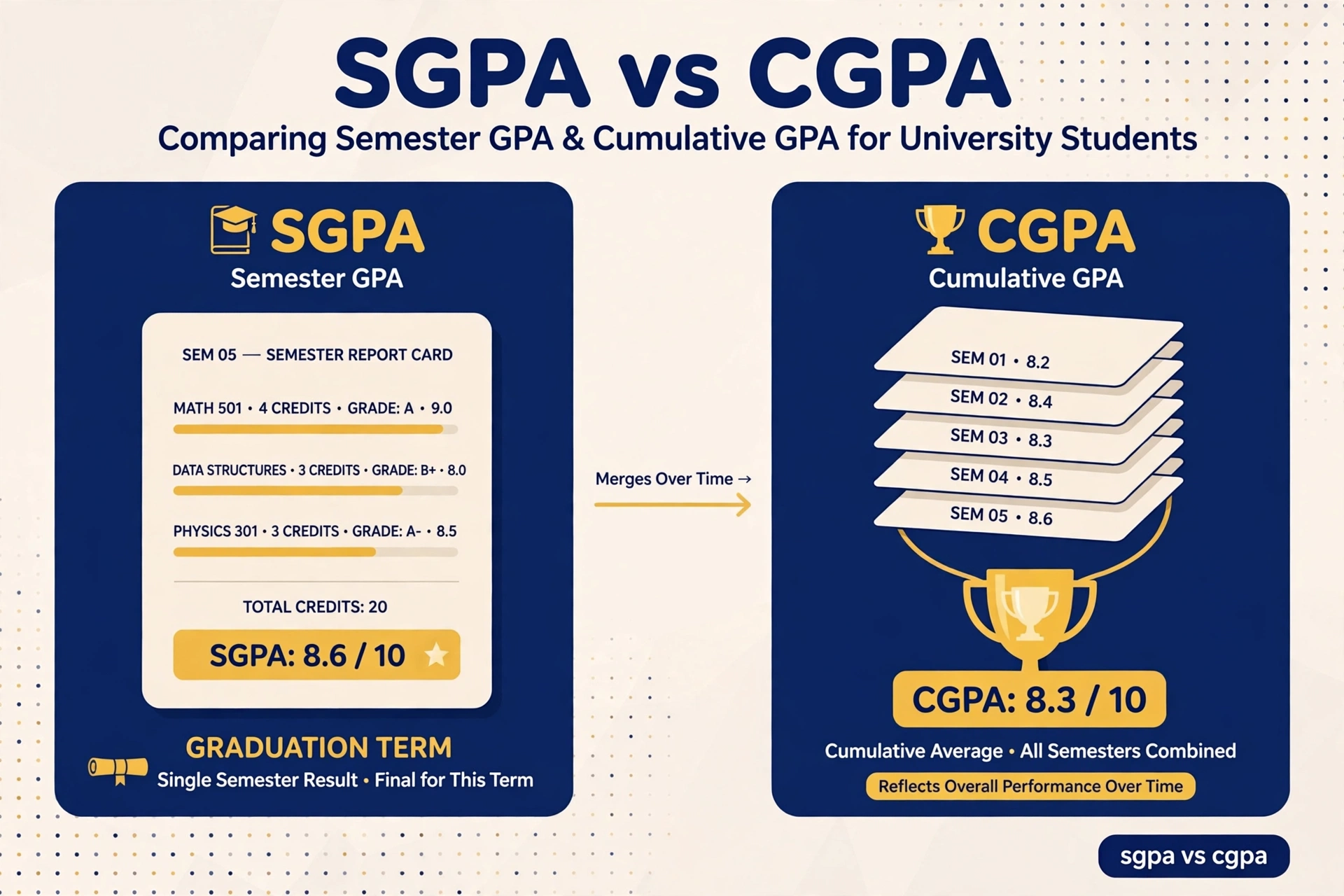
SRM students use several overlapping terms, and mixing them up causes real confusion. GPA and SGPA (Semester Grade Point Average) usually refer to the same thing: the weighted average for one semester, calculated exactly as shown above. CGPA (Cumulative Grade Point Average) is the bigger number — it summarizes your performance across all completed semesters.
SRM calculates CGPA as a credit-weighted average of semester GPAs:
CGPA = Sum of (Semester GPA x Semester Credits) / Sum of All Semester Credits
Example: Semester 1 GPA is 8.07 with 15 credits, Semester 2 GPA is 8.63 with 16 credits.
CGPA = (8.07 x 15 + 8.63 x 16) / (15 + 16) CGPA = (121.05 + 138.08) / 31 CGPA = 259.13 / 31 = 8.36
A simpler approach some students use — averaging the GPAs directly — only works when every semester has the same total credits. The credit-weighted version is the correct one, and the difference matters when credit loads vary between semesters.
Converting SRM CGPA to Percentage
Job applications, higher-study forms, and government applications in India usually ask for a percentage, not a CGPA. As per SRM norms, the standard conversion is:
Percentage = CGPA x 10
So a CGPA of 8.36 becomes 83.6 percent. A CGPA of 9.2 becomes 92 percent. It is deliberately simple — unlike some universities that subtract an offset (for example, several state universities use formulas like CGPA minus 0.75, times 10), SRM’s conversion is a straight multiplication by ten.
One caution: some recruiters or universities apply their own conversion norms regardless of university rules. When in doubt, report both — “CGPA 8.36 (83.6% as per university norms)” — to remove ambiguity. The University Grants Commission expects universities to publish official conversion formulas, verifiable through channels such as ugc.gov.in.
What a Good SRM GPA Looks Like
Context helps. A CGPA of 7.5 or above is widely considered strong at SRM and comfortably clears the eligibility cutoff for most campus recruiters, including major IT services companies and product firms. Crossing 8.5 puts a student in genuinely competitive territory for top recruiters and for MS or MBA applications abroad, where admissions committees convert the number into their own 4.0-scale equivalents.
Below 7.0, options narrow — many recruiters set 7.0 or 7.5 as a hard filter, and some set 8.0. The good news is that CGPA is cumulative, so a weak first semester can be diluted by stronger later ones. Since each semester typically carries similar credits, one bad semester out of eight only drags the final CGPA down by about an eighth of the gap.
Common Mistakes SRM Students Make
The most damaging mistake is ignoring credit weightage — treating every subject as equal when the formula clearly does not.
The second is confusing percentage with GPA — 75 percent in a subject is not “7.5 GPA”; the grade band decides, and 75 percent sits in the A band (8 points). The third is omitting lab and project credits from the denominator; every credited course counts.
Practical Tips to Raise Your SRM GPA
Start with the credit map. Before each semester begins, list every course with its credits and rank them by weight. Allocate study time proportionally — the 4-credit subjects deserve roughly four times the attention of 1-credit labs, not equal attention.
Chase the band edges, not perfection. Because grades move in bands, the return on effort is highest just below a cutoff. Moving from 79 to 81 crosses from A to A+ (8 to 9 points); moving from 84 to 88 changes nothing. If internal assessment marks are visible during the semester, identify which subjects sit near a boundary and push those first.
Treat labs as guaranteed points. Lab courses have predictable evaluation and generous grading — an O in a lab is one of the cheapest grade points available. Never neglect them, but never let them consume theory-study time either.
Track your GPA after every semester using a calculator rather than memory. Watching the number move creates a feedback loop that keeps the next semester honest. And protect your attendance: under current regulations, shortage of attendance can result in an SA grade worth zero points — an entirely avoidable disaster.
Frequently Asked Questions
How is GPA calculated at SRM University?
Multiply each course’s grade point by its credits, add up all those products, and divide by the total credits for the semester. The formula is GPA = Sum of (Grade Point x Credits) / Sum of Credits. It is a credit-weighted average, so high-credit subjects matter most.
What is the difference between GPA and CGPA at SRM?
GPA (or SGPA) covers a single semester. CGPA is the cumulative average across all completed semesters, calculated as the credit-weighted average of each semester’s GPA. Employers and universities almost always ask for the CGPA.
How do I convert my SRM CGPA to a percentage?
Multiply your CGPA by 10, as per SRM norms. A CGPA of 8.5 equals 85 percent. Always mention that the conversion follows university norms when reporting it on applications.
What grade do I need to pass a subject at SRM?
In most programs, you need at least a B grade (or the minimum pass grade under your regulation) to clear a course. Below that, the course becomes an arrear that you must reappear for. An F, Ab, RA, or SA grade carries zero grade points.
Do lab marks count in the SRM GPA?
Yes. Every credited course counts, including labs. A 1-credit lab with an O grade contributes 10 grade points to the numerator and 1 credit to the denominator. Labs are easy grade points, but their low credit weight means they cannot rescue weak theory grades.
Can I improve my CGPA after a bad semester?
Yes. CGPA is cumulative, so strong later semesters dilute an early weak one. With roughly equal credits each semester, one poor semester out of eight only affects about an eighth of the final number. Consistent improvement also reads well to recruiters.
Where can I calculate my SRM GPA online?
You can use the free GPA calculator on this site — enter each subject’s credits and grade, and it computes the weighted GPA instantly. For multi-semester totals, this site’s CGPA calculator page handles the cumulative math. More student tools live on the homepage.


