 Skip to main content


A student is enrolled in a CBSE school, appears on its rolls, and will sit for the board examinations under that school’s name. Yet the student rarely, if ever, walks through the school gates. Instead, the days are spent at a coaching institute preparing for competitive examinations. This arrangement has a name in Indian education circles: a dummy admission. And it is exactly what the latest round of CBSE surprise inspections for dummy admissions is designed to uncover.
According to recent reports, the Central Board of Secondary Education is preparing to conduct surprise inspections after concerns about dummy admissions and inflated attendance records were flagged at the highest levels, including by the Central Information Commission. For students, parents, and schools, this development matters a great deal, because it connects directly to the board’s attendance rules and to who is ultimately allowed to sit for the Class 10 and Class 12 examinations.
What Triggered the Surprise Inspections
The immediate trigger, as reported, was concern raised over dummy admissions and the state of attendance records in some affiliated schools. The Central Information Commission’s observations brought the issue into sharp focus, prompting the board to consider unannounced visits to verify whether the attendance figures schools report match the reality inside classrooms.
This is not the first time the board has acted on this front. CBSE has, over the years, repeatedly warned affiliated schools against enrolling students who do not attend regular classes. The board’s August 2025 circular reiterated Rules 13 and 14 of the Examination Bye-Laws, reminding schools that a minimum of 75 percent attendance is mandatory for students to be eligible for the board examinations. The Controller of Examinations has also publicly stated that schools must inform students and parents clearly about the rule and its consequences, and that the board may conduct surprise checks at any time.
The reported inspection drive fits into this longer pattern. Where earlier warnings were issued on paper, surprise inspections are the enforcement arm: officials arrive without notice and compare registers with reality.
What Are Dummy Schools and Dummy Admissions
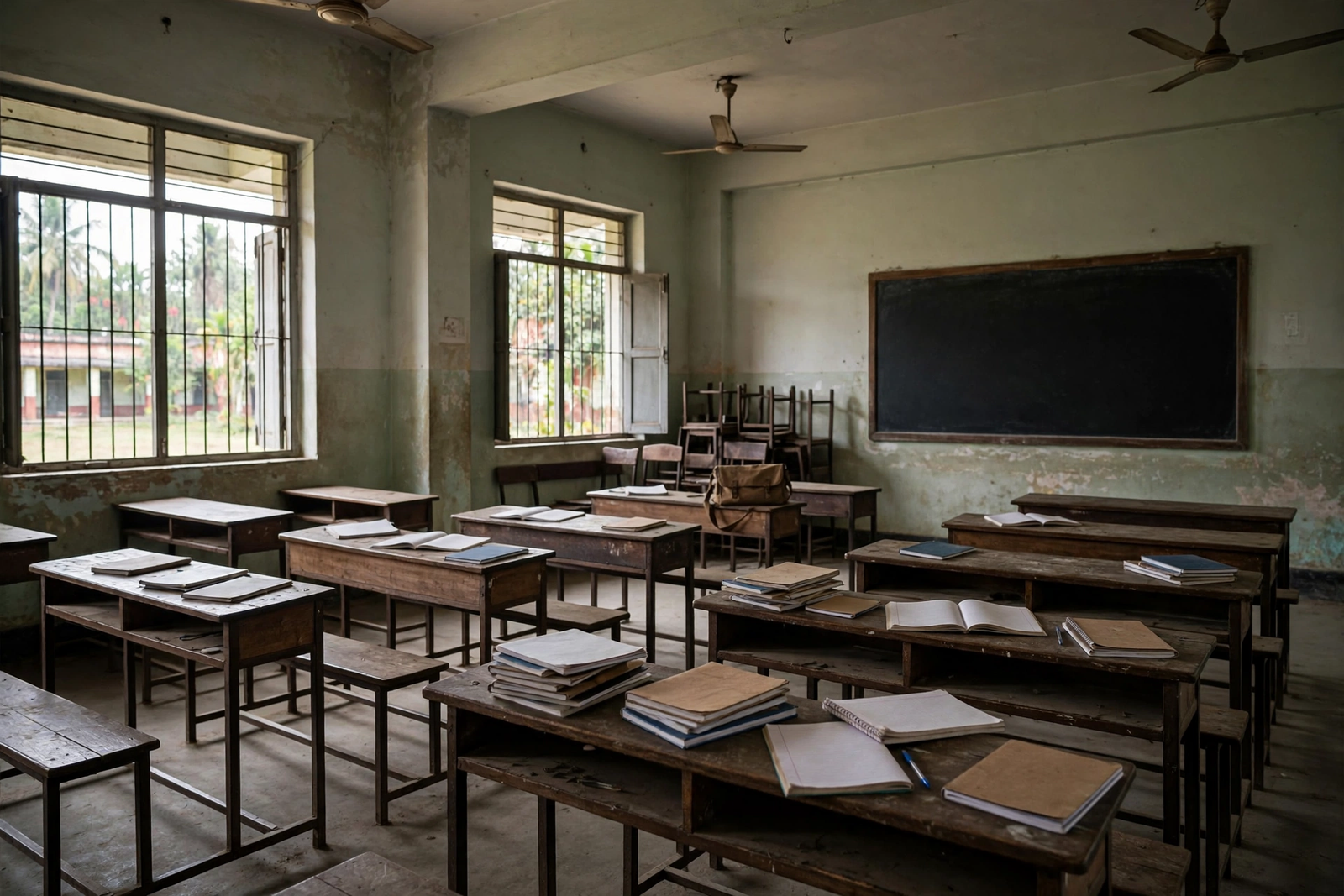
To understand why the board treats this so seriously, it helps to understand the dummy school model. In many cities, especially where competition for engineering and medical entrance examinations is intense, some students enroll in a regular CBSE school but attend almost no classes there. Their real classroom is a coaching institute. The school, in effect, lends its affiliation so the student remains eligible for the board examinations, while the student’s actual preparation happens elsewhere.
For families, the logic is about time management. A full school day plus coaching hours can stretch beyond what a teenager can sustain, so some families choose to treat school as a formality. For some schools, accommodating such students has been a quiet, open secret.
The problem, from the board’s perspective, is that this undermines the entire attendance framework. If attendance registers show a student present when the student was never in the building, the records are unreliable. And unreliable records make it impossible to enforce the 75 percent rule fairly across all students, including those who attend school diligently every day.

The CBSE Attendance Rule Behind the Crackdown
Everything in this story flows from one rule: students need at least 75 percent attendance to be eligible for the Class 10 and Class 12 board examinations. This requirement comes from Rules 13 and 14 of the CBSE Examination Bye-Laws, and the board restated it firmly in its August 2025 circular.
The rule applies to regular candidates and is not waived because a student is enrolled in an external coaching programme. The board has placed clear responsibilities on schools: explain the requirement at the start of the session, monitor attendance, update registers every day, warn families in writing when a student falls short, and keep every record ready for inspection. Leave must be requested in writing with valid documents, or it is treated as unauthorised absence.
Students and parents sometimes assume that enrolment alone secures examination eligibility. The board’s position is the opposite: eligibility is earned through presence, documented day by day. A student can read more about how this rule works in practice in this detailed look at CBSE attendance rules for Class 10, which breaks down the requirements grade by grade.
What Surprise Inspections Actually Look Like
A surprise inspection is exactly what it sounds like: board officials visit a school without advance notice and verify compliance on the spot. Based on the board’s stated expectations, here is what such a visit typically examines.
First, the attendance registers. Schools are required to maintain daily attendance records, signed by class teachers and verified by school authorities. Inspectors compare these registers against the actual number of students present in classrooms on the day of the visit. A large gap between the register and the classroom raises immediate questions.
Second, the supporting documentation. Attendance is not just a number in a register. The board expects leave applications, medical records where applicable, written warnings sent to parents about attendance shortages, and records of how condonation cases were handled. If a school claims a student was on leave, there should be paperwork to support it.
Third, the pattern across the school. Inspectors look for systemic issues rather than isolated cases. If a significant share of students in senior classes is routinely absent while remaining on the rolls, that points to an institutional practice rather than individual truancy.
The board has warned that incomplete records or irregular attendance patterns can lead to strict action, including disaffiliation of the school. For students, the parallel risk is disqualification from the board examinations, which is why understanding whether attendance is compulsory is not an academic question but a practical one.
What Schools Must Keep Ready
Whether or not an inspection team ever walks through the gate, the board’s circulars make it clear what every affiliated school is expected to maintain at all times.
Daily attendance registers, updated every working day and signed by the class teacher, form the foundation. These registers must be countersigned or verified by the school authorities so that there is a clear chain of responsibility. Leave applications from students and parents must be filed in writing with valid supporting documents. When a student’s attendance begins to slip, the school must communicate with the family in writing, creating a documented trail of warnings before the examination season arrives.
Schools must also be ready to explain their condonation decisions. The bye-laws allow for some relaxation of the attendance requirement in genuine cases, but these are exceptions granted through a defined process, not informal arrangements. Every exception should have a file behind it.
For school administrators, the message of the inspection drive is simple: paperwork that is created only when an inspection is announced will not survive an inspection that is never announced.
What This Means for Students in Dummy Schools
For students currently in dummy arrangements, the inspection drive changes the risk calculation considerably. The arrangement has always carried risk, but enforcement was sporadic. Systematic surprise inspections make the risk concrete.
The most immediate risk is examination eligibility. If a school’s records are found unreliable, or if a student’s genuine attendance is far below the 75 percent line, the student may not be permitted to appear for the board examinations as a regular candidate. Years of preparation, both for boards and for competitive examinations, can be jeopardised by an attendance record that was never real.
There is also a secondary risk that families often overlook. Even if a student scrapes through one year, the inspection findings can affect the school itself. A school facing strict action from the board becomes an unstable platform for every student enrolled in it, including those who attended regularly.
Students who are worried about where they stand should learn what happens if attendance falls below 75 percent so they understand the full picture before making decisions about the academic year.
How Students Can Track Their Own Attendance
Whatever the enforcement environment, the smartest move for any student is to know their own number. Attendance percentage is calculated with a simple formula:
Attendance percentage = (Days attended ÷ Total school days so far) × 100
A student who has attended 130 out of 160 school days has an attendance percentage of 81.25 percent, comfortably above the line. A student who has attended 110 out of 160 days sits at 68.75 percent, below the requirement and in need of near-perfect attendance for the rest of the term to recover.
To find how many more days must be attended, students can reverse the formula. If 200 school days are scheduled in the session, the 75 percent line requires 150 days of attendance. A student who has attended 100 of the first 140 days needs 50 more days out of the remaining 60, which means almost no further absences are affordable.
Tracking this number weekly, rather than discovering it in February, gives students time to act. A free attendance calculator removes the arithmetic entirely and shows exactly where a student stands and how many absences the remaining buffer allows.
A Note for Parents Considering Dummy Arrangements
Parents are often the decision-makers behind dummy admissions, and the reasoning usually comes from a place of care: the child is under enormous pressure, and something has to give. But the inspection drive reframes the decision. What looked like a clever optimisation of the child’s time now carries a documented enforcement risk that did not exist in the same form a few years ago.
Parents weighing this choice should ask three practical questions. First, can the school produce a genuine, day-by-day attendance record for the child if inspectors arrive unannounced? Second, does the family have written leave documentation for every absence? Third, if the answer to either question is no, is the family comfortable staking a board examination year on the hope that no inspection happens? Honest answers to these questions usually point in one direction.
What Happens Next
The inspection drive is best understood as part of a broader tightening of the board’s attendance regime. Alongside inspections, the board has emphasised written communication with parents, daily register discipline, and readiness for verification at any time. Schools that treat attendance as a living record rather than an end-of-year formality will have nothing to fear. Schools that do not will find the new environment uncomfortable.
For students and parents, the practical takeaway is to treat attendance as what the board says it is: a condition of examination eligibility, documented daily and verifiable without notice. Families considering or currently using dummy arrangements should weigh the reported enforcement seriously, because the cost of being wrong is measured in academic years.
Frequently Asked Questions
What are CBSE surprise inspections for dummy admissions?
They are unannounced visits by board officials to affiliated schools, intended to verify whether attendance records match actual student presence. The drive follows concerns flagged about dummy admissions, where enrolled students rarely attend school. Inspectors check registers, leave records, and classroom headcounts.
What is a dummy admission?
A dummy admission is an arrangement where a student is formally enrolled in a CBSE school but attends few or no classes there, spending the time instead at a coaching institute. The school’s affiliation keeps the student eligible for board examinations on paper, while actual preparation happens elsewhere.
How much attendance does CBSE require for board exams?
CBSE requires a minimum of 75 percent attendance for students to be eligible for the Class 10 and Class 12 board examinations, under Rules 13 and 14 of the Examination Bye-Laws. The requirement applies to regular candidates and is restated in the board’s circulars to schools.
Can a school lose affiliation over attendance irregularities?
The board has warned that incomplete attendance records or irregular attendance patterns found during inspections can lead to strict action, including disaffiliation of the school. Students of such schools may also face disqualification from the board examinations.
How can students check if their attendance is safe?
Students should calculate their attendance percentage regularly using the formula of days attended divided by total school days, multiplied by 100. The result must stay at or above 75 percent. Tracking it monthly leaves room to recover, while checking it only before examinations often leaves no room at all.
A free attendance calculator on the homepage does this math instantly and shows how many absences a student can still afford. Check it here: https://attendancepercentagecalc.com/


