 Skip to main content


At a glance: what the new study found
– A Tufts University analysis of roughly 30,000 US adults found daily coffee calories rose from 43 kcal in 2003 to 60 kcal in 2018 — an increase of nearly 40 per cent, even though the volume of coffee consumed barely changed.
– Non-dairy creamer is now the single biggest source of added coffee calories, contributing 18.5 kcal a day and overtaking both sugar (16 kcal) and dairy milk (11 kcal).
– Creamer use more than doubled, from 3.37 grams a day to 8 grams, while sugar and dairy milk consumption showed no significant change.
– People who slept fewer hours or worked longer hours drank more coffee — a pattern the researchers say will feel familiar to anyone who has leaned on an extra cup during a rough week.
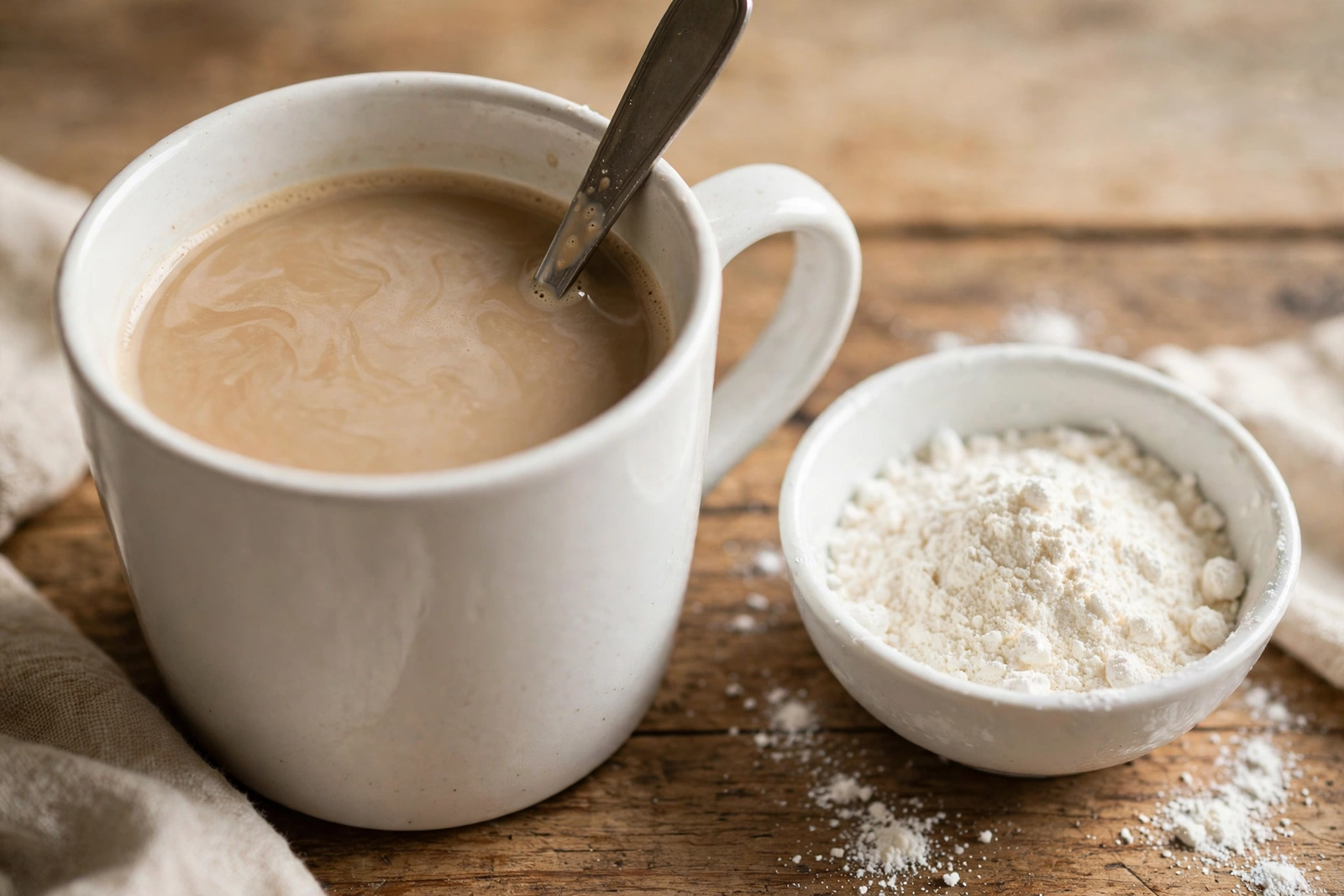
Coffee itself has barely changed over the past two decades. The average American adult still drinks about 13 ounces a day — roughly one and two-thirds cups — and plain coffee remains nearly calorie-free. Yet the coffee that people actually drink has quietly become far more energy-dense. A new study published in the Journal of the Academy of Nutrition and Dietetics on October 19, 2026, shows that the daily calories arriving in Americans’ coffee cups jumped nearly 40 per cent between 2003 and 2018. The culprit, according to the researchers, is not sugar. It is the powdered and liquid non-dairy creamer that millions of people now stir in every morning without a second thought.
The Timeline: What Changed Between 2003 and 2018
The study, led by PhD candidate Yongyi Pan at the Gerald J. and Dorothy R. Friedman School of Nutrition Science and Policy at Tufts University, drew on data from the National Health and Nutrition Examination Survey — a long-running national survey that tracks what Americans eat and drink through detailed dietary recalls. The research team analysed coffee consumption across roughly 30,000 adults aged 20 and older, comparing patterns from the 2003–2004 survey cycle with those from 2017–2018.
Start with what stayed the same. Total coffee consumption held steady across the fifteen-year window: coffee without additions did not change significantly, and the average daily volume remained at about 13 ounces. About a tenth of that volume was add-ins rather than coffee itself. Dairy milk was the most common add-in by weight, followed by creamer and then sugar — and consumption of dairy milk and sugar, as well as sugar substitutes, showed no significant change since 2003.
What changed was the rise of non-dairy additions. Consumption of non-dairy additions overall grew from a mean of 3.65 grams a day to 10.5 grams a day. Within that category, non-dairy creamer increased the most — from 3.37 grams a day to 8 grams a day — and non-dairy milk (such as oat, almond and coconut varieties) rose from 0.27 grams to 2.45 grams a day. Other coffee additions, such as cocoa powder, inched up by a mean of just 0.5 grams a day. The researchers noted that creamer’s popularity likely reflects its convenience as a shelf-stable alternative to dairy cream, a product that has been sold in the United States since the 1950s but has surged in recent years as consumers seek plant-based or dairy-free alternatives.
The calorie math tells the real story. Because creamer is calorie-dense — powdered creamer packs more calories per gram than sugar, based on the USDA values the researchers used — the small rise in grams translated into a large rise in calories. Mean daily energy intake from coffee went from 43 kilocalories in 2003 to 60 kilocalories in 2018. For a habit that repeats every single day, year after year, that is a meaningful shift in total energy intake.
By the Numbers: Where the Extra Calories Come From
The clearest way to see the change is to rank the additives by the calories they contribute. By 2018, the ranking had flipped from what most people would expect:
| Additive | Calories per day (2018) |
|---|---|
| Non-dairy creamer | 18.5 kcal |
| Sugar | 16 kcal |
| Dairy milk | 11 kcal |
Contrast that with 2003, when non-dairy creamer contributed just 7.71 kcal a day. In fifteen years, creamer’s calorie contribution more than doubled and overtook both sugar and milk — even though, by weight, dairy milk remained the most-used additive at 21.4 grams a day. Calories told a different story than grams, the researchers emphasised, precisely because creamer is so calorie-dense.
The team was careful to divide coffee-containing beverages into categories: non-combination beverages (plain coffee) and beverages with additions. To estimate how much of each add-in went into premixed coffee beverages and powders reported in diet recalls, they used the cycle-specific USDA Food and Nutrition Database for Dietary Studies and its linked standard reference codes — a detailed, methodical approach that grounds the calorie figures in official nutritional data rather than guesswork.
Habits also varied across groups in 2017–2018. Men drank more coffee than women, but women took in more calories from theirs. Non-Hispanic White adults and higher earners drank more than other groups. Adults who slept fewer hours or worked longer hours consumed more coffee — a pattern familiar to anyone who has reached for a third cup during a demanding stretch. Importantly, the rise in coffee calories did not differ significantly between groups: the shift was broad-based, affecting heavy and light coffee drinkers alike.
The study’s senior author, Professor Fang Fang Zhang, stressed that while coffee itself is frequently linked to positive health outcomes, the habit of augmenting it with sweeteners and creamers introduces substantial amounts of saturated fat and added sugars into the daily diet. Co-author Bingjie Zhou conducted the work while a PhD student at the Friedman School.
What the Researchers Said
The most quotable finding came from lead author Yongyi Pan, who put the headline result plainly: “We found that non-dairy creamer being added to coffee has now passed both sugar and dairy for its contribution to the total energy consumed from coffee.”
She offered a straightforward nutritional explanation: “Non-dairy creamers can be high in saturated fat, which is calorie-dense. This could explain the increased calories that non-dairy creamer is contributing.” And she placed the trend in context: “Even though it has been on the market since the 1950s, non-dairy creamer has increased in popularity in recent years as consumers seek plant-based or dairy alternatives.”
That context matters. Many people switched to non-dairy creamer believing they were making a healthier or more modern choice — and in some respects, such as avoiding lactose, they were. But the calorie density of these products means the swap is not calorie-neutral. Because creamer is also often sold in flavoured varieties, it can carry both saturated fat and added sugars in a single serving, compounding the effect.
The official announcement from Tufts University’s newsroom, which published the study’s full findings, notes the researchers’ caution about one limitation: the analysis relied on self-reported dietary recall data, which is subject to measurement error from day-to-day variation in food intake. The team took steps to improve the estimates, and the direction and scale of the trend are consistent across survey cycles — but as with all nutrition epidemiology, the figures are best understood as well-measured estimates rather than exact tallies.
Common Questions About Coffee and Calories
Has coffee itself become more caloric?
No. Plain coffee remains essentially calorie-free. The study found that total coffee consumption and coffee without additions stayed stable from 2003 to 2018. The nearly 40 per cent increase in daily coffee energy — from 43 to 60 kilocalories — came entirely from what people put into their coffee, not the coffee itself.
Why is creamer a bigger problem than sugar?
It is mostly a matter of calorie density. Powdered non-dairy creamer packs more calories per gram than sugar, based on the USDA values used by the researchers, and creamer use grew far faster — from 3.37 to 8 grams a day — while sugar consumption showed no significant change. Many non-dairy creamers are also high in saturated fat, which is especially calorie-dense.
Are plant-based milk alternatives adding many calories?
Far fewer. Non-dairy milks such as oat, almond and coconut rose in popularity too — from 0.27 to 2.45 grams a day — but the researchers found they added far fewer calories than creamer. If the goal is a lighter cup, a splash of almond or oat milk behaves very differently from a spoonful of powdered creamer.
How much does this actually matter for weight?
At the population level, 17 extra kilocalories a day sounds small, but habits that repeat daily compound over years. Researchers who study nutrition consistently find that small, sustained calorie surpluses are one of the main drivers of gradual weight gain — and beverages are a classic source because people tend not to register them as food. Coffee is exactly the kind of habit where unnoticed calories accumulate.
Did every group see the same increase?
The rise in coffee calories did not differ significantly between groups, which is notable — the shift is broad-based. Consumption levels did vary: men drank more coffee than women, women took in more calories from theirs, and shorter sleep and longer working hours were associated with higher intake. But the upward trend in coffee energy touched all of them.
A 5-Step Coffee Cup Audit
The study’s value is not that it tells anyone to stop drinking coffee — coffee itself is repeatedly linked to positive health outcomes in the research literature. Its value is that it makes the invisible visible. Here is a simple way to audit a daily coffee habit using the same logic the researchers applied.
Step 1: Count what goes in, honestly. For one week, note exactly what gets added to every cup: creamer scoops, sugar spoonfuls, milk, syrups. Most people underestimate add-ins by a wide margin, which is precisely why the study’s numbers surprised so many readers.
Step 2: Weigh a single serving. A coffee scoop of powdered creamer is often larger than the serving size on the label. Measuring once, with a spoon and a kitchen scale, turns a vague habit into an exact gram figure — the same gram figures the study tracked from 2003 to 2018.
Step 3: Convert to calories. Multiply each add-in by its per-gram calorie value from a nutritional database. Remember the study’s key finding: creamer is calorie-dense, packing more calories per gram than sugar. Two modest-looking scoops can easily exceed the calories of two full teaspoons of sugar.
Step 4: Multiply across the day. Most coffee drinkers have two or three cups. Per-cup calories that look trivial — 10, 20, 30 kilocalories — become the population-level numbers the researchers measured when multiplied across cups and days: 43 kcal a day in 2003, 60 kcal a day by 2018.
Step 5: Rank the swaps by impact. The study’s comparison table is a practical guide. Replacing creamer with dairy milk cuts the top calorie contributor; replacing it with a non-dairy milk cuts calories further; drinking it black removes the calories entirely. The biggest lever is the biggest add-in — and for most people in 2018, that is creamer.
This kind of audit is the beverage equivalent of knowing your daily energy budget. A guide to what TDEE actually means explains how total daily energy expenditure works — and why small, repeated calorie additions like a creamier coffee matter more than people expect within that budget.

Why Small Daily Numbers Deserve Attention
There is a broader lesson in the 43-to-60 kilocalorie jump. Human beings are good at noticing big, single events and bad at noticing slow drifts. Nobody decided in 2003 to add 17 kilocalories to their daily coffee; it happened through millions of tiny decisions — a new flavoured creamer here, a switch to a dairy-free alternative there — each one individually reasonable and collectively significant.
That is exactly how most weight-management mathematics works. Total daily energy expenditure is the sum of everything the body burns, and total intake is the sum of everything consumed — including the drinks people forget to count. When intake drifts a few dozen kilocalories above expenditure, day after day, the scale moves. The Tufts findings quantify one specific drift in vivid detail: a beloved daily habit that stayed the same in volume while nearly 40 per cent more energy-rich.
For anyone tracking their nutrition, the practical move is straightforward. The energy in coffee is not fixed by the coffee itself — it is chosen with every scoop and splash. Understanding the standard TDEE formulas behind those calculators turns the study’s population-level numbers into something personal: a daily budget, a daily cup, and a choice made with open eyes.
If daily beverage calories are quietly climbing, the first step is knowing the whole budget. A free TDEE calculator estimates total daily energy expenditure from activity level and body metrics, so small habits like a morning coffee can be weighed against the day’s real numbers — and adjusted long before they become a problem.


